
On this page
An agent that takes hours to work cannot be treated like a button inside one editor tab. Close that window, update the extension, or move to another device and the process may disappear with its host. GitHub says it built AHP to decouple the session lifecycle from individual clients, after separate products had each created their own integration with cloud agents. [1]
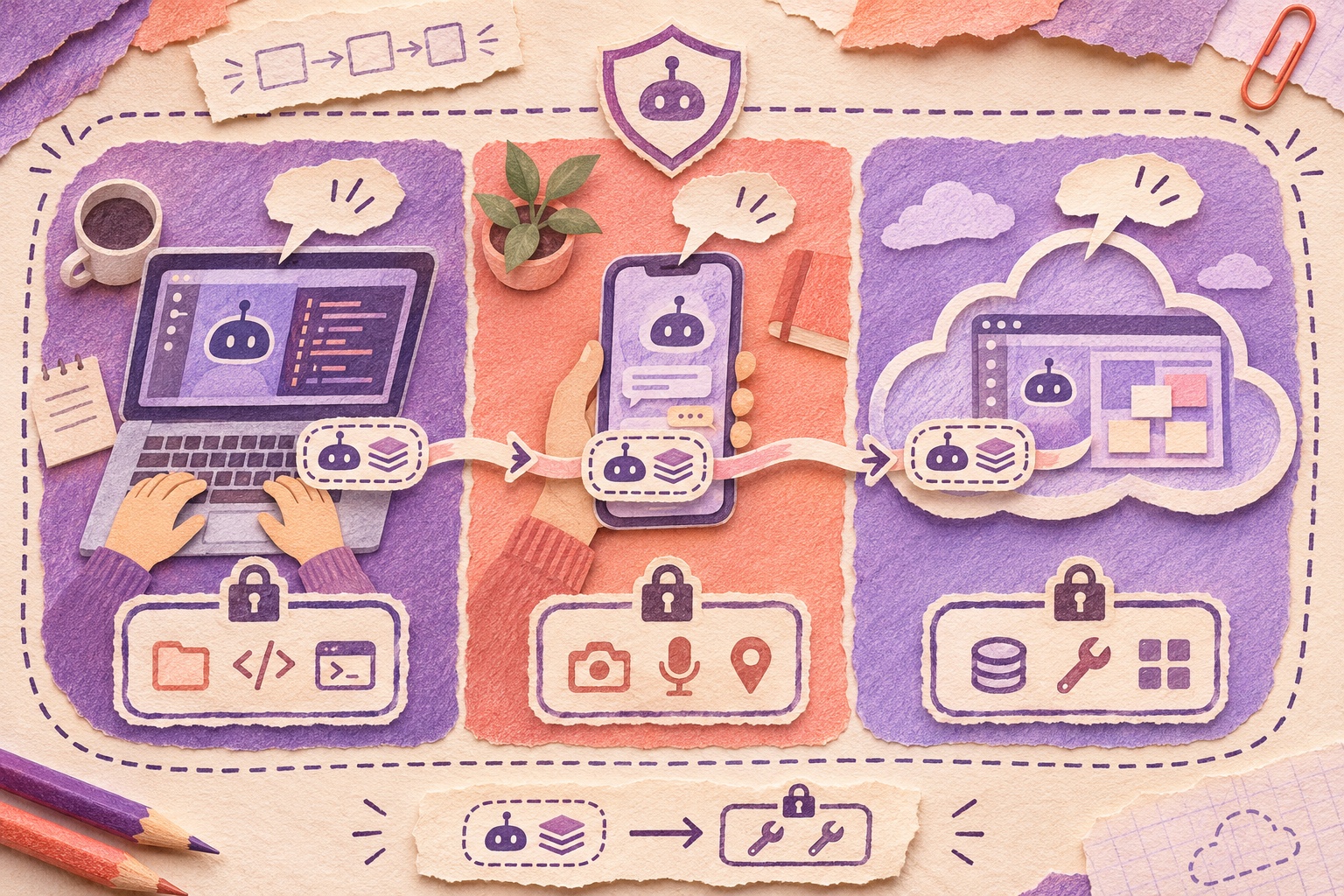
Make the host the state authority
AHP organizes functionality into URI-identified channels. The root, session, and chat channels form its required core; implementations can add capabilities such as terminal, MCP, or telemetry support. Within a channel, the host owns reducer-based state and clients send ordered actions that mutate state or trigger work. That arrangement gives reconnecting clients a way to replay queued actions and wait for the host to reconcile and acknowledge them. [1]
This is a practical response to unreliable networks and multiple interfaces. A phone can initiate work, a laptop can inspect the resulting diff, and a client can reconnect after a dropped connection without inventing a second session model. GitHub describes AHP as focused on how people interact with agents, rather than defining the agents’ internal reasoning or implementation. [1]
Portability is a protocol property and a security boundary
A shared schema doesn’t make every environment interchangeable. A local host may have access to a repository, terminal, or remote machine; a cloud host may run in a sandbox with different credentials and policies. The protocol can transport actions and state, but each host still decides which tools exist and what approval they require. Treating a session identifier as authority would erase that distinction.
GitHub’s own implementations surfaced protocol gaps: separate TypeScript and Rust hosts exposed differences in tool output representation and assumptions about session identifiers. Those mismatches illustrate why a standard needs independent implementations and real interoperability work, not just a published schema. [1]
What teams can take from the design
If an internal agent must survive client restarts, define host-owned state, sequence client actions, make acknowledgments explicit, and specify replay behavior after interruption. Keep tool execution and authorization attached to the host that actually performs the operation. Version the protocol independently from each UI, and test two implementations against the same conformance cases.
AHP is open for others to build on, and GitHub lists libraries in multiple languages. That is an invitation to experiment, not evidence that every agent or client already interoperates. The useful architectural move is separating session continuity from a single UI lifecycle while keeping environment capabilities explicit. [1] [2]
Frequently asked questions
What problem does the Agent Host Protocol solve?
It gives clients and agent hosts a shared protocol for session state and actions, so a session is not tied to one editor window or a one-off client integration.
Does the protocol make every agent portable automatically?
No. Hosts and clients must implement compatible channels and behavior, and tools or permissions still depend on each environment.
How does AHP handle reconnecting clients?
GitHub describes clients queuing actions and reconciling them with server-owned reducer state before confirming them, which supports replay after interruptions.
Sources & further reading
Keep reading

Gemini Decisions API Turns Classification into a Batch—Confidence Still Needs a Job
Google’s new multimodal Decisions API scores up to 1,000 bounded questions; build a human review path before trusting its confidence values.

Adobe’s Doki Treats a Video Script Like an Editing Surface
Adobe Research’s Doki prototype puts scenes, previews, and revisions in one text document. A small study suggests promise and clear limits.

AI Simulated Users Can Find Friction. They Can’t Stand In for Your Users
UXCascade turns simulated-agent traces into reviewable design issues. Its study supports early iteration, not replacing human usability research.
/* Comments */
Comments are offline right now — we reconnect automatically, nothing is lost.