The AI Backlash Is Getting Worse
AI adoption keeps climbing while public trust keeps falling. Here's the layoffs, lawsuits and power bills driving the backlash — and where it goes next.
On this page
Every quarter brings another adoption chart pointing up and to the right. And every quarter, the public conversation about AI gets angrier. Those two facts are not in tension — they are the same phenomenon viewed from opposite sides of the counter. The people shipping AI keep finding new reasons for optimism. The people living downstream of it keep finding new reasons to distrust it. Understanding the backlash means taking both charts seriously at once.
Why are adoption and trust moving in opposite directions?
Because they’re measuring different things: how useful AI is to the people deploying it, versus how safe it feels to the people affected by that deployment. Enterprise adoption of AI tools keeps accelerating — procurement numbers, seat licenses, and internal usage metrics are all up. At the same time, survey after survey shows public sentiment sliding, and it is not a soft, vague unease. It is specific, informed, and increasingly organized.
That split shows up most starkly along generational lines. Gen Z is registering the sharpest collapse in AI sentiment of any cohort, and it is not because they understand the technology less than older users — reports suggest the opposite. They grew up inside algorithmic platforms, watched engagement-optimized feeds reshape their attention spans, and learned early what happens when a powerful system optimizes for a company’s metrics rather than a user’s wellbeing. Their skepticism toward AI reads less like fear of the unfamiliar and more like informed contempt for a pattern they’ve already lived through once.
That reframes what looks, from inside a boardroom, like an “intelligence gap” — the assumption that public resistance would fade once people understood the technology better. The evidence increasingly points the other way: this is a values gap, not a knowledge gap. AI insiders tend toward optimism because they’re evaluating capability. The general public is evaluating power — who controls it, who profits from it, who is exposed when it fails. Those are different questions, and no amount of explainer content closes that gap, because it was never a comprehension problem.
Adoption is a measure of what AI can do. Trust is a measure of who you believe will be accountable when it doesn’t. Right now those two numbers are diverging, and the gap itself has become the story — see our companion piece on Pew’s reality check on Big Tech and AI sentiment for the polling detail behind it.
Is the fear of AI job losses actually justified?
Yes — and it’s measurable, not speculative. Reports tracking 2025 layoffs attributed more than 55,000 U.S. job losses directly to AI or workflow automation. That is not a projection about some hypothetical future disruption; it’s a count of positions that were reportedly eliminated with AI or automation explicitly cited as the cause. When people say they’re anxious about their jobs, they are responding to a number that already happened, not a number that might happen.
The distribution of those cuts is what makes the anxiety compound rather than settle. Junior and entry-level roles are disappearing at a disproportionate rate, which breaks something structurally important: the pipeline that turns a 22-year-old hire into a 40-year-old expert. Entry-level jobs have always been where professionals absorb the repetitive tasks AI now automates — and also where they build the judgment that eventually makes them senior. Strip out that rung and you don’t just have fewer junior employees today; reports suggest a shrinking supply of qualified senior talent a decade from now, across every field that depends on that pipeline.
Faster output, lower headcount costs, and tools that keep improving quarter over quarter. From inside the P&L, the case for AI investment looks stronger every cycle.
Reported layoffs attributed to automation, entry-level postings drying up, and a career ladder with its bottom rungs sawn off. From inside a job search, the case reads very differently.
Related reading: our coverage of graduates booing AI at commencement captures exactly this — a cohort entering the workforce at the precise moment the entry-level door is narrowing.
Why is the creative industry treating AI as an existential threat?
Because generative models were reportedly trained on copyrighted creative work without consent, and creators view that as the founding sin of the entire industry — not a side issue to be patched later. Writers, illustrators, musicians and photographers aren’t just worried about being out-competed by AI output; many argue the systems competing with them were built using their own work as raw material. That distinction matters enormously to how the backlash in this sector has unfolded.
The result has been a wave of copyright lawsuits against AI model developers, arguing that training on copyrighted material without licensing constitutes infringement at scale. Whatever the eventual legal outcomes, the lawsuits themselves have already reframed the public conversation: AI in creative fields is now discussed less as “will this tool help me” and more as “was this tool built on stolen labor.” That framing is sticky, and it’s spreading beyond the creative industry into how people evaluate AI generally — training data provenance has become a trust question, not just a legal one.
Do
- Treat copyright and attribution as a design constraint, not an afterthought
- Expect litigation timelines measured in years, not quarters
- Watch for licensing marketplaces emerging as the eventual compromise
Don't
- Assume “it’s just a lawsuit” and unrelated to broader trust erosion
- Dismiss creator objections as fear of competition alone
- Expect the legal questions to resolve before the reputational damage does
What are the physical, real-world costs of the AI boom?
Data centers — and the communities living next to them are increasingly saying no. AI’s backlash isn’t confined to job boards and copyright filings; it has a physical footprint measured in electricity, water, and concrete. Training and running large models requires enormous, constant power draw and, in many designs, significant water for cooling. That demand doesn’t stay abstract for long once a multi-billion-dollar facility goes up next to a residential grid.
According to reports, 69 U.S. jurisdictions have banned or paused new data center construction, citing power capacity, water usage, and cost concerns. That is not a fringe handful of towns — it’s a broad, geographically distributed rejection of AI infrastructure by the people asked to host it. Our reporting on data centers, power cuts and the fight in the Lake Tahoe area walks through what that looks like on the ground: rolling capacity concerns, local opposition campaigns, and utilities caught in the middle.
The anger has a specific, personal trigger for a lot of residents: their utility bills. When a hyperscale data center comes online nearby, reports indicate nearby ratepayers can see costs rise as grid operators pass through the expense of new transmission and generation capacity built to serve that facility. People are being asked, in effect, to subsidize the infrastructure of companies posting some of the largest profits in corporate history — and they’ve noticed.
| Backlash front | What triggered it | Public response |
|---|---|---|
| Labor market | 55,000+ reported AI-linked layoffs in 2025 | Career anxiety, entry-level pipeline concerns |
| Creative industry | Training on copyrighted work without consent | Copyright lawsuits against model developers |
| Physical infrastructure | Power, water and cost strain from data centers | 69 jurisdictions pausing/banning construction |
| Household economics | Utility bills rising near new facilities | Local political resistance, rate-case disputes |
That resistance is not merely symbolic. Local opposition is actively blocking billions of dollars in planned tech development, forcing companies to renegotiate siting, delay projects, or abandon locations entirely. It’s proof that communities will not quietly absorb infrastructure costs just because the industry attached is called “AI” instead of, say, a refinery or a landfill — the same NIMBY playbook that’s blocked other unwanted industrial neighbors for decades is now aimed squarely at hyperscale compute.
Where does the AI backlash go from here?
Toward regulation — because that’s what the public is now explicitly asking for. A strong majority of Americans reportedly distrust tech executives on AI and support mandatory government regulation and independent safety boards, according to recent polling. That is a notable shift from the earlier “let the industry self-regulate while it figures itself out” posture that dominated tech policy for the past two decades. The public isn’t waiting for AI companies to earn trust back through better products; it’s asking lawmakers to impose guardrails regardless of how good the next model release is.
That distrust-plus-appetite-for-regulation combination is the real throughline connecting every point above. Layoffs made the labor risk concrete. Lawsuits made the provenance risk concrete. Data center fights made the infrastructure risk concrete. Each one chipped away at the assumption that the AI industry could be trusted to weigh its own costs and benefits fairly. What’s left is a public that increasingly wants someone else — a regulator, a safety board, a court — doing that weighing instead.
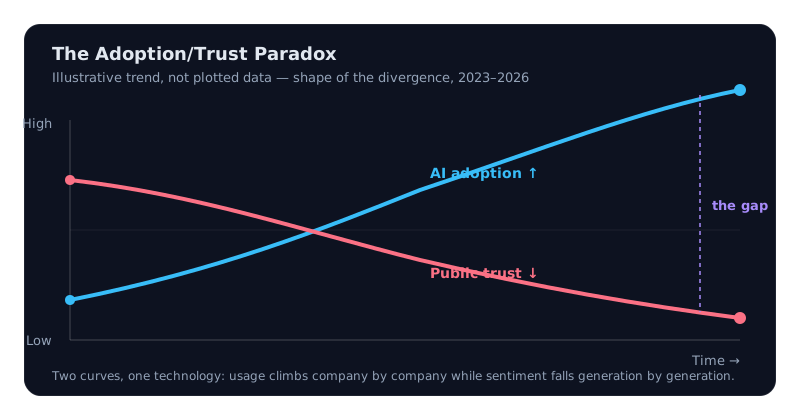
None of this means AI adoption reverses course — the diverging lines above aren’t converging anytime soon. Companies will keep deploying, and usage numbers will likely keep climbing through 2026 regardless of sentiment. But the size of the gap between “AI is everywhere” and “the public trusts AI” is itself becoming a business and political liability that executives can no longer wave off as noise from people who “just don’t get it.” They get it. That’s precisely the problem.
Frequently asked questions
Why is there a backlash against AI in 2026?
The backlash stems from a widening gap between AI adoption and public trust. Tech companies keep shipping AI into products while people experience its downstream costs directly: job losses, copyright disputes, surging electricity bills near data centers, and a sense that they were never consulted about any of it.
How many jobs has AI actually eliminated?
Reports tracking layoffs through 2025 attributed more than 55,000 U.S. job losses directly to AI or workflow automation. Entry-level and junior roles have been hit hardest, which threatens the traditional pipeline that turns graduates into experienced senior professionals over time.
Why are cities blocking new AI data centers?
Data centers strain local power grids, consume large volumes of water for cooling, and have reportedly pushed up nearby utility bills. According to reports, 69 U.S. jurisdictions have banned or paused new data center construction as residents and officials push back on who absorbs those costs.
Is Gen Z more against AI than older generations?
Reports suggest Gen Z shows the sharpest decline in AI sentiment of any age group. Having grown up scrutinizing algorithmic platforms, many young people report viewing AI's rollout as a continuation of familiar tech-industry patterns: extract value first, address harm later, if at all.
Do Americans support government regulation of AI?
According to reports, a strong majority of Americans now favor mandatory government oversight and independent safety boards for AI development, alongside declining trust in the tech executives building it. That combination of distrust and appetite for regulation defines the current backlash.
/* Comments */
Comments are offline right now — we reconnect automatically, nothing is lost.