
topic: education-technology
author: Crashtech Editorial
published: Nov 10, 2026 · read: 5 min
---
Students Are Using AI for Homework Faster Than Schools Can Set the Rules
A new survey reports widespread AI homework use, but its public sample details conflict. The gap calls for school guidance and stronger evidence.
On this page
A student can open an AI tool at home long before a school decides what its homework policy should say. New figures from OpenAI and research group ThinkYoung put that mismatch in focus: 79% of surveyed students reportedly use AI for assignments, while fewer than half say they were shown how. The numbers point to an education problem, but the documentation behind them also needs scrutiny. [1] [2]
Use is not the same as learning
The statistic appears in OpenAI’s November 10 post about responsible AI in education. The company says a ThinkYoung survey found that 79% of respondents used AI for homework or assignments and 47% had been shown how to use it for those tasks. The report argues schools need clearer guidance and better teacher support. [2]
ThinkYoung’s public page describes a larger research effort involving 5,000 high-school students ages 13–19, 600 teachers and focus groups with students and parents across 12 countries in Europe, the Middle East and Africa. It also says 95% of teens use AI tools. But OpenAI’s linked report characterizes the homework comparison as a survey of 5,000 secondary students across ten European countries. The materials available for this review do not explain whether those are different samples, a subset, or a page-level labeling error. [1] [3]
The public ThinkYoung page requires a form to access the full report, and its “download” link did not expose the methodology in the page text. That leaves readers unable to inspect the questionnaire, field dates, country-level results, sampling frame and weighting behind the headline numbers from the visible materials. This does not make the results false; it limits how confidently they can be generalized. The safest wording is “the survey reports,” not “students everywhere do.”
Even when the measurement is sound, use alone does not show that AI improved learning. A student may ask for a hint, check an explanation, translate an unfamiliar phrase or generate a complete answer. Those are different activities with different effects on understanding. A percentage about use collapses all of them into a single category.
The gap is a classroom design problem
Schools often try to answer a broad question—“Is AI allowed?”—when students need to know what help is acceptable for a specific task. An essay designed to assess a student’s ability to form an argument may require a different rule from a worksheet where AI is used to explain a difficult concept. A blanket ban can be hard to enforce outside school; blanket permission can hide whether the student has learned the material.
The OECD’s 2026 AI literacy framework gives schools a more useful target. It defines literacy around understanding how AI works, critically evaluating outputs and using tools ethically and creatively. That shifts the curriculum from memorizing a list of permitted apps to learning habits that transfer across tools: check a claim, identify uncertainty, protect personal information and explain what assistance was used. [4]
The OECD’s Digital Education Outlook also cautions that completing a task with a general-purpose chatbot does not automatically create learning gains. Emerging evidence suggests the tool can improve an immediate output while weakening the learner’s later performance if cognitive work was simply outsourced. Clear teaching principles and teacher involvement matter. [5]
UNESCO’s guidance likewise emphasizes human-centered policy, privacy and institutional readiness. It recommends that education systems consider age-appropriate use and build the capacity to validate tools, rather than treating access to a chatbot as an education strategy on its own. [6]
A practical rule set students can actually follow
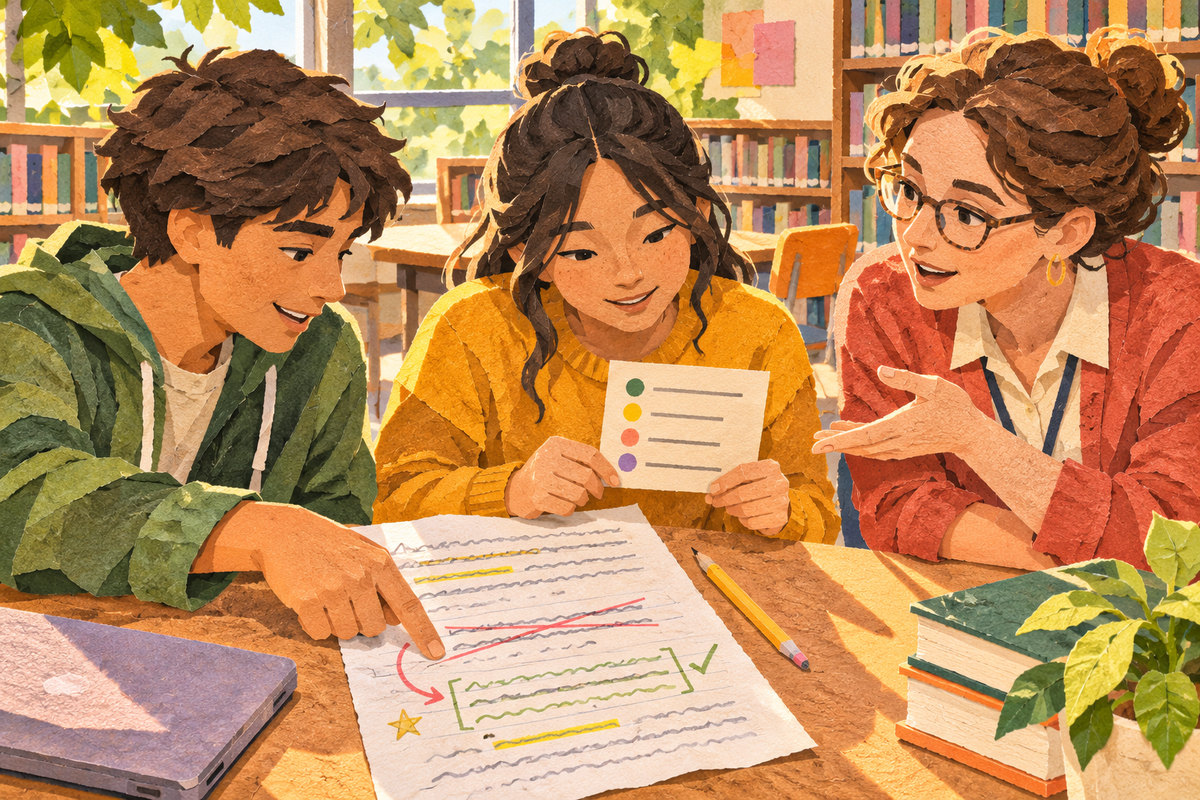
Teachers can make expectations concrete with a short task-specific note. For example: “Use AI to generate questions you can use to study; do not submit generated answers. Verify every factual claim against class materials. Add one sentence describing what the tool helped with.” That lets the student use a tool while keeping the intellectual work visible.
Assignments can ask students to show a small piece of their process: an annotated source, a draft with revisions, a short oral explanation, or a comparison between an AI suggestion and the student’s final choice. These methods are not perfect AI detectors, and they should not be used to accuse a student based on an unreliable classifier. Their purpose is to assess learning directly and help students reflect on decisions.
Schools should also provide a path for students who cannot access paid tools or do not want to share personal data with them. The OpenAI report itself stresses local context and ongoing evaluation; those principles apply to procurement as well as pedagogy. A rule that assumes every student owns the same device, account or subscription can turn a lesson about AI into an access disadvantage. [3]
What the numbers can—and cannot—tell us
The reported 79% versus 47% gap is a strong prompt for schools to ask whether students know what responsible assistance looks like. It is not enough to set policy from two headline percentages, particularly when the accessible materials disagree about the survey’s geographic coverage and do not provide the full methods.
Readers can use the report as a signal to investigate their own context: ask students how they use AI, ask teachers what support they need, and publish rules that distinguish brainstorming, feedback, factual lookup and answer generation. Then measure whether students can explain the subject better without the tool, not merely whether they can submit polished work with it.
For education leaders, the opportunity is to close the guidance gap with transparent evidence. That means sharing survey methods, publishing local results, making teacher development part of the plan and testing whether an intervention improves understanding. Students will keep encountering AI beyond the classroom. The question is whether they are prepared to use it with judgment when a teacher is not standing beside them. [1] [4] [5]
For related coverage, see how guided-learning features work in classrooms and AI literacy in Australian universities.
Frequently asked questions
What does the new student AI survey report?
OpenAI cites ThinkYoung research saying 79 percent of surveyed students used AI for homework or assignments, while 47 percent said they had been shown how to use it for those tasks. The public survey page and OpenAI report disagree on the number of countries represented.
Is the 79 percent figure representative of all students?
The public materials reviewed do not provide enough accessible detail on sampling, weighting, field dates or the full questionnaire to establish representativeness. Treat it as a reported survey result, not a universal student-use rate.
What should teachers do about AI homework?
Set task-specific rules, show students how to verify outputs and protect personal information, and design assignments that reveal reasoning. The OECD's 2026 framework emphasizes critical evaluation and ethical use as parts of AI literacy.
Sources & further reading
Keep reading

Australian Universities Are Turning AI Access Into an Assessment Problem
Australian universities are pairing AI access with practical projects and clearer assessment rules, while a commissioned survey has clear limits.
AI-Exposed Workers May Be Facing a Slower Job Search, Not a Layoff Wave
A Cleveland Fed analysis links higher AI exposure to weaker job finding and worse outcomes for younger workers, while finding no clear rise in job separations.
AI Proved Parts of Signal’s Code. Here Is What That Actually Guarantees
Google DeepMind used Lean-checked proofs on Signal’s libsignal code. The result is meaningful assurance with a carefully bounded scope, not a blanket guarantee.
/* Comments */
Comments are offline right now — we reconnect automatically, nothing is lost.