
AI Security Scans Need Verified Fixes, Not Bigger Queues
GitHub and Microsoft describe a pilot that filtered thousands of AI security findings into a much smaller set of verified reports for maintainers.
On this page
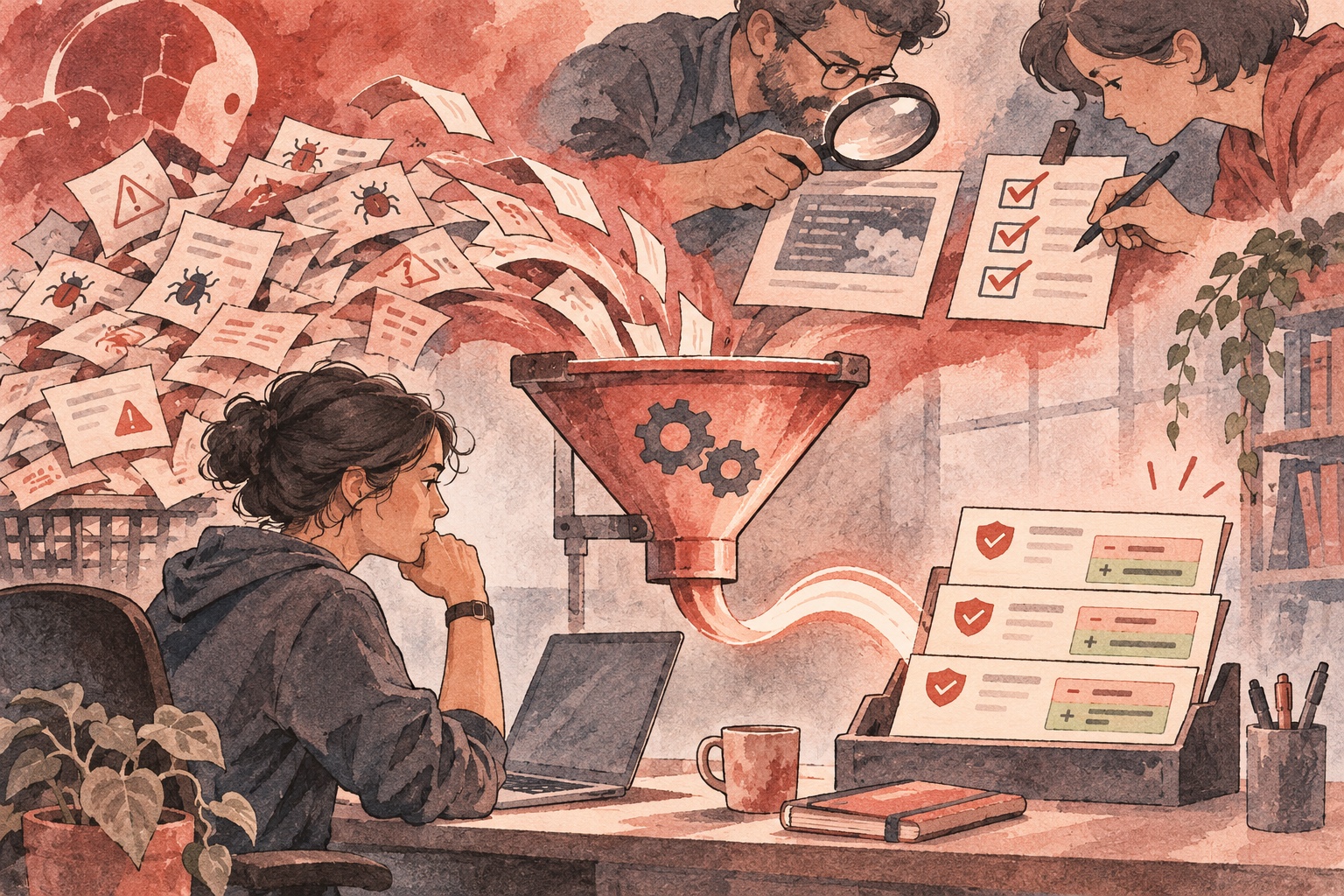
A maintainer’s inbox is not an infinite security queue. Every report consumes time to reproduce, assess impact, distinguish a bug from a scanner artifact, and coordinate disclosure. GitHub and Microsoft describe a pilot that narrowed thousands of AI-generated findings to 99 checked, private reports with suggested fixes for six widely used open-source projects. The companies said maintainers had fixed more than half at publication. Those are pilot results, not a general measure of AI security accuracy. [1]
Triage is part of the security work
A scanner can identify suspicious code paths, but a useful report needs more: a reproducible input, affected version or configuration, realistic impact, and a clear explanation of what an attacker can do. Without those details, maintainers must repeat the investigation before they can decide whether a fix is needed. At scale, noisy findings can bury the credible ones.
The MDASH account emphasizes verification and suggested fixes. That shifts effort toward checking whether a finding is real and giving maintainers a concrete starting point. A proposed patch still needs review: it may be incomplete, introduce a regression, or solve the wrong threat model. Automation can make evidence cheaper to assemble; it should not silently declare its own work confirmed. [1]
Private reporting protects the repair window
Keeping a confirmed issue private while a fix is prepared can reduce the chance that exploit details spread before users have a remedy. Coordinated disclosure is a process with responsibilities on both sides: reporters provide enough evidence to act, while maintainers need a workable timeline and a secure channel. Public dashboards that count raw alerts can reward volume while obscuring whether anyone can fix the underlying issue.
The pilot’s small final set compared with the thousands of initial findings is a reminder to measure conversion through the whole lifecycle: raw signal, validated bug, maintainer-accepted report, fix, and release. Each stage answers a different question. “Found” is not synonymous with “confirmed,” and “suggested fix” is not synonymous with “patched.” [1]
Build a workflow maintainers can sustain
Security teams deploying AI-assisted scans should cap duplicate reports, attach minimal reproductions, identify affected versions, preserve private handling, and provide a human contact who can respond to questions. Track false-positive rate and maintainer time as well as findings. If the system cannot explain its evidence or support remediation, increasing scan volume may transfer cost to the smallest teams least able to absorb it.
The strongest claim supported by this pilot is operational: filtering and verification can turn a large discovery stream into a smaller set of actionable reports. Whether the approach works elsewhere depends on project mix, validation quality, disclosure practice, and maintainer capacity. [1]
Frequently asked questions
What did GitHub's MDASH pilot report?
GitHub and Microsoft say thousands of raw AI findings became 99 checked, private reports with suggested fixes across six open-source projects; maintainers had fixed more than half at publication.
Does an AI-generated vulnerability report prove a vulnerability exists?
No. Findings need reproducible evidence, impact analysis, and maintainer review before they should be treated as confirmed vulnerabilities.
Why keep reports private during triage?
Coordinated private reporting can give maintainers time to validate and fix a real issue before details become broadly actionable to attackers.
Sources & further reading
Keep reading

Only One-Third Met Their AI Business Case. Read the Survey’s Fine Print
A new survey finds reported AI returns lag expectations, but its sample covers AI-active enterprises. Here is how leaders should interpret the result.

Australia’s Proposed AI Regulator Puts Incident Reporting at the Center
Australia proposes security, evaluation and rapid incident reporting rules for frontier AI firms, with a new regulator to enforce them.

Can a Flexible Data Center Protect the Neighbors on Its Grid?
OpenAI’s Grid Protectors promises flexible data-center power use. Contracts, controls, and reporting will determine whether the response is dependable.
/* Comments */
Comments are offline right now — we reconnect automatically, nothing is lost.