
Cell-Based Architecture at American Express: How Card Payments Survive Failing Services
Surviving partial failures during real-time authorization: blast radius isolation, deterministic routing, and cell-based mid-transaction recovery.
On this page
When a cardholder swipes an American Express card at a physical payment terminal, the transaction operates under unforgiving real-time constraints:
- The entire distributed authorization pipeline must complete in under 1,500 milliseconds.
- The pipeline spans fraud detection neural networks, merchant account validation, currency conversion, credit limit checks, and ledger logging.
- If the transaction takes more than two seconds, the card terminal times out, the merchant is frustrated, and the customer’s card is declined.
Now consider what happens in a conventional distributed microservice architecture when a single service (such as an internal fraud scoring database) begins throwing 500 errors or stalling under a memory leak.
In a traditional shared microservice topology, that one failing service poisons the entire global fleet:
- Every payment authorization across the world routes through the shared fraud cluster.
- Every payment thread blocks and times out.
- The entire global financial network suffers an outage.
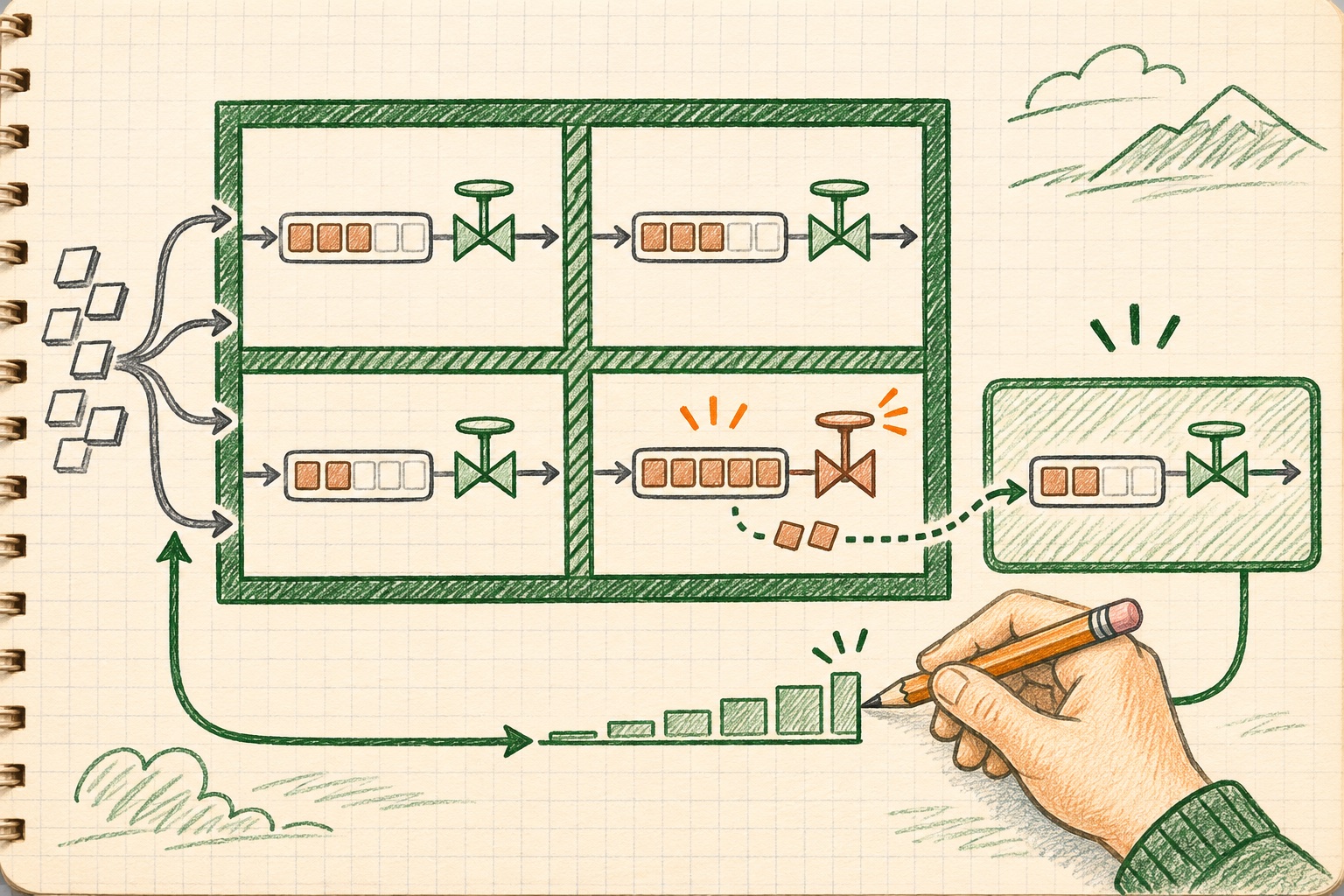
To guarantee that transactions complete even when internal services are actively failing mid-flight, American Express pioneered a Cell-Based Architecture.
+--------------------------------------------------------------------------+
|                  THE CELL-BASED ISOLATION PARADIGM                       |
|                                                                          |
|  Shared Microservices (High Blast Radius):                               |
|  [All Global Users] ----> [Global Fraud Service (Fails!)] -> TOTAL OUTAGE|
|                                                                          |
|  Cell-Based Architecture (Bounded Blast Radius):                         |
|  [Cell 1] -> Self-contained (Handles Users 0 - 2M)                      |
|  [Cell 2] -> Self-contained (Handles Users 2M - 4M)                      |
|  [Cell 3] -> Self-contained (Handles Users 4M - 6M)                      |
|                                                                          |
|  If Cell 2's fraud engine crashes, Cell 1 & 3 experience ZERO impact!    |
+--------------------------------------------------------------------------+
What Is a Cell? (Failure Boundaries vs. Functional Boundaries)
Engineers frequently confuse cells with microservices:
- Microservices are divided by function: the Auth Service, the Pricing Service, the Inventory Service.
- Cells are divided by failure: a cell is an independent, self-contained, complete instance of the entire application platform.
A single cell contains its own private copy of every service required to process a transaction:
- Its own API gateway.
- Its own fraud scoring microservice.
- Its own account validation database.
- Its own message brokers and caches.
Crucially: Cells share zero runtime infrastructure. Cell 1 cannot make a network call to Cell 2. If an unhandled null-pointer exception or memory leak destroys Cell 1, Cell 2, Cell 3, and Cell 4 remain 100% operational. The blast radius of any infrastructure failure is strictly mathematically bounded (e.g., to 10% of total users).
The Data Locality Challenge: Pushing Static vs. Dynamic State
The hardest architectural problem in cell-based systems is data storage. If cells cannot share a database, how do they access account balances and merchant rules?
American Express solved this by partitioning data into two categories:
[Static Reference Data] (Merchant catalogs, fee tables, risk rules)
-> Pushed asynchronously to EVERY cell ahead of time.
-> Read locally in RAM with sub-millisecond latency.

[Dynamic State Data] (Card balance, available credit, active holds)
-> Partitioned by Cardholder Account Number (PAN).
-> Account `3782-xxxx-102` is permanently pinned to Cell 4.
1. Replicated Static Reference Data
Rules like merchant category codes, currency exchange tables, and fraud blacklists change infrequently. This data is pre-replicated to local read-only caches inside every single cell. Every cell can evaluate merchant rules locally without crossing cell boundaries.
2. Sharded Dynamic State Data
Cardholder balances change every second. An account can only have one authoritative source of truth.
American Express uses Deterministic Hash-Based Routing: the cardholder account number is hashed to map permanently to a specific cell (e.g., hash(card_id) % total_cells = Cell_ID). All transactions for that cardholder route directly to the designated cell.
The Global Transaction Router (GTR)
The only shared component in the entire architecture is the Global Transaction Router (GTR).
The GTR is an ultra-lean, stateless routing proxy deployed across multiple data center points of presence:
[Card Swiped at Merchant] ---> [Global Transaction Router (GTR)]
                                              |
                     +------------------------+------------------------+
                     | (Primary Hash Route)                            | (Cell 2 Health Degraded!)
                     v                                                 v
           [Cell 2 (Cardholder Home)]                        [Cell 9 (Clean Stateless Recovery)]
           - Authorizes transaction                          - Discards partial work
- Writes local ledger - Re-runs auth cleanly- Deterministic Hashing: The GTR inspects the card number and computes the destination cell in under 2 milliseconds.
- Health Monitoring: The GTR continuously evaluates the health of every cell using synthetic heartbeat probes and live transaction error rates.
- Mid-Transaction Failover: What happens if Cell 2 accepts the transaction, but its fraud scoring engine hangs for 800 milliseconds?
The Mid-Transaction Recovery Rule
If a cell fails to respond within a strict 600 ms deadline:
- The GTR does not retry the operation inside the same failing cell.
- The GTR severs the connection, marks the transaction in Cell 2 as aborted, and routes the transaction to an alternate healthy cell (e.g., Cell 9).
- The alternate cell does not attempt to resume partial state: it executes the authorization cleanly from the beginning using replicated reference data and credit line limits.
The Five Principles of Cell-Based Design
- Strict Blast Radius Ceilings: Cap cell capacity. Never allow a cell to grow beyond a set threshold (e.g., max 2 million cardholders). If customer volume doubles, spin up more cells; never make existing cells bigger.
- Zero Cross-Cell Synchronous Calls: A service inside Cell A is physically forbidden from making an RPC call to a service inside Cell B.
- Decoupled Deployments: Never deploy code to all cells simultaneously. Roll updates out to Cell 1 (Canary). Verify live production metrics for 24 hours. Gradually promote across remaining cells.
- Independent Failover: Any single cell can be completely decommissioned or isolated without affecting the health of neighboring cells.
- Deterministic Routing at the Edge: Route traffic based on invariant entity IDs (like account UUIDs), not dynamic session cookies.
By treating failure as a physical certainty rather than an exceptional circumstance, American Express guarantees that even during major data center hardware crashes, payments continue swiping smoothly at terminals worldwide.
Keep reading
Designing Gateways That Fail Without Taking the Fleet Down
A technical blueprint for gateway overload control: N-1 capacity, bounded queues, load shedding, isolated failover and controlled recovery.
How Airbnb Shipped 20+ Local Payment Methods in 360 Days: Config-Driven Domain Architecture
Inside Airbnb's payments replatforming: shipping 20+ Local Payment Methods (LPMs) across 75 global markets in under 360 days using config-driven architecture.
Database Performance is a Trade-Off Ledger: The Hidden Costs of Indexing, Caching, and Sharding
Why every database optimization creates a new liability: the hidden write costs of B-tree indexes, caching stale reads, and sharding operational taxes.
/* Comments */
Comments are offline right now — we reconnect automatically, nothing is lost.