
Data Warehouse vs Data Lake vs Data Mesh: Architecture and Ownership Models
Compare data warehouses, data lakes, and data mesh architectures across schema enforcement, compute separation, storage formats, and team boundaries.
On this page
Storing raw bytes in the cloud is cheap and solved. The real engineering battle in data platforms is deciding how to structure those bytes, who owns their quality, and how downstream teams consume them.
Over the past three decades, enterprise data architecture evolved through three distinct waves:
- The Data Warehouse (1990s to present): Centralized, highly structured, schema-on-write relational stores designed for business intelligence and executive reporting.
- The Data Lake and Lakehouse (2010s to present): Distributed object stores holding raw, semi-structured files with decoupled compute engines, powering machine learning and petabyte-scale telemetry.
- The Data Mesh (2020s to present): A socio-technical decentralization that rejects the monolithic central data team, treating domain data as an operational product owned by the software teams that produce it.
Choosing between these patterns is not an engineering fashion statement. Each represents an explicit trade-off between schema governance, infrastructure cost, and organizational scalability.
The Three Paradigms Side by Side
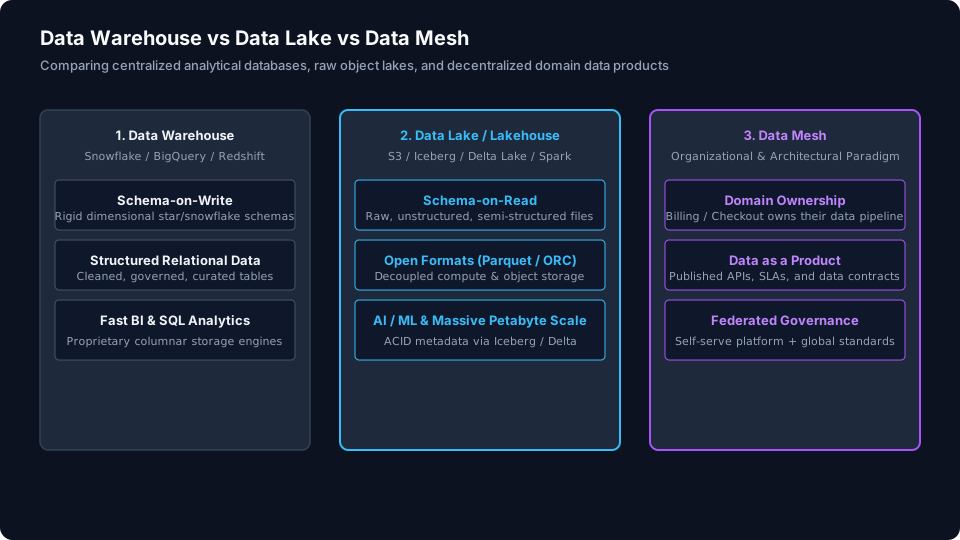
1. The Data Warehouse: Schema-on-Write Rigor
A Data Warehouse (such as Snowflake, Google BigQuery, or Amazon Redshift) ingests structured data from operational databases via Extract-Transform-Load (ETL) pipelines, transforming it into optimized dimensional models (star or snowflake schemas).
Core Characteristics:
- Schema-on-Write: Data cannot enter the warehouse without conforming to a predefined schema. If an upstream service alters an enum or removes a column, the ETL pipeline halts.
- Proprietary Columnar Storage: Storage is heavily compressed and indexed (for example, Snowflake micro-partitions), enabling lightning-fast SQL aggregations.
- High Governance, Low Velocity: Data analysts enjoy clean, verified financial and operational metrics. However, adding new data sources requires central data engineering tickets, creating severe organizational bottlenecks.
2. The Data Lake and Modern Lakehouse
To overcome the rigid schema constraints and high storage costs of data warehouses, organizations built Data Lakes on top of object storage (such as AWS S3 or Google Cloud Storage).
Core Characteristics:
- Schema-on-Read: Raw data (JSON logs, Parquet files, images, clickstream events) is dumped directly into object storage. Schemas are applied only when a compute engine queries the data.
- Decoupled Compute and Storage: Storage costs pennies per gigabyte. Compute engines (Apache Spark, Trino, Presto) scale up dynamically to run queries and spin down immediately after.
- Open Table Formats (The Lakehouse): Early data lakes suffered from data corruption and dirty reads (the data swamp problem). Modern lakehouses introduce open table format layers (Apache Iceberg, Delta Lake) that bring ACID transactions, time travel, and metadata pruning to open Parquet files on S3.
3. The Data Mesh: Decentralized Domain Products
When an enterprise scales to 500+ engineers across 40 domains, both centralized data warehouses and central data lakes collapse under organizational friction. The central data team becomes a bottleneck, disconnected from the operational context of the business.
Introduced by Zhamak Dehghani, Data Mesh is an architectural and organizational paradigm built on four foundational pillars:
- Domain-Driven Decentralized Ownership: The team that builds the Checkout microservice owns the analytical Checkout data. They do not throw raw MySQL dumps over the wall to a central team.
- Data as a Product: Domain teams publish clean, versioned analytical datasets with documented SLAs, discoverability metadata, and schema contracts (Data Contracts).
- Self-Serve Data Infrastructure Platform: A central platform team builds self-service provisioning tooling (e.g., one-click Iceberg table provisioning, access control), enabling domain teams to publish data without managing low-level infrastructure.
- Federated Computational Governance: Global standards (PII redaction, GDPR compliance, cross-domain join keys) are enforced automatically via CI/CD policies and access proxies.
Architectural Comparison Matrix
| Dimension | Data Warehouse | Data Lake / Lakehouse | Data Mesh |
|---|---|---|---|
| Data Philosophy | Clean, curated, schema-on-write. | Raw, multi-format, schema-on-read. | Distributed analytical data products. |
| Storage Layer | Proprietary managed columnar format. | Open formats (Parquet, ORC, Iceberg). | Heterogeneous (Lakehouse or Warehouse per domain). |
| Primary Consumer | Business analysts, SQL BI dashboards. | Data scientists, ML training, ad-hoc queries. | Cross-functional product teams, services, BI. |
| Team Structure | Central data engineering team. | Central data platform team. | Distributed cross-functional domain teams. |
| Failure Mode | Pipeline brittleness, schema lock-in. | Data swamp, inconsistent definitions. | High organizational maturity requirement. |
Architectural Recommendation
- Small to Mid-Sized Teams (< 100 engineers): Deploy a managed Data Warehouse (BigQuery or Snowflake) with dbt. Introducing data mesh or custom lakehouse infrastructure prematurely introduces crushing operational overhead.
- Petabyte-Scale / Multimodal Workloads: Deploy an Open Lakehouse using Apache Iceberg on cloud object storage, querying with Trino or Spark.
- Large Multi-Business Enterprises (> 300 engineers): Adopt Data Mesh principles, establishing strict data contracts and domain product ownership to prevent central engineering bottlenecks.
/* Comments */
Comments are offline right now — we reconnect automatically, nothing is lost.