
Event-Driven Architecture Patterns: Outbox, Event Sourcing, and Sagas
Why synchronous RPC chains fail at scale, and how event-driven architecture patterns (Transactional Outbox, Sagas, CQRS) guarantee resilience.
On this page
When organizations transition from a monolith to microservices, they almost always begin with synchronous HTTP or gRPC calls.
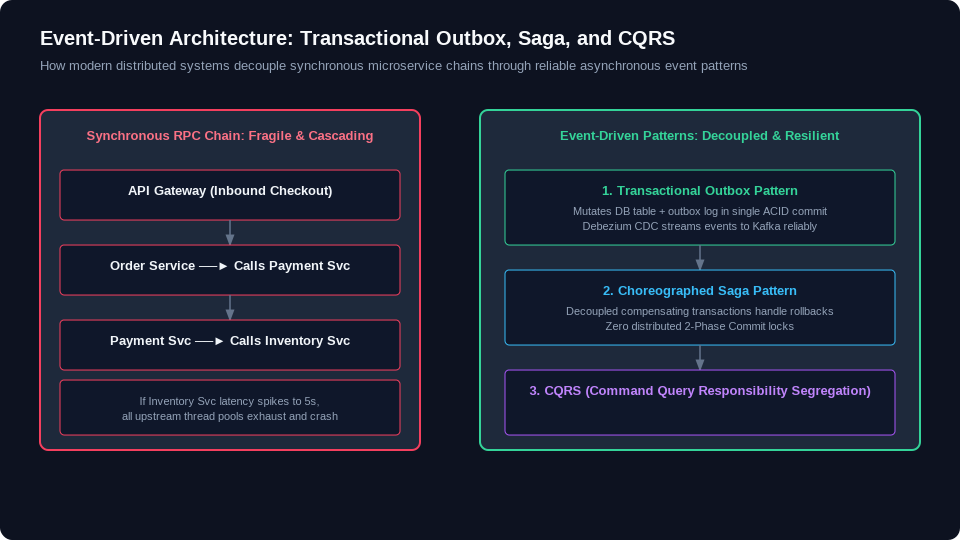
The architecture looks clean on a whiteboard: the Order Service calls the Payment Service over HTTP, which calls the Inventory Service over gRPC, which calls the Notification Service over HTTP.
In production, synchronous call chains are an architectural time bomb. When system components are coupled synchronously over a network, their availability is multiplicative, not additive:
Availability = A_order * A_payment * A_inventory * A_notification
If each service achieves 99.9% uptime:
0.999 * 0.999 * 0.999 * 0.999 = 99.6% (Over 35 hours of downtime per year!)
Worse, if the Inventory Service slows down by 3 seconds due to a database lock, upstream connection pools in the Payment and Order services exhaust within seconds, triggering a cascading outage across the entire enterprise.
To build resilient, horizontally scalable distributed systems, engineering teams transition to Event-Driven Architecture (EDA). This guide analyzes why synchronous calls break and details the foundational patterns that solve distributed consistency: Transactional Outbox, Sagas, and CQRS.
The Synchronous Cascade vs Asynchronous Decoupling
1. The Dual-Write Problem and The Transactional Outbox Pattern
In an event-driven system, a service must update its internal database and publish a notification event to Apache Kafka:
// THE DUAL-WRITE BUG
async function createOrder(orderData) {
  // 1. Write to database
  await db.orders.insert(orderData);

  // 2. Publish to Kafka
  await kafka.publish("order-created", orderData);
}
What happens if the application crashes immediately after writing to the database but before publishing to Kafka? The database row exists, but no downstream service ever hears about it.
What if we reverse the order? If Kafka succeeds and the database fails, downstream systems act on an order that does not exist in the primary ledger.
The Solution: The Transactional Outbox Pattern
Instead of writing to two separate distributed systems, the application writes both the business entity and the outgoing event into the same relational database within a single local ACID transaction:
BEGIN TRANSACTION;
  -- Insert business entity
  INSERT INTO orders (id, user_id, amount) VALUES ('ord_101', 'usr_42', 99.00);

  -- Insert into outbox table in the same transaction
  INSERT INTO outbox_events (id, aggregate_type, payload)
  VALUES ('evt_901', 'ORDER', '{"order_id": "ord_101", "amount": 99.00}');
COMMIT;
A dedicated Change Data Capture (CDC) worker (such as Debezium) streams mutations from the database transaction log directly to Kafka, guaranteeing at-least-once delivery with zero dual-write vulnerabilities.
2. Distributed Transactions: The Saga Pattern
In a monolith, transferring money or booking a flight and hotel occurs inside an atomic database transaction (BEGIN ... COMMIT). If the hotel booking fails, the database automatically rolls back the flight booking.
In microservices, where each service owns its private database, distributed ACID transactions (Two-Phase Commit / 2PC) are non-viable: they lock physical database rows across network boundaries, destroying throughput.
The Saga Pattern solves this by breaking a distributed transaction into a sequence of local transactions, coordinated through domain events:
- Order Service: Creates an order in
PENDINGstate and emitsOrderCreated. - Payment Service: Consumes
OrderCreated, charges the credit card, and emitsPaymentAuthorized. - Inventory Service: Consumes
PaymentAuthorized, discovers out-of-stock items, and emitsInventoryAllocationFailed. - Compensating Transaction: The Payment Service consumes
InventoryAllocationFailedand executes a refund, while the Order Service marks the orderCANCELLED.
3. CQRS (Command Query Responsibility Segregation)
In complex domains, the optimal data model for processing writes (transactions, invariants, normalized 3NF schemas) is completely different from the optimal data model for querying reads (denormalized, pre-aggregated, searchable).
CQRS separates the write path from the read path:
- Command Model (Writes): Handles transactional mutations, validating business invariants in PostgreSQL.
- Query Model (Reads): Consumes domain events from Kafka and updates read-optimized projections in Elasticsearch, Redis, or ClickHouse.
Summary Checklist for Distributed Systems Architects
- Eliminate Synchronous Chains: If a service does not need an immediate response to complete its local responsibility, replace the HTTP call with an asynchronous Kafka or SQS event.
- Never Dual-Write: Use the Transactional Outbox pattern backed by CDC to guarantee atomicity between local state updates and event publishing.
- Design for Idempotency: Because network retries guarantee at-least-once delivery, every event consumer must track processed message IDs to prevent duplicate execution.
/* Comments */
Comments are offline right now — we reconnect automatically, nothing is lost.