
Flocci Talent: The Hiring Command Center That Refuses to Think Twice
An AI-native ATS that sources from Gmail, screens resumes with content-addressed AI, and runs a 12-stage pipeline — without vendor lock-in.
On this page
The stack of unread resumes is four hundred and eleven deep, and the requisition it belongs to has been open for nine days. Somewhere inside that pile is the person who should get hired. Not the loudest applicant. Not the one who applied first. The right one — whose three years of async payments work maps exactly onto the role — is sitting at position 287, subject line “resume (final) (2).pdf.” She is the one genuinely qualified candidate in the batch, and while the pipeline dithers — re-reading the top of the heap, re-deciding what it already half-decided — she quietly accepts an offer elsewhere and goes cold. This is the quiet tragedy of modern hiring: the signal is almost always there. It just drowns before anyone reads it.
What a slow, re-deciding pipeline really costs
Every hiring team pays a cost it never counts: the cost of reading. A resume takes two to five minutes to genuinely parse — pull the skills, weigh the experience, cross-check it against what the role actually needs, form a judgment. Multiply by four hundred applicants and the arithmetic gets grim. So teams cut corners. They keyword-skim. They read the top of the pile and let the bottom rot. They score candidate seven at 9am with fresh eyes and candidate seventy at 6pm with none, and call the result a process.
The industry’s usual answer is a bigger upload box: drag your PDFs in, and software will tag them. But that answer misplaces the problem. The resumes were never sitting in a tidy folder waiting to be uploaded. They arrive as email attachments, scattered across threads, forwarded from a hiring manager, buried under calendar invites and newsletters. The triage burden starts in the inbox, and that is exactly where most tools refuse to go.
Flocci Talent — which describes itself, plainly, as an AI Hiring Command Center — starts from a different premise. The problem is not storage. The problem is that a human is doing a machine’s job, one PDF at a time, and the machine is not even looking where the work actually lives.
The insight: never pay to think the same thought twice
Here is the thesis that makes Talent more than another ATS with an AI sticker on it. AI screening is expensive — not ruinously, but enough that at hiring volume it adds up. The naive design bills every screen at full cost, forever, even when nothing has changed. Re-open a candidate. Re-run a shortlist. Compare last month’s applicants against a near-identical role. Each time, the meter spins, and you are paying premium rates to have the model reach a conclusion it already reached.
Talent’s screening is content-addressed. Every result is keyed on a hash of the resume, a hash of the job description, and the model version. Ask the same question of the same inputs and the system does not re-summon the model — it returns the cached judgment. The economics are stark: a full AI screen costs 50 credits; a cache hit costs 1. That is a fifty-fold drop, not from a discount but from a refusal to redo settled work.
Talent is engineered to never pay to think the same thought twice. Screening results are keyed on content_hash + input_hash + model_version — so re-running an identical resume against an identical job description is billed at 1 credit instead of 50. The cheapest AI call is the one you don’t make.
The same discipline runs one level deeper, in the provider layer. Talent’s entire AI engine lives behind a single code contract with only two call sites. That contract fronts a lineup of ten pre-mapped AI providers — swappable by configuration change, never a code change. A unified adapter pattern covers the standard API shape; bespoke adapter classes are held in reserve only for APIs whose shape genuinely differs. The result is a product that is simultaneously cheap to run and structurally impossible to lock in. If a better model appears next quarter, Talent adopts it by editing a line, not by refactoring a business.
How the pipeline actually moves
Strip away the architecture and watch a candidate travel through the system. This is the loop a recruiter lives inside.
- Sourced from the inbox, not an upload box
Talent owns dedicated Gmail scopes and connects through a separate Connect-Gmail flow. Its email-search endpoints reach into the recruiter’s own inbox, find the resumes, and harvest the candidates — so the pile you were drowning in becomes the pipeline you’re working. Crucially, that Gmail connection survives platform SSO as its own authenticated flow, so sourcing never breaks when you log in through the shared identity service.
- Parsed and scored by AI
Each resume is run through Flocci Intelligence by default, extracting skills, education, experience, projects and certifications, then scoring fit against the role. Identical work is never re-billed at full rate — the content-addressed cache sees to that.
- Moved through a 12-stage board
Candidates flow across a drag-and-drop Kanban board driven by a 12-state pipeline, with detail views and recruiter notes at every stage. The funnel is visible, not a mystery you reconstruct from a spreadsheet.
- Reached with tracked, templated email
Interview invites and follow-ups go out from template CRUD, as single or bulk sends, with per-email open, delivered and clicked tracking feeding delivery-rate analytics. You know whether the message landed.
- Resurfaced when the next role opens
When a pipeline closes, its candidates are harvested into a talent pool and AI-matched against future requisitions. The strong applicant you couldn’t hire this time isn’t lost — they’re reactivated the moment a fitting role appears.
There is one more move that happens before any of this: the job requisition itself gets critiqued. Talent runs an AI quality score against a JD before the role goes live, returning feedback on the posting so the top of the funnel isn’t poisoned by a vague or contradictory description. Fixing the requisition is the cheapest hiring improvement there is, and it costs 15 credits to check.
The stack that shouldn’t fit, and does
Talent is the first and only Python/FastAPI backend in the entire Flocci estate — an async SQLAlchemy 2 and Alembic stack spanning roughly 110 endpoints across 19 tables, fronting a React/Vite UI. The outsider stack that nonetheless became the first app to fully converge onto every shared platform service.
Per-user credit wallets hold expiring credit lots, consumed soonest-expiry-first, with coupons, plan changes and PayU Standing-Instruction mandates for recurring billing. Wallet concurrency is guarded with row-locked SQL, so two simultaneous actions can’t corrupt a balance.
A single contract with two call sites fronts ten AI providers. A unified adapter pattern covers standard API shapes; genuine API-shape differences get their own adapter. Model swaps are config, never code.
On Business and Enterprise plans, an organization owner’s wallet acts as a shared credit pool. Team actions debit the org’s balance, not scattered personal ones — so finance sees one meter, not fifty.
That “first fully converged app” line deserves a closer look. Talent doesn’t hand-roll the hard parts. Login and SSO come from the identity service over RS256/JWKS. The org layer — email-OTP signup, members, invites, the Admin-through-Viewer role ladder, teams and the org switcher — comes from the org-identity service. Payments route through the PayU-backed payment service; AI through the intelligence service’s chat endpoint; transactional email through the notification service. And Talent feeds a Graph event mesh, emitting candidate.status_changed, screening.completed and requisition.created so the rest of the estate can react to what happens in hiring. A Python app, an outsider by stack, became the reference for how thoroughly a Flocci product can plug in.
Do
- Let AI do first-pass extraction and scoring, then spend human judgment on the shortlist
- Source from the inbox where resumes actually arrive, not a manual upload box
- Re-open and re-compare candidates freely — the cache makes iteration nearly free
- Fix the requisition with a JD quality check before the role goes live
Don't
- Keyword-skim four hundred PDFs by hand and call the survivors a shortlist
- Pay full screening rates to re-derive a judgment the system already reached
- Let closed-pipeline candidates vanish instead of resurfacing them for new roles
- Bet your recruiting stack on a single AI vendor you can’t swap out
Who it’s for, and where it’s going
Talent is built for the person we opened on — the solo recruiter buried in inbound resumes — and it scales up from there to multi-recruiter organizations that need shared, org-level billing. SMB through mid-market hiring teams. The transparency of the credit model is part of the pitch: per-action costs are explicit rather than hidden behind seat tiers. AI screening is 50, bulk screening 40, a JD check 15, a resume 10, an email 5, and a cache hit just 1, on an 18% GST. You can see exactly what each judgment costs, which is more than most recruiting software will tell you.
The forward story writes itself from the architecture. Because the AI boundary is config-swappable across ten vendors, Talent gets faster and cheaper every time the model market moves, without a rewrite. Because screening is content-addressed, the more a team iterates, the less it pays. And because the product already emits its hiring events into the Flocci mesh, it is positioned to become the recruiting nervous system of a wider platform — where a screening.completed event can trigger anything, anywhere in the estate. The pile of four hundred resumes hasn’t gone away. Talent just stopped pretending a human should read it first.
Frequently asked questions
What is Flocci Talent?
An AI-native applicant tracking system for recruiting. It sources candidates from Gmail, parses and AI-screens resumes, scores job requisitions before they go live, and runs candidates through a 12-stage hiring pipeline — all with prepaid credit-based billing built in.
Which AI does it use, and am I locked to one vendor?
Flocci Intelligence is the default, but the AI sits behind a single code boundary fronting ten pre-mapped providers — swappable by configuration alone. Switching models never touches business logic, so you are never vendor-locked.
How does pricing and billing work?
It uses a prepaid credit wallet backed by PayU. Actions cost credits — AI screening 50, bulk screening 40, JD check 15, resume 10, email 5 — and credits are expiring lots spent soonest-expiry-first. Re-screening the same resume against the same job description hits the cache at just 1 credit. GST is 18%, and recurring plans use PayU Standing-Instruction mandates.
Can it pull candidates from my email?
Yes. It sources candidates directly from Gmail, searching and harvesting resumes from the inbox through a dedicated, product-owned Gmail connection rather than a manual upload box. That Connect-Gmail flow survives SSO, so sourcing keeps working after platform login.
Does it support teams and organizations?
Yes. There is a full org layer — email-OTP organization signup, members, invites, a role ladder of Admin, Hiring Manager, Recruiter, Interviewer and Viewer, teams, and an org switcher. Corporate billing lets team actions debit the org owner's shared credit pool on Business and Enterprise plans.
Sources & further reading
Keep reading
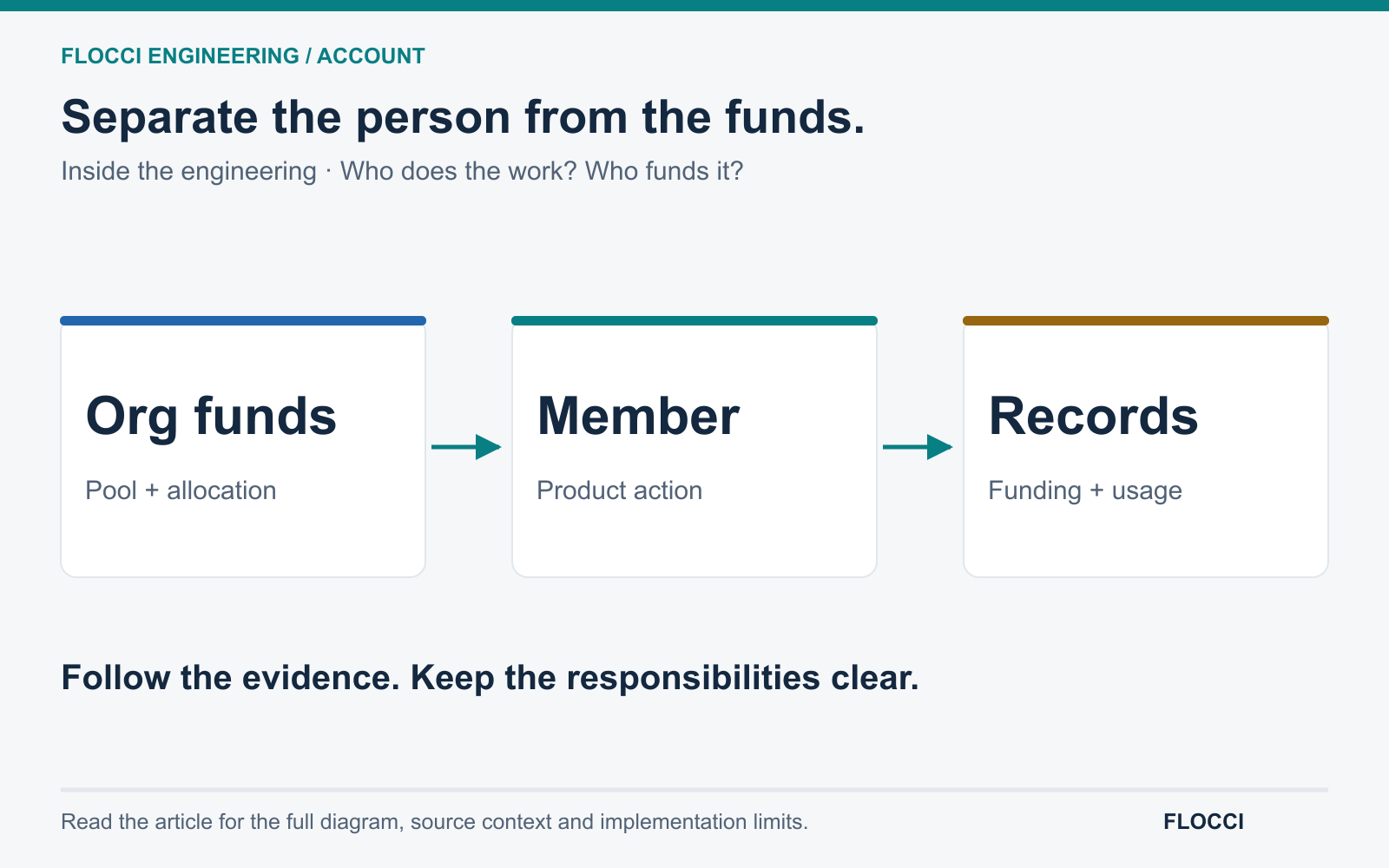
Freedom to Use AI, Control Over Its Cost: Inside Flocci Account
How Flocci Account and shared payment capabilities connect personal credits, organization funding, allocations and accountable spending across products.
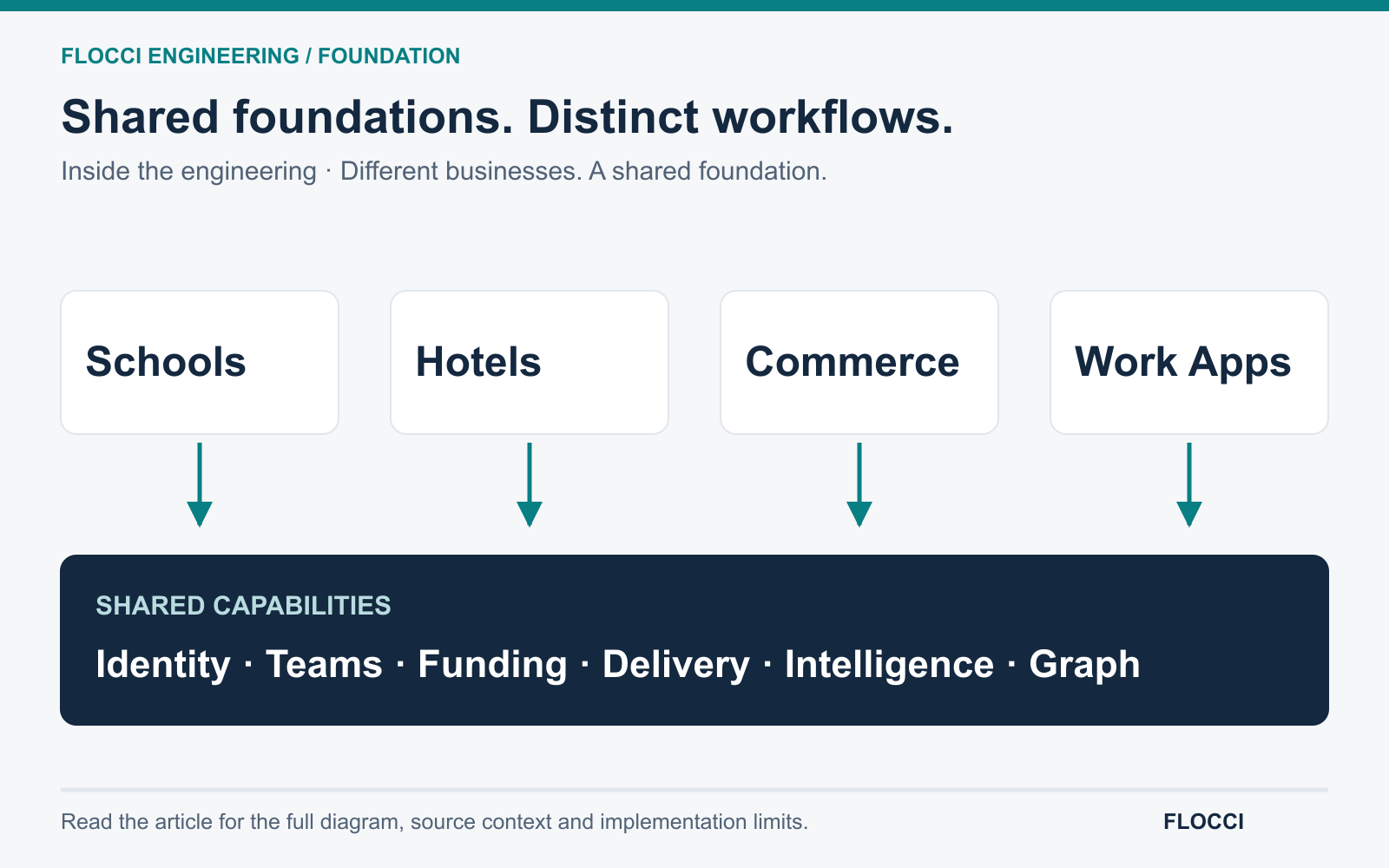
Inside Flocci: The Shared Foundation Beneath Very Different Businesses
How Flocci connects specialized business products through reusable identity, spending, delivery and intelligence while preserving distinct workflows.
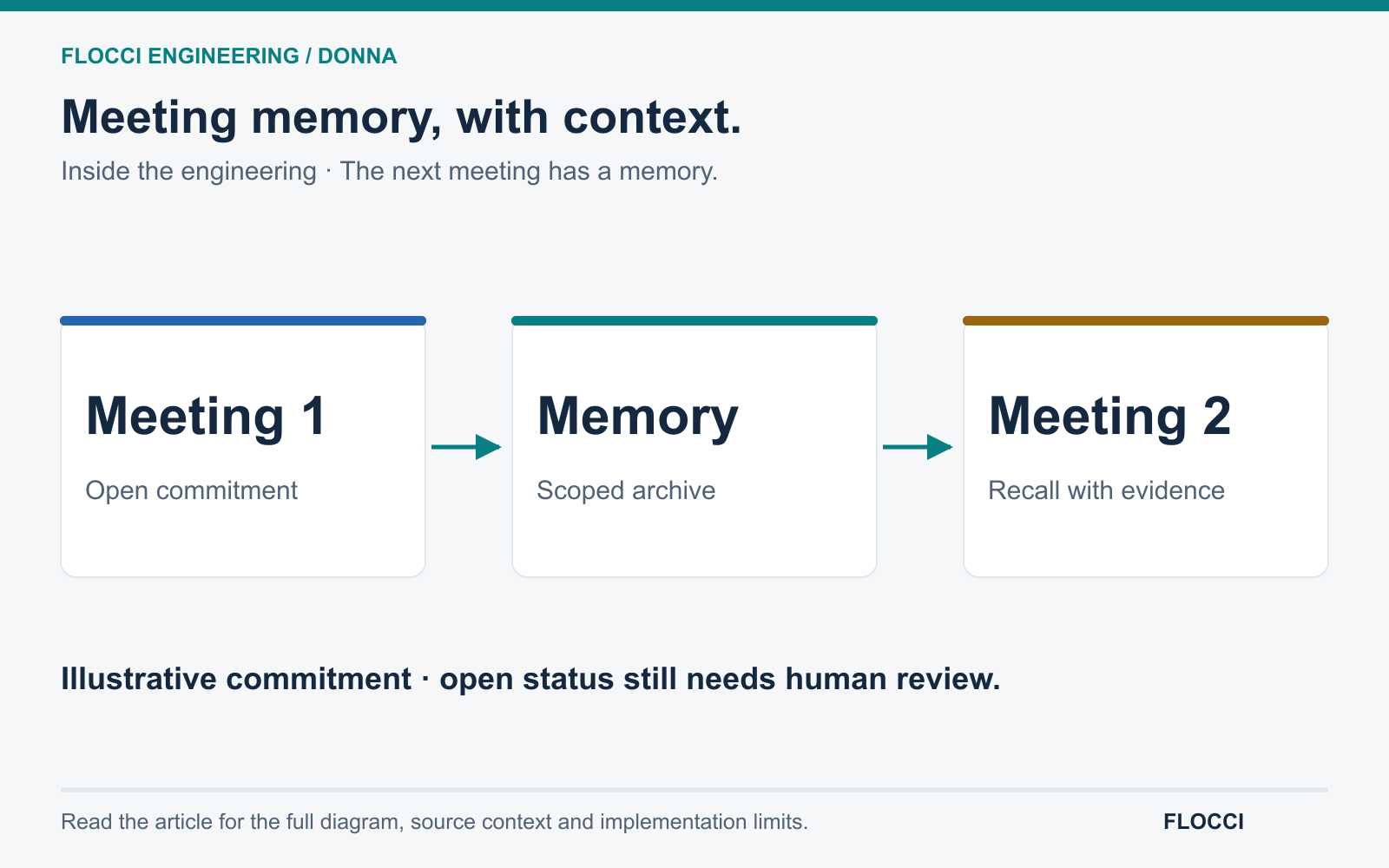
The Meeting Ends. The Commitments Stay: Inside Flocci Donna's Memory
Donna brings unresolved commitments and earlier questions into later meeting analysis, giving recurring conversations a memory with context and evidence.
/* Comments */
Comments are offline right now — we reconnect automatically, nothing is lost.