
On this page
NVIDIA’s November 13 cuDLA walkthrough exposes a Python binding for running Deep Learning Accelerator (DLA) loadables on Jetson AGX Orin. It is a useful change in ergonomics, but the important boundary remains: Python orchestrates an engine that has already been compiled for the supported DLA target. This is not a general Python model runtime on the accelerator. [1]
From network to submitted work
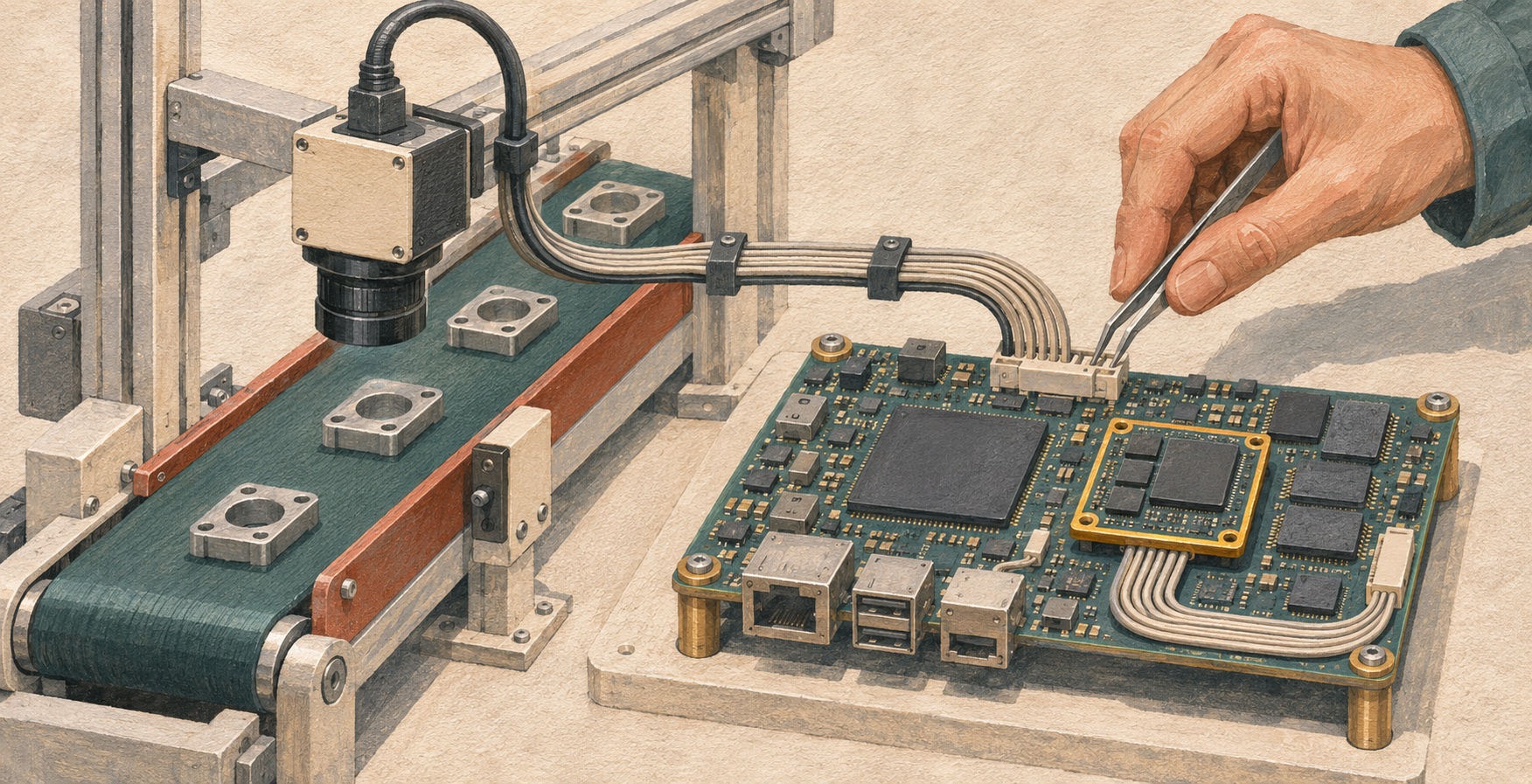
The documented flow starts with a TensorRT network and a DLA-compatible build. The application loads the resulting loadable, queries tensor descriptors, allocates device buffers, registers those buffers with cuDLA, copies inputs, and submits work on a CUDA stream. It then synchronizes and reads outputs. Hybrid mode allows work unsupported by DLA to use the GPU, subject to the engine’s build configuration and fallback rules.
That sequence makes the interface accessible while leaving deployment engineering intact. Operators must validate tensor formats, dimensions, alignment, memory lifetime, stream ordering, and synchronization. Buffer registration and copies can erase the expected latency benefit if the application moves data unnecessarily. Measure end-to-end latency, including preprocessing and transfer, instead of timing only accelerator execution.
Partitioning is a model property
DLA supports a constrained set of layers and configurations. An engine that does not fit those capabilities may fail to build or require GPU fallback. Fallback can preserve functionality, but it changes power, latency, and contention behavior. A production test should inspect the compiled engine and confirm which layers execute on which processor. It should also exercise the actual input shapes and concurrency expected in the field.
NVIDIA’s post targets a specific software baseline, including TensorRT 11.4.1, CUDA 13.4 Update 1, and JetPack 7.2.2 or later. Treat those versions as part of the recipe, not an interchangeable detail. Upgrade testing should rebuild the engine and repeat correctness and performance checks.
The contribution is a lower-friction control path for DLA inference. The hard questions remain model coverage, memory movement, fallback placement, and sustained system behavior on the deployed device.
Treat compilation output as part of deployment
A successful Python call only proves that the application could submit work. It does not prove that the intended layers ran on DLA. Keep the TensorRT build log and inspect the engine’s layer placement, precision, and fallback decisions. A build may be valid while some operations are assigned to the GPU. That hybrid path can be exactly what the application needs, but it should be understood rather than inferred from an API name.
For every supported input profile, validate output correctness against the GPU or CPU reference with task-appropriate tolerances. Test boundary dimensions and batches, not only the sample shape in a tutorial. Exercise buffer lifetime and stream behavior under repeated inference; asynchronous execution can expose races that a single synchronized example will not. Measure both cold-start and warmed execution, since engine loading and memory registration affect startup behavior differently from steady-state throughput.
A useful deployment record contains the ONNX or source model version, TensorRT build flags, DLA core assignment, engine checksum, fallback report, JetPack and CUDA versions, and power mode. If an upgrade changes any of these, rebuild and rerun correctness tests. Device power and cooling also matter: a bench result in a powered lab is not automatically representative of a sealed enclosure beside a camera.
This distinction is especially relevant to edge systems that combine accelerators. Our edge NPU deployment coverage discusses the wider integration problem; cuDLA adds another target whose supported graph and runtime path must be verified independently.
Separate graph eligibility from runtime orchestration
The interface makes submitting compiled work from Python more convenient, but it does not make graph support dynamic. An operator may compile differently depending on data type, tensor dimensions, layout, or TensorRT version. Keep representative engine builds in continuous integration and inspect their layer placement after every model or software change. If an engine moves more work to GPU fallback, a latency regression may otherwise appear only after deployment.
When measuring, collect power and thermals alongside latency. DLA can reduce competition for GPU compute, yet camera ingest, resize, normalization, and postprocessing may still consume GPU or CPU resources. Run the full camera-to-decision path at realistic frame rate, with the device enclosed and operating at the intended power mode. Related edge accelerator integration coverage discusses why compiler, runtime, and application boundaries matter on constrained devices.
Frequently asked questions
Can cuDLA run any Python model directly on the DLA?
No. Python provides orchestration around a compiled DLA loadable. TensorRT build support, layer coverage, tensor formats, and fallback behavior determine what executes on DLA.
Why can GPU fallback change performance?
Unsupported portions may execute on the GPU and contend with other work. It can preserve a supported execution path while changing latency, power use, and resource isolation.
How should an edge deployment be benchmarked?
Measure end-to-end latency, copies, preprocessing, synchronization, power, and sustained thermals on the target Jetson software and input shapes.
Sources & further reading
Keep reading

cuBLAS FP64 Algorithms: Trading Extra Products for Faster Scientific GEMM
Ozaki-II and 2M complex multiplication add algorithmic paths to cuBLAS; their speedups depend on precision, shape, and hardware.
Serving GLM-5.3 Across Two DGX Stations: Where vLLM's Distributed Path Gets Hard
A technical look at tensor parallelism, RDMA, KV-cache precision, and the limits of NVIDIA's two-station GLM-5.3 benchmark.

Why Blackwell Attention Can Hit the Softmax Wall Before FP4 Peaks
A new Blackwell kernel paper shows why low-precision matrix throughput can be stranded by quantization, softmax and data movement in long-context attention.
/* Comments */
Comments are offline right now — we reconnect automatically, nothing is lost.