
Monolith vs Microservices vs Serverless: Architectural Trade-Offs and Real Costs
Compare monolithic, microservices, and serverless architectures across team velocity, operational costs, network latency, and deployment boundaries.
On this page
Every engineering organization eventually faces the architecture crossroads: Should we deploy a single unified monolith, decompose capabilities into fine-grained microservices, or run ephemeral event-driven serverless functions?
Industry discourse often treats these three patterns as an evolutionary ladder, suggesting that mature engineering teams naturally graduate from monoliths to microservices, and ultimately to serverless. In production, this progression is fundamentally false. Each pattern represents an explicit exchange of one category of engineering friction for another.
A monolith trades deploy independence for simplicity and zero-latency function calls. Microservices trade operational simplicity for team autonomy and bounded scaling, while introducing complex network boundaries and distributed transactions. Serverless trades runtime control and cost predictability for automated scaling and zero maintenance overhead.
This guide provides a rigorous architectural evaluation of all three models, examining real operational limits, hidden financial costs, and how leading tech companies run hybrid architectures in production.
The Three Paradigms Side by Side
To evaluate these architectures objectively, consider how each paradigm handles the three fundamental primitives of software systems: execution environment, state persistence, and inter-component communication.
┌────────────────────────────────────────────────────────────────────────┐
│                          1. Monolithic Architecture                    │
│                                                                        │
│   ┌──────────────────────────────────────────────────────────────┐     │
│   │ Monolithic Application Binary (e.g., Rails, Django, Go)      │     │
│   │                                                              │     │
│   │  ┌──────────────┐   ┌──────────────┐   ┌──────────────┐      │     │
│   │  │ Auth Module  │◄─►│ Billing Mod  │◄─►│ Analytics    │      │     │
│   │  └──────────────┘   └──────────────┘   └──────────────┘      │     │
│   │         ▲                  ▲                  ▲              │     │
│   │         └──────────────────┼──────────────────┘              │     │
│   │               In-Memory Calls (Nanoseconds)                  │     │
│   └────────────────────────────┬─────────────────────────────────┘     │
│                                │ Direct ACID Connections               │
│                                ▼                                       │
│                 ┌─────────────────────────────┐                        │
│                 │ Single Primary Database     │                        │
│                 └─────────────────────────────┘                        │
└────────────────────────────────────────────────────────────────────────┘

┌────────────────────────────────────────────────────────────────────────┐
│                        2. Microservices Architecture                   │
│                                                                        │
│   ┌──────────────┐         ┌──────────────┐         ┌──────────────┐   │
│   │ Auth Service │◄───gRPC─► Billing Svc  │◄───gRPC─► Analytics Svc│   │
│   └──────┬───────┘         └──────┬───────┘         └──────┬───────┘   │
│          │                        │                        │           │
│          ▼                        ▼                        ▼           │
│   ┌──────────────┐         ┌──────────────┐         ┌──────────────┐   │
│   │ Auth Database│         │ Billing DB   │         │ Analytics DB │   │
│   └──────────────┘         └──────────────┘         └──────────────┘   │
│                  Service Mesh (Istio / Envoy / mTLS)                   │
└────────────────────────────────────────────────────────────────────────┘

┌────────────────────────────────────────────────────────────────────────┐
│                          3. Serverless Architecture                    │
│                                                                        │
│   API Gateway ──► [ Function 1 ] ──► EventBridge ──► [ Function 2 ]    │
│   (HTTP Route)    (Ephemeral Exec)  (Async Bus)     (Ephemeral Exec)   │
│                          │                                 │           │
│                          ▼                                 ▼           │
│                   Managed NoSQL                     Managed Object     │
│                   (DynamoDB / S3)                   Storage (S3)       │
└────────────────────────────────────────────────────────────────────────┘
Detailed Architectural Comparison
| Dimension | Monolith | Microservices | Serverless |
|---|---|---|---|
| Component Communication | In-memory function calls (under 1 microsecond). | Network RPC/gRPC/HTTP (1 to 10 milliseconds). | Event bus, queues, or HTTP triggers (10 to 100 ms). |
| Data Consistency | ACID transactions across tables; single DB. | Eventual consistency; Saga pattern or 2PC across DBs. | Eventual consistency; DynamoDB transactions or S3 events. |
| Operational Complexity | Low: single deploy script, single process monitor. | Very High: Kubernetes, Envoy mesh, distributed tracing. | Moderate: managed infrastructure, but complex IAM and state. |
| Scaling Characteristics | Scale entire binary horizontally (vertical limits). | Scale individual bottleneck services independently. | Automatic zero-to-thousands horizontal concurrency. |
| Cold Start Latency | None: processes remain warm in memory. | None: persistent containers remain warm. | 50 to 2,000 ms depending on runtime, VPC, and memory. |
| Failure Blast Radius | High: memory leak or OOM in one module crashes all. | Low: failure in analytics does not halt billing. | Extremely Low: failures isolated to individual invocations. |
| Infrastructure Cost | Predictable baseline: fixed VM or bare-metal cost. | High baseline: cluster overhead, mesh proxies, nodes. | Pay-per-invocation (cheap at low/bursty load; expensive at scale). |
Monolith: The Productivity Standard
A monolith packages all business capabilities into a single codebase and deploys them as a single executable artifact.
Strengths
- Zero Network Serialization: Invoking another module is a pointer dereference or stack push. There is no JSON serialization, HTTP parsing, TLS handshake, or socket timeout.
- Atomic Refactoring: Renaming a domain entity or updating a method signature is verified at compile-time across the entire application in a single Git commit.
- Trivial Observability: A stack trace contains the entire call path from HTTP controller to SQL query execution without requiring OpenTelemetry trace context stitching.
Failure Modes
- Blast Radius Propagation: A single memory leak or infinite loop in a low-priority background reporting module can exhaust JVM heap or Node.js CPU cycles, taking down critical checkout endpoints.
- Deployment Serialization: In teams with 200+ developers, merge conflicts and deployment queue contention slow down release frequency.
Engineering Principle: A modular monolith (with strict package boundaries, separate domain schemas, and zero circular dependencies) solves 90% of team coordination issues without incurring distributed systems overhead.
Microservices: Independence at the Cost of Distributed Systems
Microservices decompose a system along business domain boundaries (Domain-Driven Design bounded contexts), where each service owns its codebase, deployment pipeline, and persistent data store.
Strengths
- Independent Team Cadence: The payments team can deploy five times a day without coordinating with the inventory or recommendations teams.
- Targeted Resource Allocation: A video transcoding service can be provisioned with GPU nodes while an auth service runs on high-memory compute instances.
- Failure Isolation: If the recommendations cluster crashes under load, users can still view product pages and complete orders.
The Hidden Tax
Decomposing a monolith into microservices turns in-memory calls into unreliable distributed network calls:
- Network Latency Inflation: A call tree that traversed four modules in 0.2 ms now incurs 4 network round trips, serializations, and proxy traversals, adding 15 to 40 ms.
- The Dual-Write Problem: Updating two distinct databases without distributed two-phase commit (2PC) requires implementing outbox tables, change-data-capture (CDC) pipelines, and idempotent consumers.
- Infrastructure Overhead: You must now operate Envoy sidecars, Kubernetes ingress controllers, Jaeger/Tempo distributed tracing, and Prometheus metrics aggregators.
Serverless: Ephemeral Compute with Boundary Constraints
Serverless abstracts the operating system, container runtime, and host provisioning. Code executes in ephemeral micro-VMs (such as AWS Firecracker) that spin up in response to events and terminate after completion.
Strengths
- Zero Idle Capacity Cost: If an internal administrative webhook is invoked only four times a week, you pay exactly for four fractions of a second.
- Instant Elasticity: A sudden spike of 10,000 concurrent webhooks spawns 10,000 isolated execution environments automatically without waiting for auto-scaling group warmups.
- No OS Patching: The cloud vendor handles Linux kernel updates, security patches, and physical node lifecycle.
Critical Limitations
- Cold Starts: When traffic scales from zero or triggers a new instance, downloading code and initializing runtimes adds latency (50 ms for Go/Rust, 300 to 1,500 ms for Java/C#).
- Relational Database Connection Exhaustion: Relational databases like PostgreSQL allocate memory per connection. If 5,000 Lambda functions execute concurrently, they can easily exhaust database connection limits, requiring intermediary pooling solutions like AWS RDS Proxy or PgBouncer.
- Execution Time Caps: Functions cannot run longer than fixed provider limits (e.g., 15 minutes on AWS Lambda), ruling out long-lived batch computations.
Production Hybrid Architecture
In reality, top-tier engineering organizations rarely run a purely dogmatic architecture. The most common battle-tested model is a core modular monolith surrounded by targeted services and serverless triggers:
┌────────────────────────────────────────────────────────┐
│                   Public Clients                       │
└──────────────────────────┬─────────────────────────────┘
                           │
                           ▼
┌────────────────────────────────────────────────────────┐
│                   Edge API Gateway                     │
└──────────────┬───────────────────────────┬─────────────┘
               │                           │
               ▼                           ▼
┌──────────────────────────────┐  ┌──────────────────────┐
│     Core Modular Monolith    │  │  Ephemeral Webhooks  │
│  - User Authentication       │  │  (Serverless Lambdas)│
│  - Core Checkout & Accounts  │  │  - Stripe Webhooks   │
│  - Relational PostgreSQL DB  │  │  - Slack Bot Events  │
└──────────────┬───────────────┘  └──────────────────────┘
               │
               ▼ Domain Events (Kafka / SQS)
┌────────────────────────────────────────────────────────┐
│          Specialized Microservices                     │
│  - Video Transcoding Service (GPU Nodes)               │
│  - Recommendation Engine (Vector DB / Python Embeddings)
└────────────────────────────────────────────────────────┘
The Architectural Decision Checklist
- Team Size: Under 25 engineers? Start with a well-structured modular monolith. Introducing microservices prematurely slows feature velocity.
- Domain Boundaries: Are bounded contexts clearly understood? Splitting services before domain boundaries stabilize leads to distributed monoliths where every change touches multiple repos.
- Execution Pattern: Is the workload bursty, event-driven, and stateless? Use serverless. Is it a high-throughput, steady-state HTTP service? Persistent containerized instances are cheaper and offer lower latency.
- Data Consistency: Does the operation require strict ACID guarantees? Keep related tables in the same relational database within a modular monolith.
Keep reading
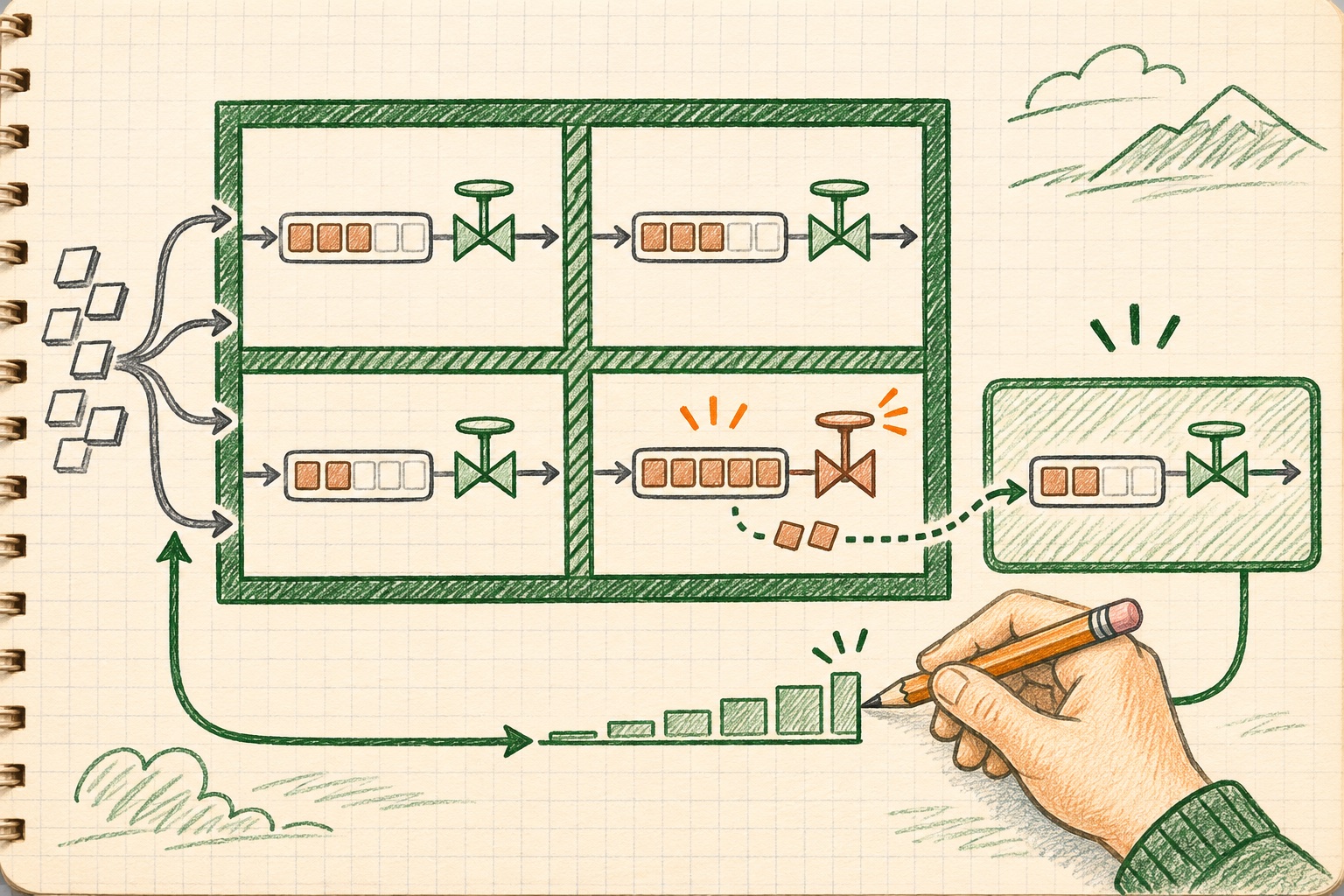
Designing Gateways That Fail Without Taking the Fleet Down
A technical blueprint for gateway overload control: N-1 capacity, bounded queues, load shedding, isolated failover and controlled recovery.
How Airbnb Shipped 20+ Local Payment Methods in 360 Days: Config-Driven Domain Architecture
Inside Airbnb's payments replatforming: shipping 20+ Local Payment Methods (LPMs) across 75 global markets in under 360 days using config-driven architecture.
Database Performance is a Trade-Off Ledger: The Hidden Costs of Indexing, Caching, and Sharding
Why every database optimization creates a new liability: the hidden write costs of B-tree indexes, caching stale reads, and sharding operational taxes.
/* Comments */
Comments are offline right now — we reconnect automatically, nothing is lost.