
NASA's Moon Base Is Becoming a Delivery Network, One Rover at a Time
NASA's November awards connect landers, cargo transfer, power and a nuclear rover. The hard problem is making those missions work as one lunar logistics system.
On this page
A rover can be built and still be stranded by a missing ride, a dark landing site or a radio link that cannot reach home. NASA’s latest Moon Base announcement matters because it treats those as connected problems. The headline rover is only one part of a longer delivery chain.
What NASA announced
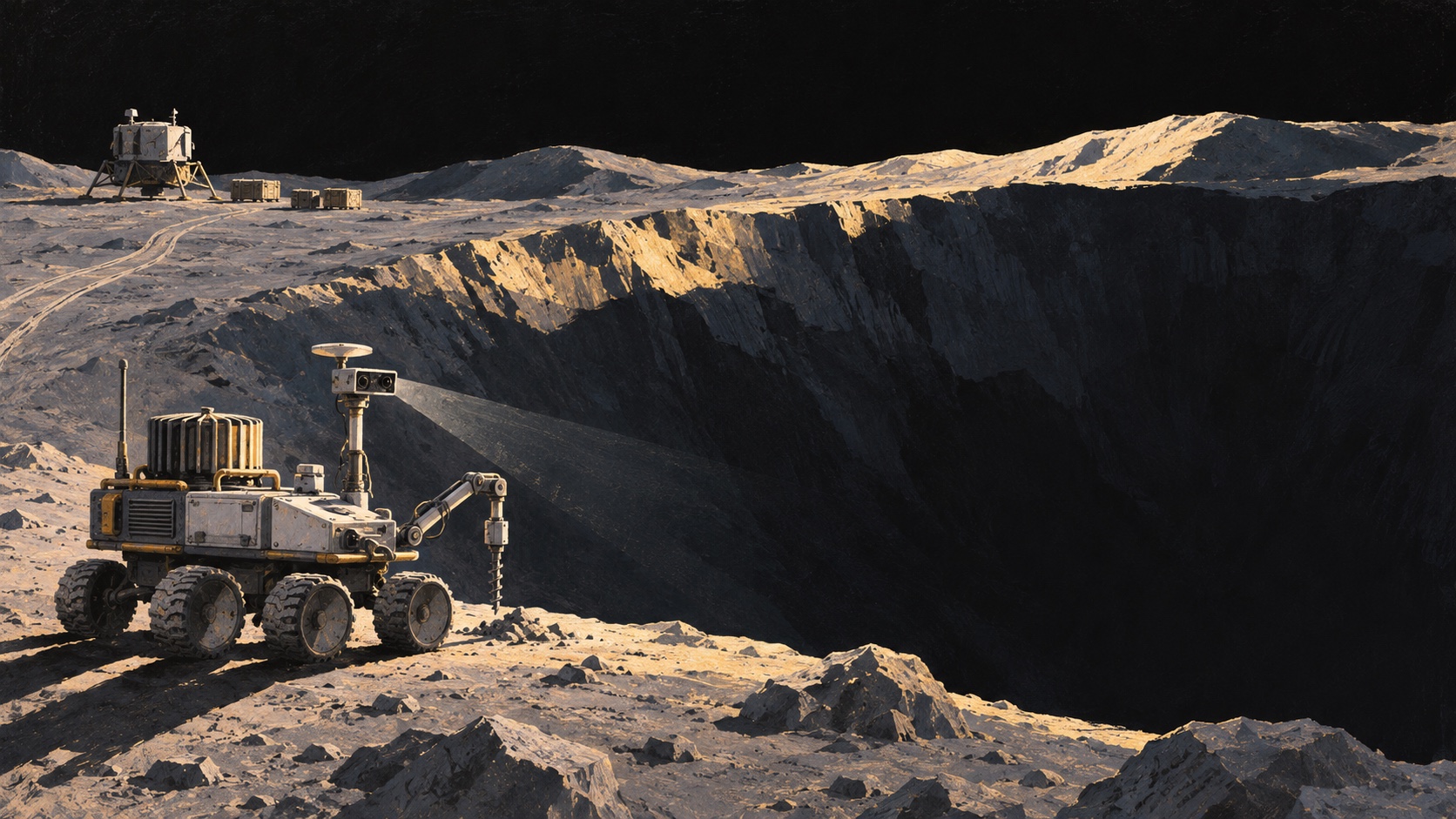
On November 7, NASA described new awards and mission updates for its Moon Base program. The most visible is PROMISE, short for Polar Rover for Observation, Mapping, and In-Situ Exploration: a planned six-wheeled, nuclear-powered rover intended to study the lunar south pole. NASA says it would drill roughly one metre into regolith, assess resources, and carry instruments for composition, temperature and radiation measurements. The agency is targeting a late-2028 launch and an 18-month mission; those are plans, not completed milestones. [1] [2]
PROMISE is designed to work in long lunar nights and permanently shadowed regions, where sunlight is scarce or absent. Its power source is a radioisotope generator, not a small fission reactor. NASA’s announcement describes a rover using a long-lived heat source to provide electrical power, not a surface nuclear power plant. [2]
NASA also named eight companies eligible to compete for future lunar delivery missions under the next Commercial Lunar Payload Services framework, CLPS 2. Its 10-year, multiple-award contract has a combined maximum value of $10 billion. A ceiling on an indefinite-delivery contract is not a cheque written on announcement day, and selection does not guarantee each company an order. NASA separately increased CLPS 1.0’s value from $2.6 billion to $4.2 billion. [1]
Think of it as freight, not a base
The useful mental model is a logistics network with several handoffs. A launch vehicle gets cargo into space. An orbital transfer vehicle can move loads through cislunar space. A lander handles the final descent. Then rovers, drones and crews have to move the payload where it is useful.
NASA’s update groups VADR task orders around launch and in-space transportation demonstrations. Some are intended to test navigation and communications between Earth orbit and the Moon; another mission type would scout the south-pole surface with mobile drones. A rover that reaches the Moon still needs communication, navigation, a safe route and infrastructure to interact with. [1]
The agency also described miniCAST, a planned communications and solar tower assembled from commercial components for power and communications. Initial work is component development and testing; NASA says a separate solicitation for fully integrated power systems is anticipated in early 2027. A collection of batteries, arrays and wireless power hardware is not yet a lunar power grid. [1]
NASA’s phased plan makes the sequence explicit: early robotic missions experiment, learn and prepare for later surface operations. Read the awards as steps toward a system that still has integration and operating risks, not proof that the system is complete. [3]
Why reuse Mars hardware?
NASA says JPL will build PROMISE using spare flight components and engineering test models from Curiosity and Perseverance. Reusing designs and operations experience can shorten development. But the lunar south pole has different gravity, dust behavior, terrain, lighting and thermal conditions from Mars.
The rover must survive those conditions while carrying a drill, spectrometers, sensors and a computing demonstration. NASA says it assessed hardware compatibility with the lunar environment, but the plan still depends on integration, testing, launch services and delivery. Reuse manages risk; it does not replace testing of the destination-specific configuration. [1] [2]
Read the contract numbers carefully
NASA’s release contains figures tied to different mechanisms. The $10 billion CLPS 2 amount is the maximum value of a 10-year framework. The agency says it awarded Blue Origin a $94 million base contract for PROMISE delivery, with an additional $140 million option tied to performance. It also describes about $1.3 billion in VADR task orders under a broader contract with a $5 billion maximum. These are not interchangeable measures of money spent, hardware delivered or mission success. [1]
For any future announcement, ask: Is this an eligibility pool, task order or funded mission? Is the figure a base award, option or ceiling? What is the next observable milestone—design review, hardware test, launch, landing or operational data? Those distinctions keep procurement from being mistaken for capability.
What comes next?
Watch for the separate power-systems solicitation, details about payload and transfer missions, and technical milestones for PROMISE’s late-2028 target. The challenge is to turn separate vehicles and components into interoperable services. Power, timing, navigation, thermal limits, communications and surface operations have to line up across suppliers.
These dependencies are familiar from other satellite systems: our coverage of NTT and Safran’s optical ground network examines how the link between spacecraft and ground stations shapes the service. For a broader view of automation’s human and operational side, see our robot adoption explainer.
That is the story behind a “Moon Base” built mission by mission. The first durable capability may look less like a habitat and more like a reliable chain that delivers a rover, keeps it alive through darkness and returns useful measurements. The chain is taking shape in contracts and plans. It still has to work on the Moon.
Frequently asked questions
Did NASA award $10 billion directly to eight Moon Base companies?
No. NASA selected eight companies as eligible to compete for future deliveries under a 10-year CLPS 2 contract with a combined maximum value of $10 billion. That ceiling is not an amount already spent or a guaranteed award to each provider.
When could the PROMISE rover reach the Moon?
NASA says it is targeting a late-2028 launch for PROMISE and plans an 18-month mission. The rover is still a planned mission, so the target should not be treated as a completed launch or guaranteed arrival date.
Why does NASA want a nuclear-powered rover near the lunar south pole?
A radioisotope power source can provide continuous heat and electricity through long lunar nights and in permanently shadowed areas. That makes it useful for prospecting and testing places where sunlight-dependent systems have limits.
Sources & further reading
Keep reading

Chrome 155's October Stable Updates: Check Your Browser Version
Google's October 13 Chrome 155 stable notice listed critical and high-severity fixes; a follow-up stable build arrived October 15. Check and restart Chrome.
Anthropic Offers Free AI Security Scans. Maintainers Still Face the Hard Part
Anthropic’s opt-in scanner may surface possible open-source flaws, but validation and remediation remain human work.
Apertus 1.5 Puts More of the AI Recipe in Public View
Apertus 1.5 documents open multimodal models and intermediate checkpoints, while its release notes clarify when weights actually appeared.
/* Comments */
Comments are offline right now — we reconnect automatically, nothing is lost.