Optimistic UI: The Illusion of Instant
Apply mutations locally and reconcile in the background, collapsing perceived latency from 150 ms to instant. Rollback, idempotency keys, offline queues.
On this page
A WhatsApp message appears in your chat 50 milliseconds after you press send. Your brain never suspects that the message is still traveling to Facebook’s servers, where it will be logged, deduplicated, and broadcast to the recipient—the server round-trip takes 150–300 ms. What you see is not reality; it’s an illusion built on a lie the client told itself. That lie, executed correctly, is the difference between a responsive app and a frustrating one.
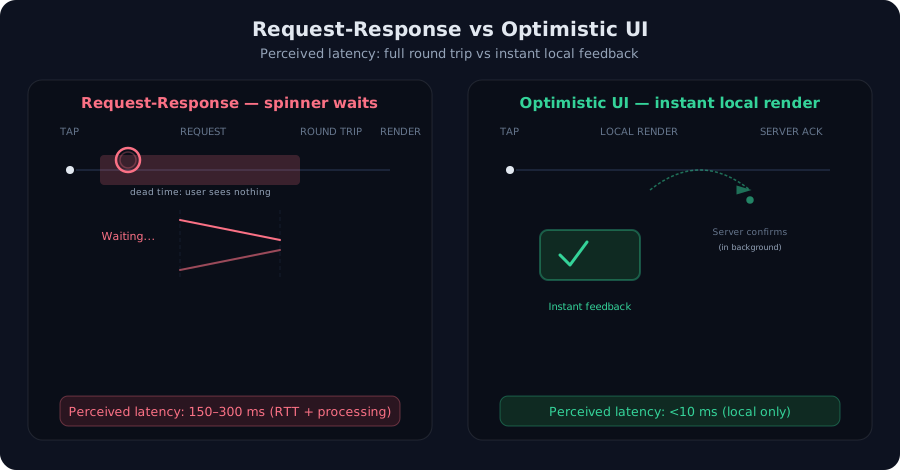 Left: request-response UIs wait for the server, blocking the user with a spinner. Right: optimistic UI applies the change instantly to local state and reconciles in the background.
The Naive Way: Request-Response Blocking
Every HTTP API call follows a simple contract: send a request, block on the response, then update the UI with the result. For reading data, this is sane—you need the server’s truth. For mutations (create, update, delete), it creates a gap.
When a user sends a message in a request-response UI, the flow is:
- Tap send
- Show spinner
- POST
/api/messageswith the message body - Wait 150–300 ms for the server to acknowledge
- Hide spinner, render the message
That 150–300 ms round-trip feels like an eternity on mobile. It’s enough time for the user’s hand to drift away from the screen, the app to lose focus, the thought to dissolve. Networks are slow; servers are far away; latency is a tax you cannot negotiate around.
Or so we thought.
The Breakthrough: Local Optimism
Optimistic UI inverts the order:
- Tap send
- Apply the mutation to local state immediately
- POST
/api/messagesin the background - Await server ACK (no blocking)
- If the server says OK, do nothing—local state already has the change
- If the server rejects, rollback and queue the mutation for retry
The user sees the message appear instantly because we assumed the server would accept it. In practice, the server almost always does—WiFi doesn’t fail, the API doesn’t reject valid input, the database doesn’t explode. The assumption is usually sound. When it isn’t, rollback hides the lie.
This is the core trade: you gain perceived speed by risking temporary inconsistency. The local view can diverge from the server’s truth for a few hundred milliseconds. A skilled UI handles that window so smoothly that users never notice it existed.
How It Works: The Mechanism
Step 1: Optimistic State Update
The moment the user presses send, the app updates its in-memory state (React state, Redux store, Solid signal, etc.) with the new message. No network call yet. The UI re-renders. The user sees the message.
// Pseudocode
const sendMessage = (text) => {
  const message = { id: 'temp-' + Date.now(), text, pending: true };
  setMessages([...messages, message]); // optimistic update

  // Network request starts now, doesn't block rendering
  postMessage(message).then(
    (response) => {
      // Server accepted; swap temp ID for real one
      updateMessage(message.id, { id: response.id, pending: false });
    },
    (error) => {
      // Server rejected; rollback
      removeMessage(message.id);
      showErrorToast(`Failed to send: ${error.message}`);
      enqueueForRetry(message);
    }
  );
};
Step 2: Idempotency Keys and Deduplication
The network is unreliable. A request might succeed on the server but the response gets dropped before it reaches the client. If the client retries blindly, the mutation executes twice: two messages, two charges, two database inserts.
To prevent this, attach an idempotency key to every mutation:
const message = {
  id: 'temp-' + Date.now(),
  text,
  idempotencyKey: generateUUID() + '-' + Date.now()
};
The server stores a mapping from idempotency key → result. When a retry arrives with the same key, it returns the cached result instead of re-executing:
- First request:
POST /messages { text: "hi", idempotencyKey: "abc-123" }→ server writes, returns id: 42 - Network dies
- Retry:
POST /messages { text: "hi", idempotencyKey: "abc-123" }→ server sees key exists, returns cached id: 42 - No duplicate insert
This pattern is so important that Stripe, GitHub, and Amazon all mandate it in their APIs. It’s the glue that makes optimistic UI safe.
Step 3: Handling Rejections and Offline State
If the server rejects the mutation (auth error, validation failure, server outage), rollback the local state and queue the mutation:
const queue = [
  { message, idempotencyKey: 'abc-123', retryCount: 0, enqueuedAt: Date.now() }
];

// When connectivity returns or backoff timer fires:
queue.forEach(async (item) => {
  try {
    await postMessage(item.message, { idempotencyKey: item.idempotencyKey });
    queue.shift(); // remove on success
  } catch (error) {
    item.retryCount++;
    // exponential backoff: 1s, 2s, 4s, 8s, ...
    setTimeout(() => retry(item), Math.pow(2, item.retryCount) * 1000);
  }
});
The queue persists in localStorage (or IndexedDB for large blobs) so it survives app restarts. If the user closes and reopens the app while offline, those pending messages are still waiting to be sent.
Step 4: Ordering and Dependent Mutations
If a mutation depends on the result of a previous one (e.g., “create a post, then add a tag”), the queue must replay them in order. Parallel retries break this contract.
A simple FIFO queue handles this: each item waits for the previous one’s ACK before starting. It’s slightly slower than parallelism, but correctness is the hard requirement.
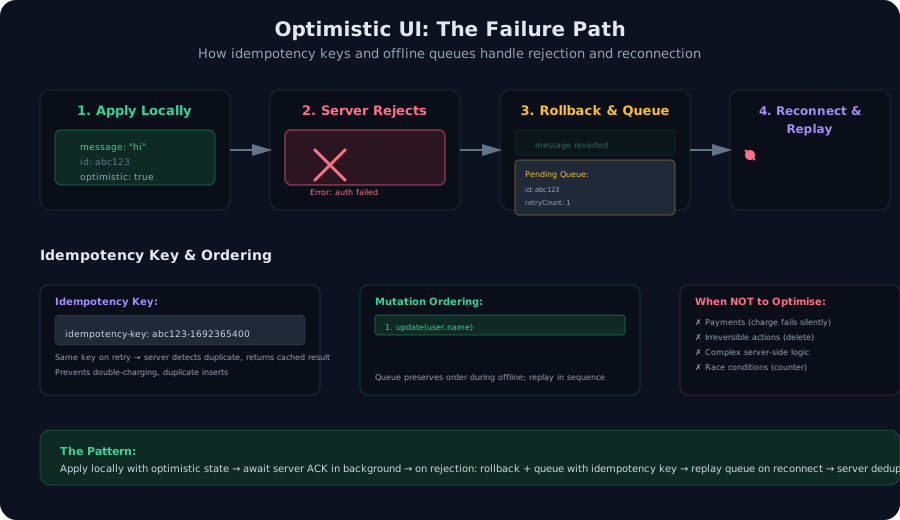 Top: the four-stage failure path. Bottom: idempotency keys ensure deduplication; ordering queues preserve causality; pessimistic patterns for payments and deletes.
When Optimism Is Wrong
Not every mutation is optimistic. Some actions are so risky that you cannot afford the lag between the local lie and the server’s truth.
Payments: If you optimistically deduct from a user’s wallet before the charge is confirmed and the charge then fails, the wallet is empty but the money never left. Refunding is complex and error-prone. Charge-first, debit-second is the safe order. Show a clear “charging” state; don’t pretend money has left the account until it has.
Irreversible deletes: A soft delete (moving to trash, with undo) can be optimistic. A hard delete (permanent removal) should never be. Rollback is impossible once the data is gone. Ask for confirmation, show a countdown timer before the deletion goes live, and keep a server-side grace period for recovery.
High-contention operations: If multiple clients are incrementing the same counter, optimistic updates will diverge. The server becomes the source of truth. Each client’s optimistic increment is wrong as soon as another client’s increment arrives. These operations need request-response blocking or a conflict-resolution protocol (like vector clocks or operational transformation).
Complex validation: If the server’s validation logic is deep (checking business rules, querying related tables, running expensive checks), the client cannot accurately predict whether the request will pass. Optimism becomes guesswork. Use request-response with clear error feedback instead.
The Trade-Off: Perceived vs Actual Latency
Optimistic UI does not reduce actual latency—the server round-trip is unchanged. It reduces perceived latency by decoupling the user’s feedback from the server’s acknowledgment. The trade-off is:
- Gain: Instant feedback, better perceived performance, happier users
- Loss: Brief window of inconsistency, rollback complexity, offline queue management, more code to maintain
For most mutations (message sends, form submissions, toggles), the window is so small and rejections are so rare that the gain far outweighs the loss. For payments and deletes, the reverse is true.
Conclusion
Optimistic UI is not a trick or a hack—it’s a deliberate trade between consistency and responsiveness, and every modern app that feels snappy is built on it. Implement it carefully: idempotency keys prevent double-writes, ordered queues preserve causality, and rollback hides the lie when the server disagrees. Know when to turn it off. And remember: the user’s sense of a responsive app is not the server’s latency. It’s the gap between their tap and the first pixel that moves.
Frequently asked questions
What is optimistic UI execution and why is perceived latency different from actual latency?
Optimistic UI applies a mutation to local state immediately and awaits server confirmation in the background. Perceived latency is instant (user sees the change right away), while actual latency is the round-trip time. Request-response UIs block and show a spinner, making both latencies the same. Optimistic UI trades accuracy risk (the server might reject) for responsiveness.
How does rollback work when the server rejects an optimistic mutation?
When the server responds with an error, the UI reverts the local state to its pre-mutation value, typically showing an error toast. The mutation is then queued with an idempotency key and retried when connectivity is restored or after a backoff delay. Users see a clear error message and the option to retry.
What is an idempotency key and why does it prevent double-charging or duplicate inserts?
An idempotency key is a unique identifier (usually a client-generated UUID plus timestamp) attached to every mutation. If the network fails after a successful server write but before the client receives the ACK, retrying with the same key tells the server 'I've already done this' and it returns the cached result instead of repeating the action.
How do you handle ordering when mutations are queued offline and replayed later?
Offline mutations are stored in a queue in the order they were attempted. When connectivity is restored, the queue replays sequentially, not in parallel. Each mutation waits for its server ACK before the next begins. This ensures dependent operations (e.g., create a post, then add a comment) complete in the correct order.
When is optimistic UI the wrong call and what should you use instead?
Avoid optimistic UI for payments (charge failures are irreversible), hard deletes (no undo), and any action with complex server-side validation that can fail unpredictably. Use request-response with clear feedback for these. Also skip it if the operation has race conditions (e.g., a shared counter) where the server's state is authoritative and changing rapidly.
/* Comments */
Comments are offline right now — we reconnect automatically, nothing is lost.