
Spotify’s Data Platform: From Event Collection to Managed Pipelines
Spotify explains how event instrumentation, anonymization, streaming and workflow tooling feed its analytics platform.
On this page
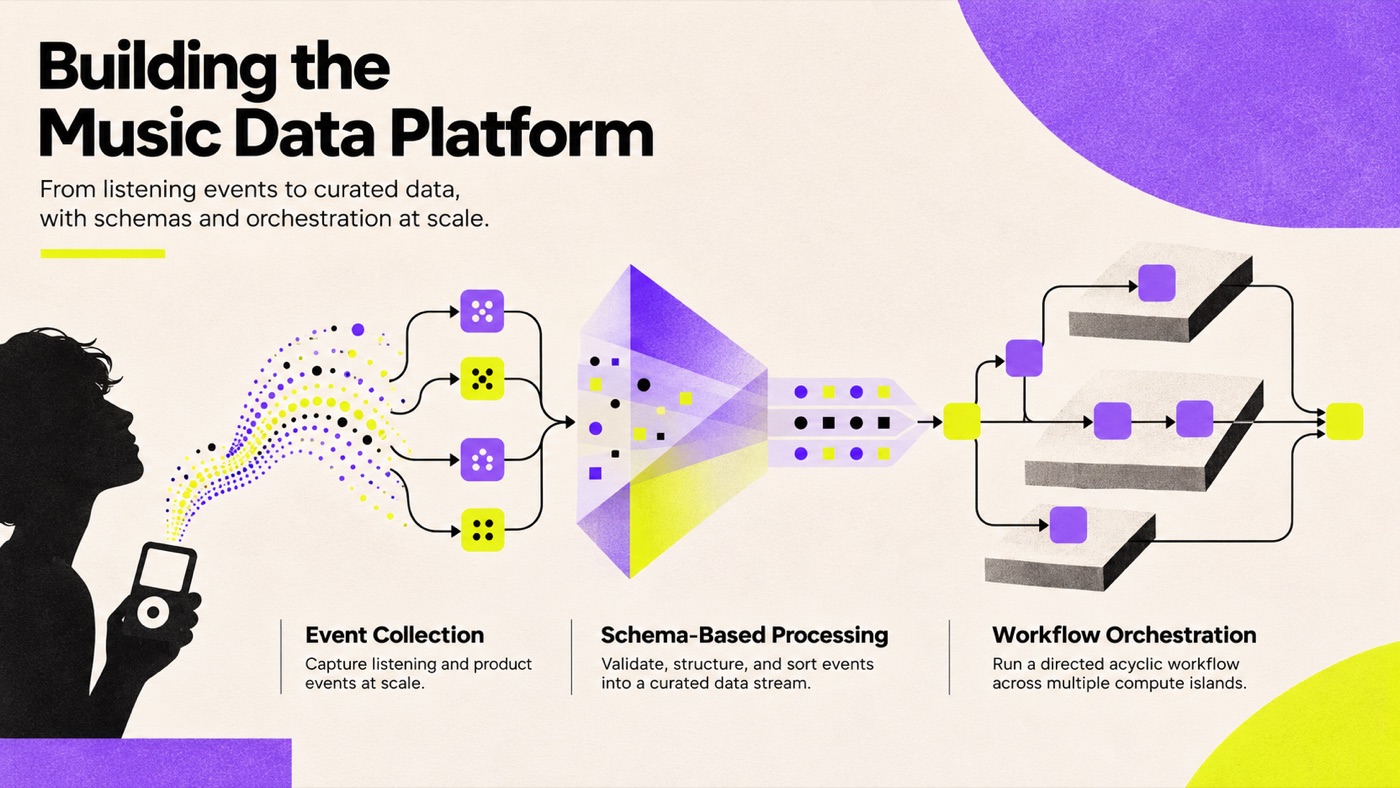
A large analytics platform starts before data reaches a warehouse. [1] Applications must define events, deliver them safely, remove or transform sensitive fields where required, and make the resulting data usable by teams who own different products.
Spotify’s engineering descriptions treat this as a platform made of connected stages rather than a single database. Its 2024 overview reports more than a trillion events per day and roughly 1,800 event types. Those are Spotify’s published scale figures. The same account discusses collection, anonymization, streaming jobs and workflow tooling; a 2021 migration post adds detail on changing event delivery while the service remained active.
Instrumentation is part of the contract
An event is useful only if its meaning and schema are understood by both producers and consumers. A platform can provide libraries and registration paths that help teams define event types consistently. This reduces bespoke ingestion work, but it does not eliminate the need to manage schema evolution and ownership.
At Spotify, collection feeds downstream processing where privacy-related transformations and other pipelines can be applied. The sequence matters: teams need to know what is collected, which transformations run, and what data is available to each consumer. The migration account emphasizes changing the delivery system without treating event producers as a small, isolated maintenance window.
Multiple execution systems, one developer path
Spotify describes using a mix of technologies [1] for different workloads, including Pub/Sub, Flink, Dataflow, BigQuery and Kubernetes. Its Scio API offers a Scala interface for Apache Beam jobs. The platform’s goal is not to make all computation identical; it is to give teams a supported way to build and operate pipelines across suitable execution engines.
Workflow orchestration and developer-facing abstractions are essential as the number of pipelines grows. The 2024 article reports more than 38,000 scheduled pipelines. A large catalog needs visibility into dependencies, ownership and operational state, or the apparent self-service quickly becomes a support burden.
Migration and reliability lessons
Replacing event-delivery infrastructure while producers continue to emit data is a compatibility problem. Teams need a migration plan that handles old and new paths, validates parity and controls the cutover. Availability, duplication and data completeness are separate properties; a successful migration should measure them rather than summarize everything as “exactly once.”
Spotify’s posts are useful because they expose the platform boundaries and operational concerns behind analytics scale. They do not imply that every company needs Spotify’s event volume or tool choices. The transferable lesson is to design event contracts, privacy transformations, execution and workflow ownership as one developer experience, then choose technology per workload.
Keep privacy and schema changes observable
A mature event platform needs a clear point where sensitive fields are removed or transformed and a way to prove which downstream datasets received the transformed event. That implies versioned schemas, data ownership, validation at ingestion, and monitoring for dropped or delayed events. A pipeline can be technically healthy while a producer silently changes the meaning of a field; contract checks should catch semantic changes as well as serialization errors.
Migration planning deserves the same rigor. During a delivery-system change, compare old and new paths over a bounded period using stable event identifiers where possible. Measure missing, duplicated and late records separately. If dual delivery is used, downstream jobs need a clear cutover rule so replayed data does not inflate aggregates. The Spotify migration story illustrates the operational shape of this work, while the platform overview describes the broader capabilities around it.
For teams adopting a similar model, begin with a few high-value event families. Publish owners, schemas, retention and privacy transformations in a catalog, then make pipeline health visible to both platform operators and data consumers. Self-service is successful when the safe path is understandable and failures have an accountable owner.
Frequently asked questions
How does Spotify describe its data platform?
Spotify’s platform article describes connected capabilities for event collection, anonymization, streaming, storage and workflow execution. It emphasizes giving product teams supported tools and abstractions to produce and consume data.
What tools appear in Spotify’s published architecture?
The articles describe technologies including Pub/Sub, Flink, Dataflow, BigQuery, Kubernetes and Scio. Different workloads use different tools; the posts should not be read as a single mandatory stack for every pipeline.
How many events does Spotify report handling?
Spotify’s 2024 platform article reports more than one trillion events per day and around 1,800 event types. These are publisher-reported scale figures from that article.
What is Scio?
Scio is Spotify’s Scala API for Apache Beam. It provides a higher-level programming interface for Beam pipelines, while Beam supplies the underlying unified batch and streaming model.
Sources & further reading
Keep reading
Inside Netflix’s Real-Time Graph: Kafka-to-Flink Ingestion at Scale
Netflix’s graph ingestion pipeline turns member events into deduplicated node and edge updates with Kafka, Flink and Data Mesh.

Zalando’s Delta Sharing Pilot: A Governed Path for Partner Data
Zalando documents a first implementation of Delta Sharing for partner insights, including governance and manual onboarding limits.

Traffic Engineering at the Boundary: Load Balancers, Gateways and Reverse Proxies
How Layer 4 and Layer 7 balancers, edge API gateways, and reverse proxies coordinate to shape, authenticate, and distribute web-scale traffic.
/* Comments */
Comments are offline right now — we reconnect automatically, nothing is lost.