
The Senior Janitor and the Junior Death Spiral: How Big Tech Inverted the Software Pyramid
Big Tech cut new-grad hiring by 50% from pre-pandemic levels while senior demand surged. The apprenticeship pipeline is broken.
On this page
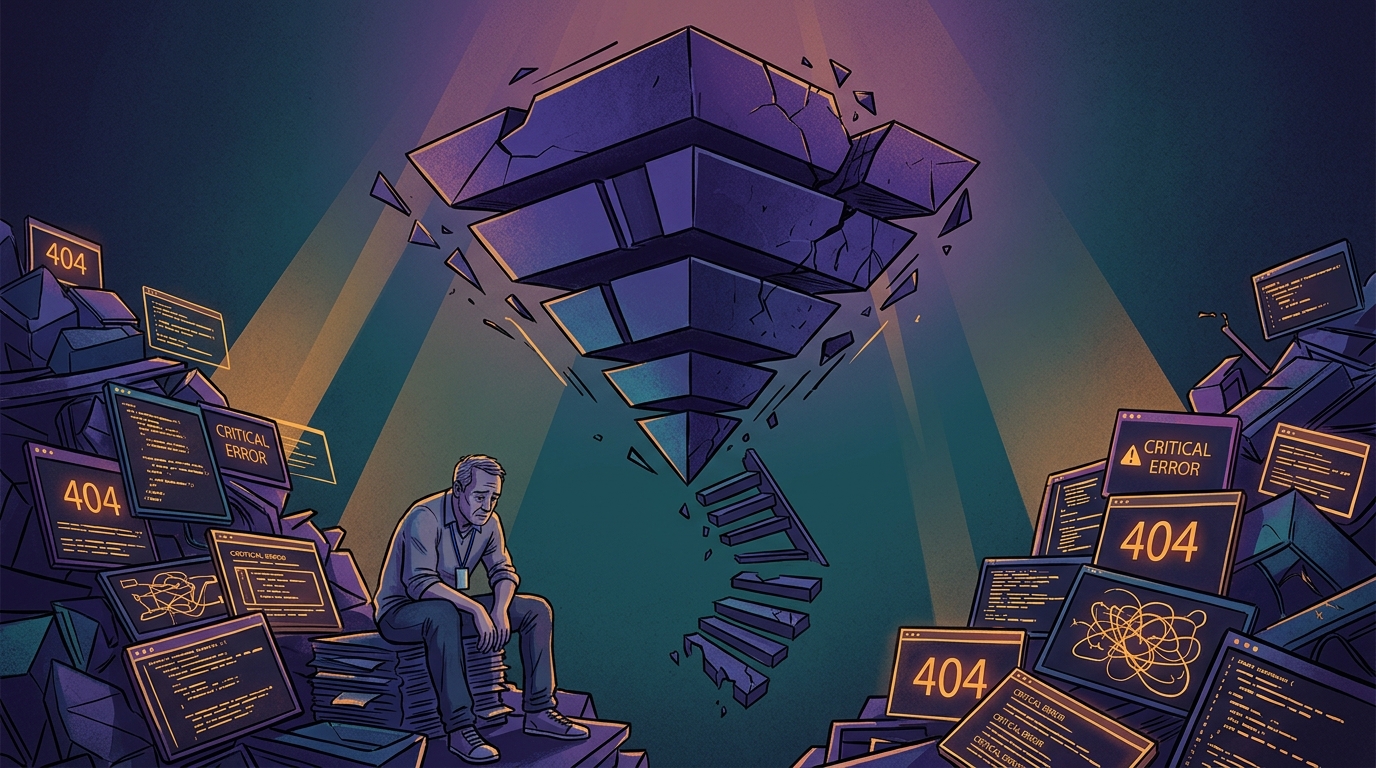
For decades, software engineering operated on an unspoken covenant: you joined an organization as an apprentice, wrote the mundane boilerplate, broke staging, learned how to debug under mentorship, and emerged five years later as a dependable senior architect. That apprenticeship bridge has been demolished. In an era where corporate leadership believes generative models can replace early-career developers, the tech sector is staring at a catastrophic structural crisis: the junior death spiral.
The $100 Dilemma: Erasing the Ground Floor
Between 2022 and 2025, tech executives facing macroeconomic pressure looked at early-career headcount and made a calculated decision. Why pay an entry-level software engineer an $80,000 annual base salary when an LLM subscription costs $100 a month and writes basic CRUD endpoints in milliseconds?
The hiring data captured the carnage almost immediately. According to SignalFire’s 2025 State of Tech Talent Report: [1]
- Big Tech firms reduced new graduate hiring by 25% in 2024 compared to 2023.
- Compared to pre-pandemic baselines in 2019, Big Tech new graduate hiring was down more than 50%.
- At startups, graduate recruitment decreased by 11% year-on-year, with new grads making up under 6% of hires — down from 30% in 2019.
- New graduates now account for just 7% of all hires across the tech industry.
The slogan “learn to code,” which defined an entire generation of computer science enrollments and bootcamp grads, crashed into a wall of automated prompts. Even the very definition of “entry-level” underwent grotesque inflation: job listings labeled as junior now routinely mandate two to five years of verified production experience.

The Phantom Recovery: The Senior Boom Masking the Junior Bust
If you look purely at top-line IT job market figures, you might assume tech hiring experienced a robust post-layoff stabilization. But aggregate indices conceal a severe labor distortion: a senior boom masking a junior bust.
While companies shut the door on entry-level candidates, corporate appetite for battle-tested senior engineers reached fever pitch. According to Indeed’s Hiring Lab: [2] [3]
- The share of tech postings requiring five or more years of experience rose from 37% in Q2 2022 to 42% in Q2 2025.
- Meanwhile, postings seeking two to four years of experience fell from 46% to 40% over the same period.
- By mid-2026, senior-level job postings grew nearly 15% year-on-year, vastly outpacing the broader employment market.
- Standard (junior) tech job titles fell 34% from February 2020 to February 2025, compared to just 19% for senior and manager roles.
This is not a healthy expansion; it is a defensive reaction.
The companies that axed their junior developers didn’t stop needing code verified, integrated, and safeguarded. When non-technical managers and junior-replacing tools began dumping millions of lines of synthetically generated code into full codebases, catastrophic defects followed.
Companies realized that junior developers weren’t just writing code — they were serving as human gatekeepers who understood the business context, manually tested features, and caught basic regressions before senior reviewers ever saw the pull request. Without that layer, repositories descended into chaos.
The High-Priced Code Janitor
With junior developers excised from the equation and 45% of AI code carrying security vulnerabilities, the role of the senior engineer has undergone an undignified demotion.
Senior engineers were hired to design resilient distributed systems, solve high-throughput concurrency bottlenecks, and mentor teams. Instead, they have become full-time, highly compensated code janitors.
Pre-AI Senior Focus:
[ 50% System Architecture & Design ] --> [ 30% Mentorship & Review ] --> [ 20% Critical Path Code ]

2026 Senior Reality:
[ 15% Architecture ] --> [ 65% Scrubbing AI Code Churn & CVEs ] --> [ 20% Firefighting Production ]
A senior engineer making $300,000 or $450,000 total compensation is now spending hours each day wading through massive pull requests authored by an LLM in minutes. The code looks syntactically pristine, beautifully documented, and passes linting. But beneath the surface lie subtle off-by-one errors, flawed concurrency assumptions, and unvetted third-party packages.
The result is widespread senior burnout. Lead architects are spending their peak creative years cleaning up synthetic debris, leading to institutional paralysis that negates whatever theoretical speed gains executives thought they purchased.
Replacing an $80,000 junior developer with an AI tool doesn’t save money when it forces a $350,000 staff engineer to spend half their work week debugging edge cases that an apprentice would have caught in local manual testing.
The “Junior Death Spiral”: Where Will Future Seniors Come From?
The immediate operational headaches of code review pale in comparison to the long-term existential crisis facing the software industry: the broken apprenticeship chain.
Senior software engineers are not created in classrooms, and they do not emerge fully formed from computer science departments. They are forged over six to ten years of making mistakes on real production systems.
- You learn how to write robust database migrations by accidentally locking a table as a junior.
- You learn how to design clean APIs by living with the painful consequences of the ugly ones you built two years prior.
- You develop an instinct for system architecture by maintaining the mundane boilerplate that LLMs now generate automatically.
- 1. Ground-Floor Elimination
Companies cease hiring junior developers, celebrating immediate quarterly cost savings on payroll and benefits.
- 2. The Missing Cohort
Two to three years pass. The junior cohort that was supposed to mature into mid-level engineers simply does not exist.
- 3. The Senior Scramble
As incumbent seniors burn out or retire, organizations enter a bidding war for an increasingly scarce, aging pool of legacy engineers.
- 4. Systemic Fragility
Software organizations lose the institutional memory of how their underlying architectures were built, leaving entire critical infrastructure stacks maintained by nobody who understands them from first principles.
The Force Multiplier vs. The Force Divider
The reality of AI in software development is not that the technology is inherently destructive — it is that how leadership deploys it determines whether it multiplies or divides human capability.
A diverging split has emerged across the industry:
- The Force Multipliers: Companies that chose to augment junior developers with AI tools. In these organizations, early-career engineers use AI as an interactive tutor, accelerating their comprehension of syntax while keeping them in the loop. These companies maintain their talent pipeline while improving individual developer output.
- The Force Dividers: Companies that used AI as an excuse to purge headcount and eliminate entry-level hiring. In these firms, costs are spiraling upward due to code churn, senior turnover is accelerating, and the talent pipeline is permanently frozen.
The tech industry treated junior developers as disposable overhead, forgetting that they were the seed crop of the entire software ecosystem. By eating their seed corn to boost next quarter’s operating margins, Big Tech didn’t optimize software engineering — it laid the groundwork for the most severe talent deficit in modern computing history.
Frequently asked questions
What is the "Junior Death Spiral" in software engineering?
The Junior Death Spiral describes a systemic collapse of the engineering talent pipeline. When companies eliminate entry-level hiring in favor of AI tools, new developers cannot gain the apprenticeship experience required to develop into mid-level and senior engineers, guaranteeing a severe shortage of experienced talent in 3 to 5 years.
How much has entry-level tech hiring declined?
According to SignalFire's 2025 State of Tech Talent Report, Big Tech firms reduced new graduate hiring by 25% in 2024 compared to 2023, and by more than 50% compared to pre-pandemic baselines in 2019. Startups reduced graduate recruitment by 11% year-on-year.
Why are senior engineer postings booming if tech hiring is slow?
While junior hiring collapsed, demand for experienced engineers surged. Indeed's Hiring Lab found that the share of tech postings requiring five or more years of experience rose from 37% in 2022 to 42% in 2025, while senior-level postings grew nearly 15% year-on-year through early 2026.
What does the "diamond" organizational structure mean?
Historically, software organizations operated as pyramids: large bases of junior developers supporting mid-level engineers and senior architects. The AI era is inverting this into a diamond: very few entry-level engineers, a hollowed-out mid-tier, and a top-heavy layer of senior engineers increasingly diverted to maintenance roles.
Why are senior engineers burning out?
With 45% of AI code introducing security vulnerabilities and code churn doubling, senior developers have stopped designing architectures and instead spend their days reviewing massive, subtle pull requests and triaging edge cases created by generative tools.
/* Comments */
Comments are offline right now — we reconnect automatically, nothing is lost.