Tries: Why Autocomplete Doesn't Scan Every Word
A trie finds all words with a prefix in O(p) time, independent of dictionary size. Radix compression and top-k heaps make autocomplete instant.
On this page
Google, Slack, and your IDE’s search box serve autocomplete suggestions in under 10 milliseconds, even with billions of indexed terms. The naive approach—scanning a database for every keystroke—is doomed by cardinality. The breakthrough is elegant: structure the dictionary so that every keystroke lands in exactly one subtree, and cache the best answers there.
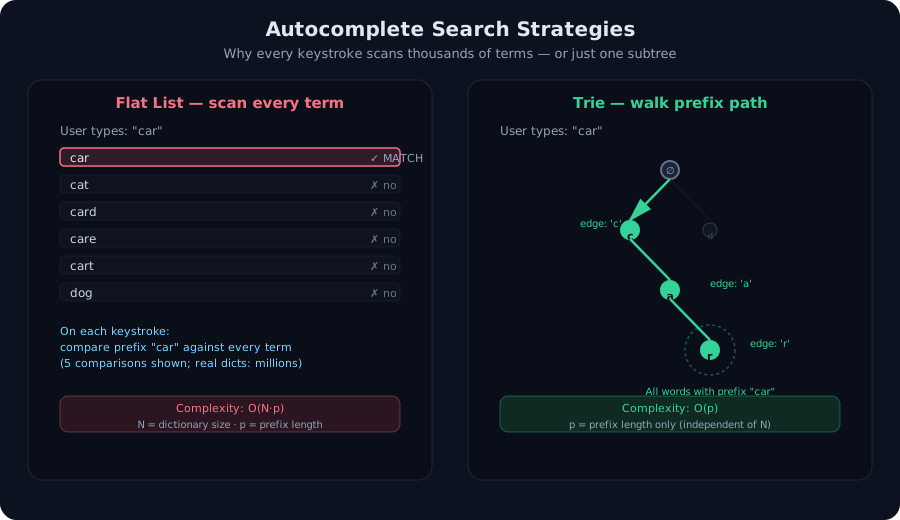 Left: flat-list matching is O(N·p); right: trie prefix walk is O(p), independent of dictionary size N.
The Naive Approach Dies Fast
Imagine a dictionary of 10 million English words (realistic for a search engine or spell-checker). A user types “car”. Your SQL query reads:
SELECT word FROM dictionary WHERE word LIKE 'car%' ORDER BY popularity DESC LIMIT 10;The database must:
- Check every row against the prefix “car” (or scan an index).
- Return matching rows (e.g.,
car,card,care,cart). - Rank them by frequency.
- Limit to 10.
This is O(N·p) per keystroke: scan all N words, compare against prefix of length p. On each new character, the query runs again. A user typing “c-a-r-p-e-n-t-e-r” triggers 9 full dictionary scans. At millions of concurrent users, your database is bottlenecked by CPU and IO.
Worse: the cost doesn’t drop as the prefix narrows. After typing “carp”, you’ve still checked millions of words; you just filtered down to 5 candidates.
Enter the Trie: O(p) Regardless of Dictionary Size
A trie (or prefix tree) is a tree where each edge is labeled with a character, and each node represents a prefix. For example, with words {car, card, care, cart, cat, dog}:
        ∅ (root)
       / \
      c   d
     / \   \
    a   t   o
   /|\   \  \
  r e t   \  g
  |/|     (CAT)
  * * *
Here:
- The path
c → a → rreaches a node labeled*(terminal), meaning “car” is a word. - The descendants of
c → a → rare{e, t, d}— the suffixes after “car” that form valid words. - All words starting with “car” are only reachable via the
c → a → rpath.
Finding all words starting with “car” is now a single tree walk: start at root, follow the edges c, then a, then r. You land on one node. Everything in its subtree is a candidate. Cost: O(p) where p = 3 (the prefix length). The dictionary size is irrelevant.
Radix Tries: Trading Traversals for Memory
The trie above uses one node per character. For long, branching-free chains, this is wasteful. The path c → a → r could be collapsed into a single edge labeled “car”, saving two node allocations:
    ∅ (root)
   / \
  "car" "dog"
  /||\  |
 e t d (DOG)
 | | |
 * * *
This is a radix trie (or compressed trie). Now the tree has 7 nodes instead of 10 for the same vocabulary. Memory savings grow with word length: a chain of 10 characters becomes 1 edge + 1 node instead of 10.
The cost: comparisons. A standard trie compares one character per node; a radix trie compares a whole edge label per node. Modern tries use string comparison (faster than byte-by-byte) and memoization to amortize this.
Real-world savings: A trie over 1 million words compresses to ~12–20 KB with radix compression, vs ~40 KB without. For a mobile app or in-memory database, that margin matters.
Top-k Heaps: Caching the Best Answers
Here’s the trap: after the c → a → r walk, your trie node may have 50,000 descendants (all words starting with “car” in a corpus). Your autocomplete feature returns the top 10 most popular. Traversing 50,000 descendants to find the 10 most frequent is O(N log k) per query — back to scanning, just a smaller set.
Solution: cache a top-k heap at each trie node. Before deployment, traverse the trie once. At each node, compute a min-heap of the k most frequent words in its subtree, where k is typically 5–10. Store this heap as metadata alongside the node.
At query time:
- Walk the trie to prefix “car” (O(p)).
- Read the cached heap (O(1) lookup).
- Extract the top k (O(k log k), usually
< 1 ms).
The complexity is now O(p + k log k), where k is small (5–10) and p is prefix length. Dictionary size is gone from the equation.
Trade-off: The heap occupies extra memory (~200 bytes per node for k=10), and if word frequencies change, you must rebuild heaps (expensive, so usually done offline or during off-peak hours).
Building and Maintaining a Trie
In production systems:
- Insertion:
O(p)per word. Compare each character against the trie path; create nodes as needed. - Deletion: Mark nodes as “not terminal” (a tombstone) rather than removing them. This avoids rebuilding the tree and invalidating heaps.
- Frequency updates: If a word’s popularity rank changes (e.g., trending), update its frequency counter. Rebuild the top-k heaps for affected ancestors.
A million-word trie is built once (from a dictionary file) and then rebuilt periodically (nightly, or every hour for trending). Most production autocomplete systems pre-build the trie offline and ship it as a binary blob in the app or database.
When to Use a Trie
Use a trie when:
- You need prefix matching (autocomplete, IP routing, spell-checking).
- The prefix is much shorter than the full term (
p <<word length). - You need fast exact-prefix matches on a large set.
Avoid a trie when:
- You need substring or fuzzy matching. A trie won’t find “carpet” from “pet”. For that, use an inverted index + edit distance.
- Your vocabulary is tiny (
< 1,000 words). A sorted array and binary search might be simpler. - You need ordered iteration over all keys. Tries are slow for “all words starting with nothing”; use a B-tree instead.
Why Tries Beat Databases
A query engine cannot do better than O(N) if forced to scan rows. A trie gives you O(p) by exploiting the structure of the problem: prefixes share characters. By grouping words by prefix at build time, you pay a one-time cost and then query in constant time (modulo prefix length).
Databases optimize for arbitrary predicates; tries optimize for one query: “give me all X starting with prefix P.” If that’s your workload, a trie is orders of magnitude faster.
Putting It Together
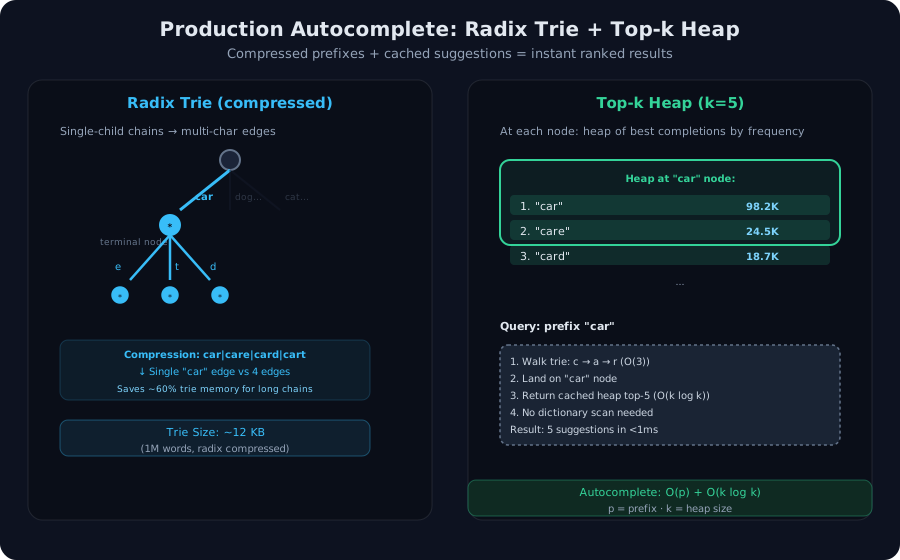 Production autocomplete: radix compression reduces memory; top-k heap caches ranked results, eliminating descendant traversal.
The full stack is:
- Radix trie for
O(p)prefix navigation. - Top-k heap at each node for instant top-k extraction.
- Persistence layer (mmap’d file, Redis cache, or database blob) so the trie survives restarts.
- Lazy rebuild of heaps when frequencies drift beyond a threshold.
Google Search, AWS autocomplete, and Slack all use variants of this. The trie is so fundamental to prefix problems that it’s a standard interview question. The next time you type “pyth” and see “python”, “pytest”, “pytorch” ranked by relevance, you’re watching a trie at work.
The Tradeoff: Memory for Speed
Radix tries with top-k heaps are not free. A 1-million-word dictionary consumes ~15–20 MB in memory. A top-k heap per node (at even 1% of nodes) adds another 2–3 MB. For a browser-based autocomplete, that’s feasible; for a device with 64 MB RAM, it’s not.
Solutions:
- Tiering: Cache the global top-k in memory, stream full results for miss cases.
- Compression: Use binary formats (e.g., Trie-DAG), not JSON or text.
- Sampling: Build the trie only for popular terms; use a fallback for tail.
The choice is yours: pay CPU now (scan on every keystroke) or pay memory once (build a trie).
- Understand the Problem
Prefix matching scales badly without structure: O(N) per keystroke on a flat dictionary.
- Trie Intuition
A trie groups words by shared prefix. A prefix walk is a single path from root to the prefix node, O(p).
- Radix Optimization
Collapse single-child chains into multi-character edges. Saves 60% memory; comparison cost amortized by modern string-comparison hardware.
- Top-k Heap Cache
Precompute k best results per node. Query-time: extract from heap, O(k log k), typically
< 1 ms. - Deployment
Build trie offline from dictionary. Ship as binary blob or Redis cache. Rebuild heaps when word frequencies drift.
Key Takeaways
- Tries are O(p) for prefix search, independent of dictionary size.
- Radix compression cuts memory by 60%, critical for mobile and embedded autocomplete.
- Top-k heaps eliminate traversal, returning ranked results instantly.
- Not always the answer: use tries for exact-prefix problems; use inverted indexes for substring/fuzzy.
The trie is a timeless data structure because it solves a real, recurring problem elegantly. Every search box you use today rests on centuries-old tree wisdom.
Frequently asked questions
Why does a naive database query like LIKE 'car%' get slower as the dictionary grows?
The query must scan every row or index entry, comparing the prefix against each one. That's O(N) per keystroke, where N is the full dictionary. A trie answers the same question in O(p), the prefix length, because it jumps directly to the 'car' subtree.
What does a radix trie save compared to a standard trie?
A standard trie stores one character per node; a radix trie collapses single-child chains into multi-character edges. For 'car', 'card', 'care', 'cart', a standard trie uses 7 nodes; a radix trie uses 2 ('car' + 'e'/'t'/'d'). Savings: 60-70% of memory for long prefixes.
Why pair a trie with a top-k heap instead of just returning all candidates?
A trie node holds millions of descendants in real dictionaries. A top-k heap (min-heap of size k) tracks the k best words by frequency/popularity. Autocomplete returns the heap top-k instantly without scanning all descendants. Cost: O(k log k) extraction, where k is typically 5–10.
Can a trie be built incrementally as new words are added to a system?
Yes. Insertion is O(p) per word. A trie is a mutable structure, not a static lookup table. If you're updating frequencies for ranking, track them alongside the trie and rebuild the top-k heaps incrementally; that's faster than full recomputation.
How does a trie handle autocomplete with typos or fuzzy matching?
A pure trie handles exact-prefix matches only. Fuzzy matching (e.g., Levenshtein distance) requires either a separate inverted index over all words or a specialized data structure like a BK-tree. Most production systems use a trie for speed, then re-rank fuzzy/typo results in a second pass.
/* Comments */
Comments are offline right now — we reconnect automatically, nothing is lost.