Vector Clocks: Detecting Causality in Distributed Systems
Vector clocks solve distributed ordering: when wall-clock timestamps fail to detect concurrent writes, vector clocks reveal true causality and conflicts.
On this page
Two users edit a shared document. User A saves at 10:05:12 UTC on a machine in us-west. User B saves at 10:05:08 UTC on a machine in eu-central. B’s clock is 4 seconds slow. A distributed database using wall-clock timestamps compares them: 10:05:12 > 10:05:08, so A’s write survives and B’s is discarded—silently, without anyone knowing. The newest edit from B is gone. This is the problem vector clocks solve.
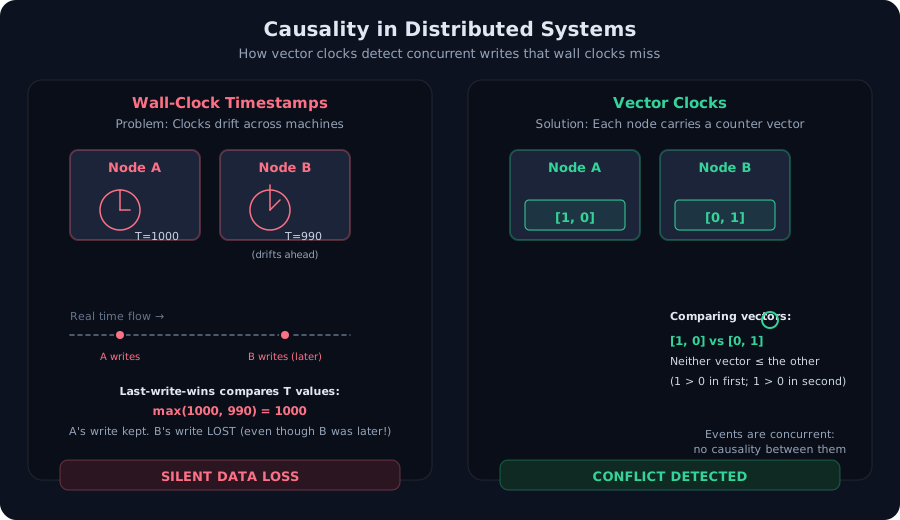
Wall-clock timestamps fail when clocks drift; vector clocks succeed by tracking causality directly.
The Core Problem: Causality Versus Wall-Clock Time
Distributed systems have no single source of truth for time. Every node has a local clock, and those clocks drift. On a typical data center machine, clock skew can be 10–100 milliseconds per second. Across continents with NTP (Network Time Protocol), it’s milliseconds, but still measurable. Over days or weeks, clocks drift by seconds.
The naive approach—ordering events by their wall-clock timestamp—fails when clocks lie. If an event from one node carries an earlier timestamp than an event from another node, but the first event actually occurred LATER in real time, a last-write-wins system will incorrectly discard the newer write.
The root cause: you cannot know whether a timestamp is “ahead” or “behind” without a global reference clock, which does not exist in a distributed system. Even NTP, which syncs clocks to within milliseconds of UTC, cannot prevent skew or race conditions.
A different approach is needed: instead of trusting wall-clock time, track which events caused which other events through messages. This is causality, and it’s what vector clocks measure.
Vector Clocks: The Mechanism
A vector clock is a mapping from node IDs to counters. In a 3-node cluster {A, B, C}, a vector clock looks like [3, 1, 5], meaning node A’s clock is at 3, B’s is at 1, and C’s is at 5. The key insight: by tracking every node’s progress, you can encode causality without trusting wall-clock time.
The algorithm:
- Before executing a local event, increment your own counter in the vector.
- Send the entire vector with every message to other nodes.
- On receiving a message, take the elementwise maximum of your vector and the incoming vector, then increment your own counter.
Why this works: incrementing your counter marks time passing locally; taking the maximum of incoming and local vectors ensures you never “forget” what other nodes have seen. If node B sends its vector [1, 2, 0] to node C, and C takes max([0, 0, 1], [1, 2, 0]), C is now aware that A has progressed to at least counter 1 and B has progressed to counter 2. The vectorclock is a transitive knowledge graph encoded as a single compact data structure.
Example trace:
- Node A starts with
[1, 0, 0](it incremented before writing). - Node B starts with
[0, 1, 0](independent write). - Node C receives A’s message: takes
max([0, 0, 0], [1, 0, 0])=[1, 0, 0], increments C’s position:[1, 0, 1]. - Node C receives B’s message: takes
max([1, 0, 1], [0, 1, 0])=[1, 1, 1], increments C’s position:[1, 1, 2].
Detecting Causality: The Comparison Rule
Given two vectors V1 and V2, define:
- V1 ≤ V2 (elementwise): every element of V1 is less than or equal to the corresponding element of V2.
- Happened-before: V1 happened-before V2 if V1 ≤ V2 AND V1 ≠ V2.
- Concurrent: if neither V1 ≤ V2 nor V2 ≤ V1, they are concurrent.
Why this works:
- If V1 happened-before V2, there is a causal chain of messages from V1 to V2 (possibly through intermediaries). The receiving side knows about the sending side. The vectorclock grows monotonically along a causal path, so every element in V1 that was non-zero has at least as much room to grow in V2.
- If they are concurrent, no message passed between them. Neither node’s view includes the other’s events. The writes conflict, and the system must resolve it (merge, last-write-wins on a tie-breaker, or ask the user).
Intuition: if you see [3, 1, 0] and compare it to [2, 2, 1], the second vector is NOT larger in every position (first element 2 is less than 3), so there is no causal path from the first event to the second. They happened independently. This is the signal the database uses to emit a conflict alert.
Example:
[1, 0, 0](node A writes alone) vs[0, 1, 0](node B writes alone): neither dominates → concurrent → conflict.[1, 0, 0](A’s vector) vs[1, 1, 0](B received A’s message): first ≤ second → A happened-before B → no conflict.
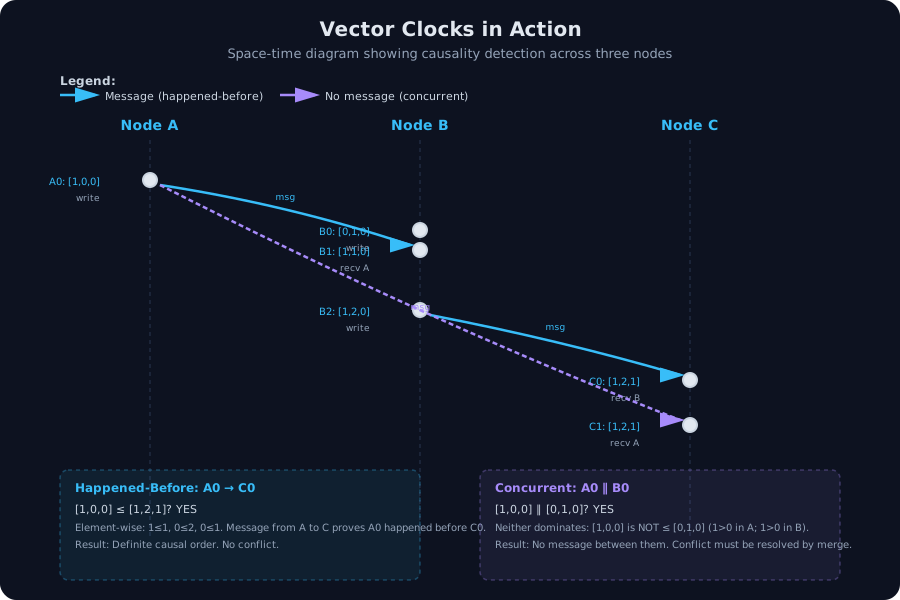
Vector clocks label each event. Messages (arrows) define causality. Non-dominated pairs trigger conflict resolution.
Why Dynamo Uses Vector Clocks
Amazon’s Dynamo and descendants (Cassandra, Riak) are last-write-wins databases that tolerate network partitions. When two replicas diverge, the system must decide which write to keep. Dynamo uses vector clocks (stored alongside each value as a context) to distinguish two cases:
- Ordered writes (one happened-before the other): keep the later one; discard the earlier. The newer event’s vector entirely dominates the older one, so there is no ambiguity. A read from any replica will see the same “final” write.
- Concurrent writes: both are “correct” in their local context. Neither vector dominates. Store both versions (siblings) and hand the conflict to the client (or a merge strategy like CRDTs). Cassandra merges by timestamp or lets applications define resolution logic.
Without vector clocks, Dynamo would default to wall-clock timestamps and lose data silently when clocks drift. A user writes value: "A" at 10:05:12 UTC; another user writes value: "B" at 10:05:08 UTC (their clock is slow); the database silently discards B’s write and no one knows. With vector clocks, the database detects this as concurrent, stores both, and forces a merge decision.
The Cost: Size and Pruning
A vector clock has one counter per node. In a 3-node cluster, vectors are small. In a 100-node cluster, every event carries 100 integers (~400 bytes uncompressed). Over billions of events, this becomes a storage and network cost.
Solutions:
- Interval Tree Clocks (ITC): compact representation using intervals, roughly logarithmic in cluster size.
- Version Vector Pruning: drop entries for nodes that are known to be behind (stale). A node’s counter can only advance if it receives messages. If a node crashes or is partitioned, its counter entry becomes unnecessary.
- Hybrid approaches: use vector clocks for conflict detection, but store only a small number of “important” versions per key.
Most Dynamo-style systems store vectors at the key-value level (per object), not per event, so the overhead is manageable.
When Not to Use Vector Clocks
Vector clocks are not a universal solution:
- Read-only systems: no conflicts exist if there are no concurrent writes. Don’t pay the cost. An immutable cache or archive needs no causality tracking.
- Strongly consistent systems (e.g., Paxos, Raft consensus): linearizability makes concurrency moot. A total ordering is already established; vector clocks add overhead without benefit. The consensus protocol already answers the question “which event came first?”
- Single-node databases: no distribution, no clock skew, no concurrent writes to different replicas. SQLite, PostgreSQL on a single machine—wall-clock timestamps are fine because there is a single time authority.
- Centralized write authority: if all writes flow through a single leader node (primary-replica architecture), timestamps work fine because they come from the same clock. The leader serializes all writes, so there is no true concurrency to detect.
- Time-series data or append-only logs: if you care about Wall-clock ordering for compliance or auditing, vector clocks obscure it. Immutable timestamps are the right choice.
Vector clocks earn their cost only when you have concurrent writes to independent replicas without a single source of truth.
Conclusion
Wall-clock timestamps are a convenient lie. Clocks drift. Messages are slow. The only truth in a distributed system is causality—which events influenced which other events through actual communication. Vector clocks encode this explicitly: a small counter vector carried in every message, compared elementwise to detect conflicts.
Dynamo-style databases rely on vector clocks to avoid silent data loss, turning a hard problem (detecting distributed conflicts) into a solvable one. The cost—O(N) vector size per event—is manageable through pruning and clustering strategies. The benefit—explicit conflict detection instead of data loss—is essential for any system that tolerates failures and partitions.
Understanding vector clocks is the foundation for reasoning about eventual consistency, CRDTs, and any distributed system that prioritizes availability over immediate consistency.
Frequently asked questions
Why can't we just use wall-clock timestamps to order events across machines?
Clock skew is inevitable in distributed systems. Two machines' clocks drift by milliseconds or seconds, so an event that happens LATER can receive an EARLIER timestamp. Last-write-wins databases relying on timestamps will silently discard the newer write and lose data.
How does a vector clock detect concurrent events?
A vector clock is a counter for each node in the cluster. Two events are concurrent if neither event's vector is less-than-or-equal (elementwise) to the other. This means no message passed between them, so neither caused the other—a genuine conflict requiring resolution, not silent data loss.
What is the 'happened-before' relationship and why does it matter?
Event A happened-before event B if A's vector is less-than-or-equal to B's vector (elementwise), and they differ. This proves A was in B's causal past—likely because A sent a message to B or through an intermediary. Respecting happened-before ensures consistency.
Why do vector clocks grow in size as clusters scale?
A vector clock has one counter per node in the cluster. A 100-node cluster carries 100 integers per event. This becomes expensive in network traffic, storage, and memory. Solutions include interval tree clocks and version-vector pruning to drop stale entries.
What systems actually use vector clocks in production?
Dynamo-style databases (Amazon DynamoDB, Cassandra), distributed version control (Git uses similar logic), and any last-write-wins store with eventual consistency. They're not used everywhere because read-only queries don't need them; they're essential only when writes race across multiple nodes.
/* Comments */
Comments are offline right now — we reconnect automatically, nothing is lost.