
AI Isn’t the Future. It’s History Repeating Itself
A tech exec got booed for comparing AI to the industrial revolution. History says he was right — and that should terrify you.
On this page
Somewhere between the diploma handouts and the polite applause, a tech executive told a room full of humanities graduates that AI was just the industrial revolution, version two. He got booed. Loudly. The moment made headlines as a viral clash between Silicon Valley optimism and Gen Z skepticism, but the more interesting story is that the crowd and the executive were both right — they just disagreed on what the comparison actually means.
Why did a tech executive get booed for comparing AI to the industrial revolution?
Because the comparison was meant to be reassuring, and the room understood it wasn’t. The industrial revolution is usually invoked as a happy ending: yes, disruption, but look how much better life is now. That’s the sanitized version — the one that skips from 1760 straight to modern plumbing, as if nothing difficult happened in between.
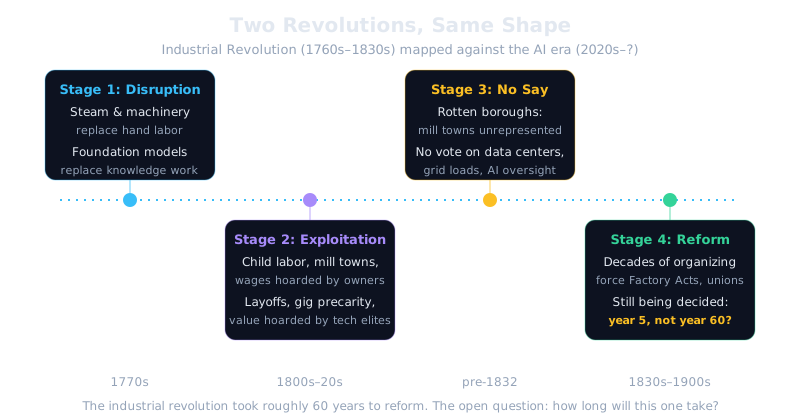
What actually happened in between was decades of mass exploitation. Children worked textile mills for pennies. Families were pulled from agrarian villages into overcrowded industrial slums with no sanitation and no legal recourse when a loom took a finger. This wasn’t a rough patch on the way to prosperity — for the generation living through it, it was the whole experience. Prosperity was something their grandchildren might see, if enough people fought for it. That’s exactly the part a room of history majors would have read in primary sources, so when an executive offered the comparison as comfort, they heard it as a warning — correctly.
The industrial-revolution analogy isn’t tech-industry spin — it’s historically sound. That’s precisely the problem. If AI’s disruption really does rhyme with 1760s–1830s industrialization, the honest forecast isn’t smooth progress. It’s generations of upheaval before benefits broadly arrive, and only if people organize to force that outcome.
What did the industrial revolution actually do to ordinary people, and is AI repeating it?
It didn’t just change jobs — it destroyed the social fabric those jobs were embedded in, and AI is doing the same thing on a faster clock. Rapid mechanization didn’t gently transition workers from farm to factory; it uprooted entire communities and forced brutal migrations into cities with no infrastructure to receive them. Traditional trades collapsed within a generation, taking with them the mutual-aid networks that had organized rural life for centuries. People didn’t choose that transition. It was done to them.
The wealth that transition generated flowed almost entirely to whoever owned the machines, not whoever operated them — and today’s massive disparities between tech billionaires and displaced workers mirror that ownership structure exactly, just with server racks instead of looms. The handful of labs and cloud operators controlling frontier AI are capturing valuation gains that dwarf anything the broader labor market has seen in decades, while communities built around call centers, radiology practices, and paralegal work watch their economic base evaporate on a timeline measured in product launches, not generations. The AI backlash is getting worse precisely because that gap is now visible in real time, not buried in a history textbook.
| Dynamic | Industrial Revolution (1760s–1830s) | AI Era (2020s–present) |
|---|---|---|
| Displaced labor | Weavers, artisans, farmers | Writers, coders, analysts, support staff |
| New infrastructure owners | Factory & mill owners | AI labs, cloud/data-center operators |
| Wealth concentration | Industrialist fortunes, minimal redistribution | Trillion-dollar valuations, concentrated among a handful of firms |
| Political representation | Rotten boroughs — no vote for industrial cities | Little formal say over AI infrastructure and grid decisions |
| Path to reform | Decades of organizing, strikes, Factory Acts | Still undetermined — regulation lagging deployment |
Who has a say over how this technology gets deployed — and who doesn’t?
Almost nobody who has to live with the consequences, then or now. Before Britain’s Reform Act of 1832, some parliamentary seats — the infamous “rotten boroughs” — represented a handful of voters or none at all, while booming industrial cities with tens of thousands of new workers had no dedicated representation whatsoever. Political power was structurally disconnected from where the disruption was actually happening.
Depopulated districts held outsized parliamentary power while industrial cities like Manchester had no dedicated representation — until the Reform Act of 1832 began correcting it.
Communities hosting AI data centers often have little formal say over power-grid strain, land use, or water consumption — decisions made far from the towns absorbing the cost.
That’s the exact structure of today’s AI governance gap: towns absorbing data-center power draw, professions being automated first, and workers displaced fastest have no proportionate voice in how AI gets regulated, sited, or deployed. Power and consequence are, once again, in different rooms.
Do conditions ever improve on their own, or does someone have to force it?
They have never improved on their own, and there’s no reason to expect AI to be the exception. Working conditions during the industrial revolution only got better because ordinary people aggressively organized, struck, and demanded legislative reform — repeatedly, over decades, against fierce resistance. The Factory Acts that eventually limited child labor didn’t arrive because industrialists had a change of heart. They arrived because workers made the status quo politically unsustainable.
- Exploitation gets normalized
Child labor and unsafe conditions were framed as the unavoidable cost of progress, not a policy choice that could be reversed.
- Elites resist every proposed fix
Factory owners argued, repeatedly, that safety regulation would collapse the economy — the same argument modern tech companies now make about AI oversight, nearly verbatim.
- Organizing raises the political cost
Strikes and public campaigns made ignoring the harm more expensive than addressing it.
- Legislation lags reality by decades
The first meaningful Factory Acts didn’t land until the 1830s–1870s — generations after the harm began.
Some jurisdictions are already testing a faster script: one country recently made AI layoffs illegal rather than waiting for the market to sort itself out — closer to what actually shortened the industrial revolution’s worst decades than any voluntary corporate restraint ever managed.
Do
Treat the “this will destroy the economy” argument as a negotiating tactic, not a fact — it’s the same claim industrialists made about ending child labor.
Don't
Assume AI’s downsides will resolve automatically as the technology matures. History has no example of that happening without organized pressure.
So what’s the actual choice in front of us?
Timing, not outcome — and that’s the part we still get to write differently. The uncertainty of AI’s downside risk is genuinely valid, and nobody, including the labs building these systems, can say precisely how deep the displacement goes or which professions are next — not even the people with the deepest technical expertise are reassured by it. What history does let us say with confidence is that the pain of economic transition will not be distributed evenly: it lands on specific professions and specific regions years before any “society adjusts and everyone’s better off” story has a chance to play out, if it ever does.
The vital question is whether society forces regulatory reform in year five of this revolution, or waits sixty years while communities and workers absorb the cost — roughly the actual gap between Britain’s first mechanized mills and its first comprehensive Factory Acts. AI doesn’t get that grace period by default just because the technology is newer. The delay last time wasn’t caused by the difficulty of the problem; it was caused by how long organized pressure took to beat organized resistance. That variable is still live, being decided now in fights over AI labor protections, data-center siting, and disclosure rules.
The booed executive wasn’t wrong that AI resembles the industrial revolution. He was wrong to say it like it was good news. History didn’t hand industrial workers better conditions as a reward for patience — it handed them to people who refused to wait sixty years to ask. The comparison isn’t comforting. It’s a warning label, and the only open question is whether anyone reads it in time.
Frequently asked questions
Is the AI revolution really similar to the industrial revolution?
Yes, structurally. Both involve machines displacing established labor, wealth concentrating among the owners of new infrastructure, and communities losing political say over technology reshaping their lives. The industrial revolution's early decades were brutal before reforms arrived — historians increasingly cite it as the closest precedent for AI's disruption.
How long did it take for industrial revolution working conditions to improve?
Roughly six decades. Britain's Factory Acts began piecemeal in the 1830s and weren't meaningfully comprehensive until the 1870s–1900s, after generations of organizing, strikes, and political pressure. Conditions did not improve automatically as factories got more efficient — they improved because workers forced legislative change.
What were rotten boroughs and why do they matter for AI policy?
Rotten boroughs were pre-1832 British parliamentary districts with tiny or vanished populations that still held outsized voting power, while booming industrial cities had almost no representation. The parallel: communities hosting today's data centers and AI infrastructure often have little formal say over the decisions reshaping their economies and power grids.
Did technological revolutions ever benefit workers immediately?
No. Historically, benefits from industrialization took decades to reach the people doing the displaced labor, and only after sustained organizing forced legislative reform. Productivity gains flowed to factory owners and investors first; wages and safety standards for workers lagged well behind, often by a generation or more.
Why do tech companies compare AI to the industrial revolution?
Executives use the comparison to frame AI disruption as inevitable and ultimately beneficial, pointing to long-run gains like higher living standards. Critics counter that the comparison actually undercuts their argument — it also predicts decades of exploitation, inequality, and suffering before those gains materialize for ordinary workers.
/* Comments */
Comments are offline right now — we reconnect automatically, nothing is lost.