
The AI-Native Engineer: Architectural Patterns to Avoid Code Overload
How high-leverage engineers shift from writing syntax to context engineering, specification-driven design, and rigorous automated verification.
On this page
The software industry is experiencing a profound paradox: AI coding models generate more lines of code than ever before, yet engineering teams report higher defect counts, increased technical debt, and what the industry now calls code overload.
When developers treat AI tools as magical autocomplete engines, they generate thousands of lines of unreviewed, fragile code that collapses under production load. The engineers who extract 10x leverage from AI do not write more code; they write fewer, more precise specifications, orchestrate context carefully, and enforce rigorous verification gates.
Becoming an AI-native engineer requires shifting mental models: transitioning from a manual syntax writer to a systems architect and verification director.
The Pitfall of Vibe Coding vs AI-Native Engineering
The contrast between superficial “vibe coding” and disciplined AI-native engineering lies in who owns the system architecture:
+-----------------------------------------------------------------------+
|  Vibe Coding (High Fragility, Production Danger)                       |
|  - Developer types vague prompt ("Add OAuth login with Google")       |
|  - Accepts 400 lines of generated code without understanding edge cases|
|  - Runs code locally once, sees it works, pushes to production        |
|  - Result: Security flaws, broken session states, unmaintainable mess |
+-----------------------------------------------------------------------+
|  AI-Native Engineering (High Leverage, Enterprise Grade)              |
|  - Architect defines strict interface specifications & invariants   |
|  - Curates deterministic context (types, schemas, existing patterns)  |
|  - Generates code against explicit behavioral contracts               |
|  - Enforces automated verification: typecheck, build, and E2E flows   |
+-----------------------------------------------------------------------+
Historically, writing syntax accounted for only 20% to 30% of a senior engineer’s job. The remaining 70% was always problem decomposition, threat modeling, API boundary design, and operational resilience. AI automates syntax generation; the architect must master the remaining 70%.
The Four Pillars of the AI-Native Engineering Loop
+-----------------------------------------------------------------------+
|                     The AI-Native Engineering Loop                    |
+-----------------------------------------------------------------------+
|                                                                       |
|  [ 1. Context Engineering ]                                           |
|  - Curate high-signal documentation, schemas, and API interfaces      |
|  - Eliminate noisy boilerplate from model context window              |
|        |                                                              |
|        v                                                              |
|  [ 2. Specification-Driven Design ]                                   |
|  - Author unambiguous Markdown / TypeScript interface contracts      |
|  - Define state machines, error conditions, and latency targets       |
|        |                                                              |
|        v                                                              |
|  [ 3. Constrained Model Generation ]                                  |
|  - Prompt LLM with strict role, task boundary, and coding standards   |
|  - Enforce zero unrequested dependencies or architectural bloat       |
|        |                                                              |
|        v                                                              |
|  [ 4. Critical Automated Verification ]                               |
|  - Typecheck (`tsc --noEmit`), Linters, Production Build Passes       |
|  - Run real end-to-end integration pass of actual user flows          |
+-----------------------------------------------------------------------+
1. Synchronized Context Engineering
Models are only as good as the context fed into their attention heads. Passing an entire 100,000-line codebase causes “needle-in-a-haystack” degradation, where models miss critical constraints buried in irrelevant files.
High-leverage engineers curate compact, high-density context:
- Interface definitions (TypeScript types, Protobuf definitions, SQL schemas).
- Existing architectural patterns and coding agreements.
- Explicit non-goals (e.g., “Do not introduce Redis; use our existing in-memory LRU cache”).
2. Specification-Driven Development (SDD)
Before asking a model to write a single line of implementation, write the technical specification first. A strong spec includes:
- The exact API routes and request/response payloads.
- State machine diagrams outlining valid state transitions.
- Concurrency and idempotency expectations.
- Concrete failure modes and how errors must be reported.
When the LLM receives an airtight specification, code generation transitions from speculative guessing to deterministic translation.
3. Problem Decomposition
Large Language Models fail when asked to solve complex, multi-layered problems in a single prompt. If you ask a model to “Build a full-text search engine with vector indexing and frontend dashboard”, it will hallucinate shortcuts and omit edge cases.
AI-native engineers decompose complex systems into modular atomic tasks:
- Define the database schema and migration script.
- Implement the ingestion change-data-capture handler.
- Build the vector embedding worker pool.
- Wire the API gateway endpoint.
- Implement the frontend search UI.
Each step is generated, reviewed, and verified independently before proceeding to the next.
4. Critical Automated Verification Gates
Never trust generated code without automated verification. The AI-native workflow enforces three non-negotiable gates before code is deemed complete:
- Static Analysis & Typecheck: The code must compile without type errors (
tsc,mypy,cargo check). - Production Build: The full production bundler (
npm run build,astro check) must complete with zero warnings or errors. - Live Surface Verification: Execute a real end-to-end pass of the actual flow in a staging environment to observe runtime behavior and edge cases.
Key Engineering Takeaways
- Context is your leverage: Feeding targeted, high-density types and schemas into the model yields vastly superior code compared to dumping massive code repositories.
- Write specifications first: Treat the specification as the source of truth. When the spec is precise, implementation generation is trivial.
- Decompose aggressively: Never prompt an agent to build an entire feature at once. Break architectures into atomic, testable components.
- Verification is non-negotiable: An engineer is judged by what runs in production. Enforce strict typechecks, builds, and live verification loops on every generated artifact.
Keep reading
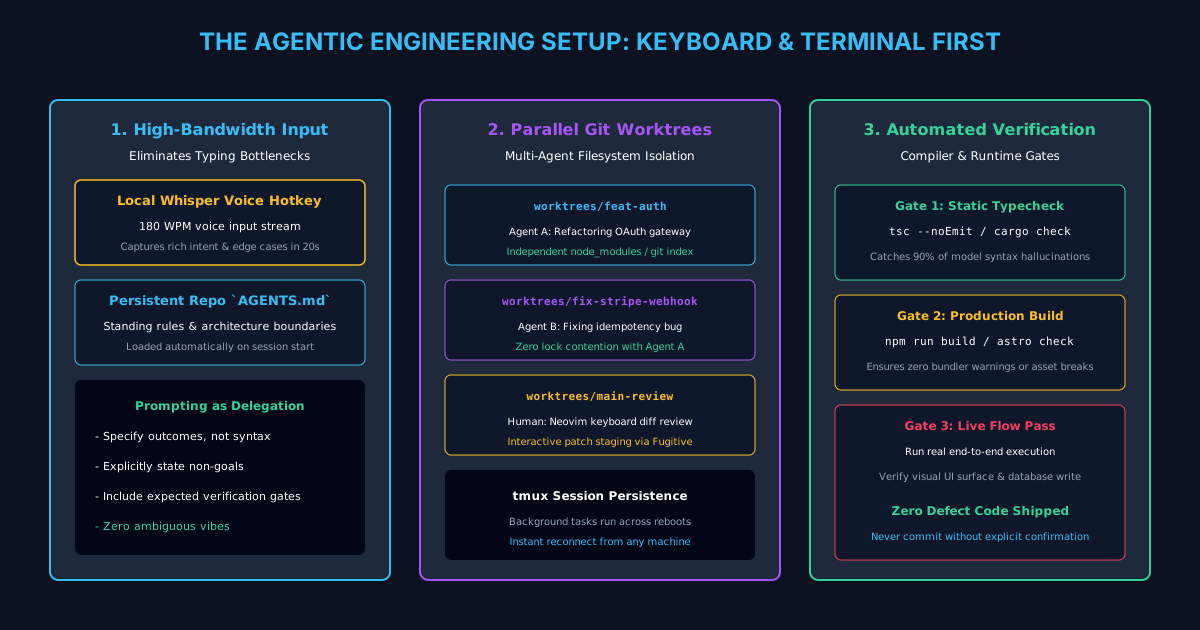
The Agentic Engineering Setup: Terminal, Voice, Worktrees, and Verification
Inside an Ex-Meta L8 engineer's keyboard-first agentic workflow: WezTerm, Neovim, local Whisper voice input, git worktrees, and automated compiler loops.
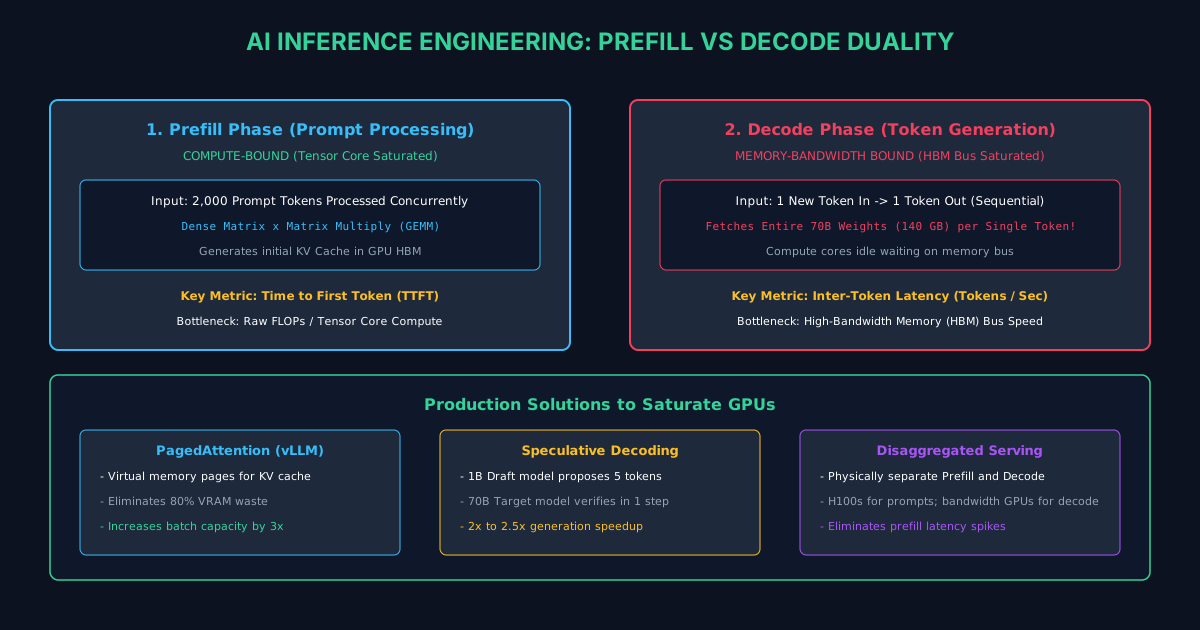
A Complete Guide to AI Inference Engineering: Prefill vs Decode
Why LLM inference splits into compute-bound prefill and memory-bound decode. Master PagedAttention, KV-caching, speculative decoding, and vLLM.
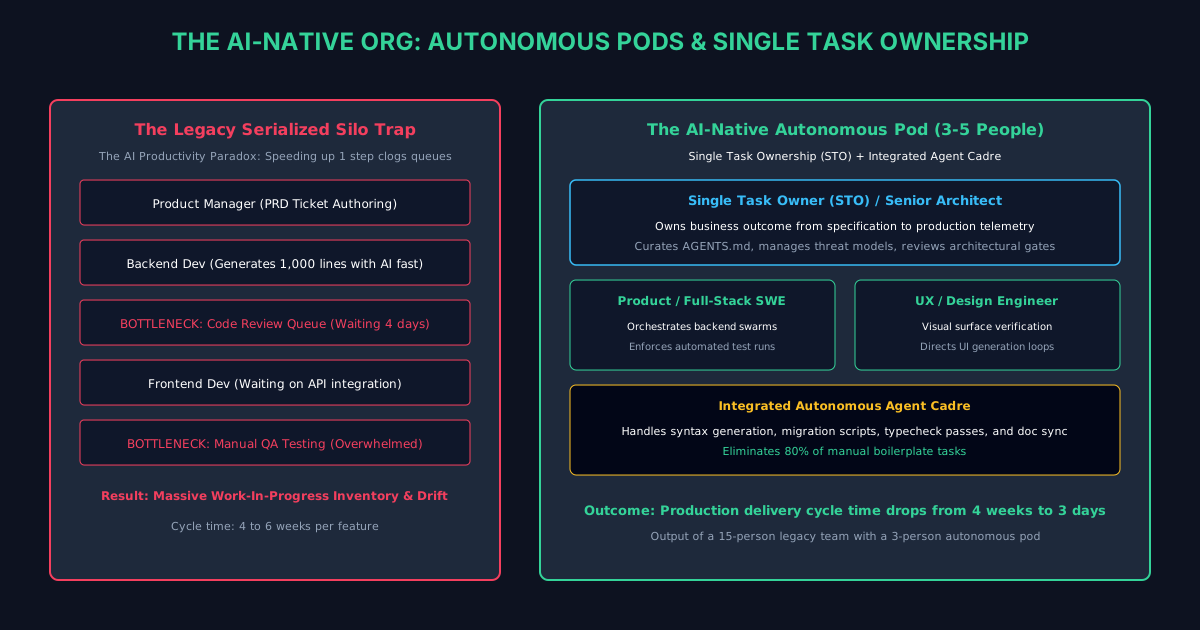
The AI-Native Engineering Org: Pods, Agent Champions, and Leadership
How engineering leaders overcome the productivity paradox: restructure teams into 3-to-5 person autonomous pods with Single Task Ownership (STO).
/* Comments */
Comments are offline right now — we reconnect automatically, nothing is lost.