
Anthropic’s Self-Assessment Monitor Adds Coverage, Not a Safety Guarantee
Anthropic says Claude can flag potentially harmful conversations using its existing context. The approach is cheap to run, but remains a triage layer.
On this page
A model that can write a response may also be able to notice something concerning about the conversation that produced it. Anthropic’s new self-assessment method asks Claude to do that after each answer, using the context the model already has. The technical appeal is obvious: broad monitoring without asking a second system to reread every long transcript. The boundary matters just as much: Anthropic uses the output for offline review, not as a replacement for the safeguards that block harmful requests.
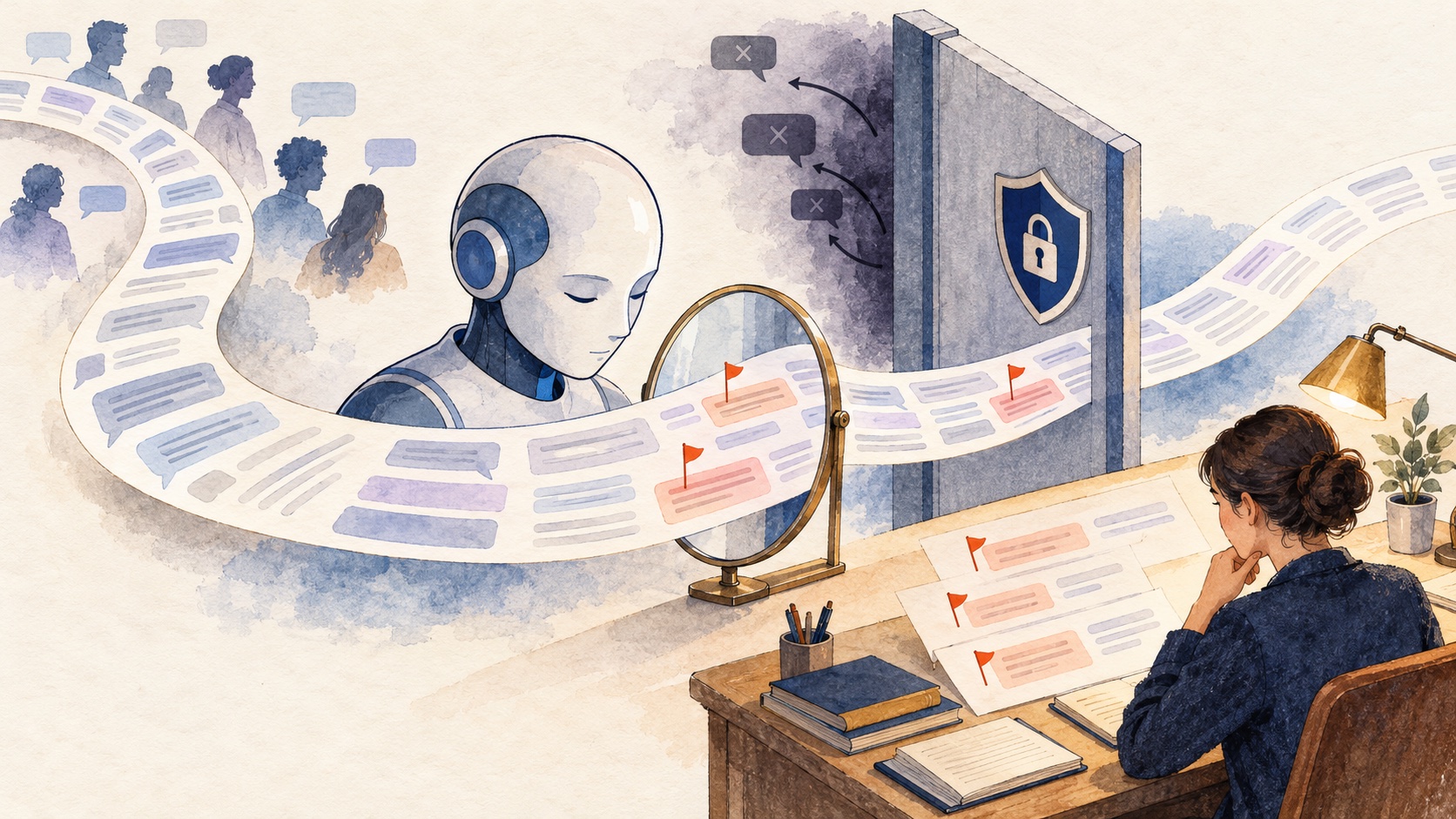
A monitor that uses the conversation already in context
Anthropic describes self-assessment as a short instruction appended after Claude’s response. The model then produces a compact assessment: whether the exchange may involve harmful intent, the type of harm, a priority for human review, whether Claude refused, and a brief explanation. Anthropic says the assessment considers the whole conversation, including requests the model declined. [1]
The design uses an existing model state rather than asking a separate classifier to read the transcript and policy from scratch. Anthropic estimates that each assessment requires around 10 extra tokens on average and adds less than 2% to inference compute across its production API traffic distribution. Those numbers are provider estimates for Anthropic’s traffic, not a universal cost guarantee for other systems or deployments. [1]
The method sits between two familiar options. A narrow classifier can be inexpensive and consistent for known categories, but it may miss a new kind of misuse. A stronger prompted classifier can reason over policy and context, but running it across every conversation costs more. Anthropic positions self-assessment as a cheap first pass, with more expensive tools reserved for cases that deserve closer review. [1]
What the reported result does—and does not—mean
On Claude Fable 5, Anthropic says the monitor flags 78% of potentially harmful conversations and 94% of high-priority conversations at a 1% false-positive rate. Its comparison target is a stronger prompted classifier supplied with Anthropic’s full safeguards policies. That is useful evidence about the method’s performance against a defined internal reference, but it does not establish performance against independent human labels or across every model provider. [1]
A false-positive rate also has to be read alongside the base rate. If genuinely harmful events are rare, even a small false-positive percentage can create a large review queue. If reviewers see too many benign conversations, they may become less attentive. A production monitor needs both recall and review capacity: which cases are escalated, how reviewers resolve them, and whether those findings improve the system.
Anthropic is direct about the limit: self-assessment does not catch every harmful conversation and is not robust enough to stop a dedicated attacker. The company says it runs the method as an offline monitor across a large fraction of traffic, where it supports higher-precision investigation tools and complements existing real-time safeguards. It should not be described as a block, a full audit or proof of safe behavior. [1]
Self-critique is not independent evidence
The core strength and weakness share the same source. Because the model has the conversation in context, it can interpret information that a simple label classifier may miss. But if the model misunderstands a multi-step harmful plan, the same blind spot may affect both its response and its self-assessment. A monitor should therefore be tested on cases where the model’s own interpretation is likely to fail, not just on straightforward examples.
Anthropic’s earlier SLEIGHT-Bench work explores ways to find blind spots in AI monitors, including attacks that make harmful intent difficult to detect. It underscores a broader lesson in evaluation: monitor accuracy depends on the threat distribution and on how the attacker adapts. A benchmark can reveal weaknesses, but no fixed set of examples proves a monitor is robust to future behavior. [2]
For organizations building a similar pipeline, keep the monitor’s role narrow and visible. The system should say whether it is detecting for review, deciding to block, or producing a research signal. Those outcomes have different consequences. A triage score should not silently become a disciplinary decision, account suspension or regulatory finding without human review and a documented process.
What a responsible evaluation should include
A deployment team can make the idea testable without assuming that the model’s self-report is correct:
- Define the target. Specify what the monitor is expected to flag and what action follows. “Unsafe” is too broad to evaluate consistently.
- Use blinded human review. Sample flagged and unflagged conversations so reviewers can estimate both missed events and false alarms.
- Stress the boundary. Test multi-turn context, indirect requests, benign security work, refusal handling and adversarial attempts to disguise intent.
- Measure workload. Track queue size, time to review, reviewer agreement and the fraction of flags that lead to a meaningful intervention.
- Keep monitoring separate from prevention. A retrospective alert is not a control that blocks an action before it happens.
NIST’s AI Risk Management Framework and Generative AI Profile emphasize ongoing measurement, monitoring, incident response and accountability across the system lifecycle. They do not prescribe this specific technique, and their guidance does not certify any vendor’s monitor. But they provide a useful frame for asking who evaluates the output, what happens after an alert and how the organization responds when the monitor misses something. [3] [4]
The useful contribution is economic
If Anthropic’s estimates hold for its deployment, reusing a model’s existing context may make broad retrospective monitoring cheaper. That could let a safety team review more conversations or reserve expensive classifier capacity for a smaller set of cases. The value is not that the model becomes its own judge; it is that a low-cost first pass may expand coverage when paired with independent checks.
The approach is therefore an efficiency claim with a safety application. Its worth depends on the quality of the review process that follows. A flag should lead to evidence a human can inspect, and a clean self-assessment should never be treated as proof that a harmful exchange was absent.
For related context, see our frontier AI incident playbook and AI governance evidence checklist.
Frequently asked questions
Does Anthropic's self-assessment block harmful requests?
Anthropic describes it as an offline monitor that flags conversations for later investigation. The company says other safeguards block harmful requests in real time; self-assessment is an additional layer, not a standalone prevention system.
How accurate is Claude's self-assessment monitor?
Anthropic reports that on Fable 5 it flagged 78% of conversations identified by a stronger prompted classifier, and 94% of high-priority ones, at a 1% false-positive rate. Those results are evaluated against Anthropic's own classifier and should not be treated as an independent audit.
Sources & further reading
Keep reading

Anthropic’s Distillation Defenses Show Why Extraction Is a Lifecycle Problem
Anthropic describes controls against model-output extraction, from reasoning access to account networks, while acknowledging tradeoffs and adaptive attackers.

ChatGPT Locked Chats Hide a Conversation. They Do Not Turn It into a Vault
OpenAI locked chats use a PIN or device authentication to hide saved conversations. Retention, training and workspace rules remain in effect.

A Detector Flagged 29% of New STEM Dissertation Abstracts. What Does That Mean?
An NBER working paper finds more AI-detector flags in STEM dissertation abstracts. The result measures classifications, not authorship or misconduct.
/* Comments */
Comments are offline right now — we reconnect automatically, nothing is lost.