
Autonomous Agent Payments: Machine Payments Protocol, Session Keys, and Settlement
How autonomous AI agents execute financial transactions without human checkout loops using delegated session keys, HTTP 402, and escrow settlement.
On this page
The entire infrastructure of the commercial web is engineered on the assumption that a human being is sitting behind the browser. Credit card checkout forms demand 3D Secure SMS one-time passwords, CAPTCHA challenges, billing addresses, and manual confirmations.
When autonomous software agents act as economic buyers: booking flights, acquiring specialized dataset access, purchasing GPU compute spot capacity, or licensing API calls, human checkout loops fail. An agent running a sub-second arbitrage or provisioning pipeline cannot pause to ask a human manager to type an SMS verification code into a browser modal.
Autonomous agent commerce requires a native machine payments architecture: cryptographic session delegation, deterministic spending envelopes, and protocol-level micropayment settlement.
Why Legacy Payment Rails Break Under Autonomous Agents
Legacy merchant acquiring and card networks break when subjected to machine commerce:
+-----------------------------------------------------------------------------+
|                          LEGACY VS AGENT PAYMENTS                           |
+-----------------------------------------------------------------------------+

 Metric                  Legacy Card Rails (Visa/Mastercard)   Agentic Machine Rails
 -----------------------------------------------------------------------------
 Auth Model              Manual 2FA / CAPTCHA / Biometrics     Cryptographic Signatures (Ed25519)
 Minimum Cost Effective  $0.50 (due to $0.30 fixed swipe fee)  $0.0001 (Micropayments)
 Latency                 2,000ms - 5,000ms                     < 50ms (Session Authorization)
 Reversibility           Chargebacks up to 90 days             Instant Finality / Cryptographic Escrow
 Delegation              All-or-nothing credit card numbers    Granular Time-bounded Session Caps
If you give an autonomous agent a raw corporate credit card number, you grant it infinite liability. If the agent enters an unconstrained recursive loop or suffers a prompt injection exploit, it can drain thousands of dollars in minutes.
Conversely, requiring a human approval push notification for every 2-cent API call destroys the autonomy of the agent.
The Three Pillars of Machine Payments Architecture
To enable safe, high-speed autonomous commerce, engineering teams deploy a three-tier financial architecture:
+-----------------------------------------------------------------------------+
|                         MACHINE PAYMENTS PROTOCOL STACK                     |
+-----------------------------------------------------------------------------+

 [Human Principal / Organization]
       |
       | 1. Authorizes Time-Bounded Spending Envelope ($50 cap, 24hr lease)
       v
 [Delegated Session Key (Ed25519 Ephemeral Keypair)]
       |
       | 2. Agent signs micropayment requests directly
       v
 [Merchant / Resource Gateway (HTTP 402 Payment Required)]
       |
       | 3. Pre-flight verification with Clearinghouse Escrow
       v
 [Cryptographic Settlement & Micro-Ledger]
1. Delegated Ephemeral Session Keys
Instead of exposing persistent credentials, the human principal issues a cryptographically signed authorization token (a Macaroon or typed EIP-712 credential) containing strict mathematical bounds:
- Maximum Cumulative Spend: E.g., No more than $150.00 total.
- Maximum Transaction Size: E.g., No single transaction exceeding $5.00.
- Merchant Whitelist / Domain Filter: E.g., Only valid for endpoints ending in
*.api.weather.comor*.compute.cloud. - TTL Expiration: E.g., Self-destructs after 12 hours.
The agent holds the private key to this ephemeral pair. Every API request or resource purchase is accompanied by a cryptographic signature generated over the request payload and current timestamp.
2. HTTP 402 and Resource Metering
When the agent requests a gated resource without prior payment, the server responds with a standard HTTP 402 Payment Required header, declaring the exact invoice details:
HTTP/1.1 402 Payment Required
Content-Type: application/json

{
  "resource_id": "dataset-segment-8841",
  "cost_cents": 12,
  "currency": "USD",
  "settlement_address": "merchant_escrow_0x7b4a...",
  "supported_rails": ["mpp-lightning", "mpp-stripe-stream", "usdc-solana"],
  "invoice_nonce": "98124810-acde-491a"
}
The agent verifies that the invoice matches its internal task intent and falls within its spending envelope. It signs the transaction and returns the signed proof in the Authorization: Payment <proof> header. The server settles the proof instantly and streams the data.
3. State Channel and Escrow Settlement
Settling credit card transactions or blockchain transactions on every discrete HTTP request is impractical due to transaction fees and network latency.
Instead, machine payment protocols employ State Channels and Prepaid Escrow:
- The agent deposits $20 into an escrow contract or merchant session pool at the beginning of the workflow.
- For each subsequent resource access, the agent and merchant exchange signed off-chain state updates incrementing the merchant balance by pennies ($0.01, $0.02, $0.03).
- When the task completes or the session expires, the final signed balance is submitted to the clearinghouse for settlement. Only one on-chain or card swipe transaction occurs for hundreds of individual tool calls.
Fraud Prevention and Prompt Injection Defense
What happens if an adversarial prompt instructs the agent to purchase an expensive luxury item or transfer money to an attacker’s account?
The payment subsystem must sit completely outside the LLM context window:
- The language model never has direct access to the payment execution binary or raw private keys.
- Instead, the LLM emits an intent struct:
{"action": "purchase", "item": "dataset", "price_limit": 2.50}. - A deterministic host runtime evaluates the intent against hardcoded local policies and validates the cryptographic constraints. If the intent violates the spending envelope, the execution is terminated at the operating system level, regardless of how persuasively the LLM was manipulated.
Architectural Takeaway
Autonomous agents cannot thrive on legacy human payment infrastructure. Building agentic commerce requires:
- Replacing raw credit cards with cryptographically bounded, ephemeral session keys.
- Leveraging HTTP 402 protocols for deterministic machine negotiation of digital goods.
- Using state channels and off-chain balance updates to make sub-cent transactions economically viable.
- Hard decoupling of financial policy evaluation from generative model weights.
Keep reading
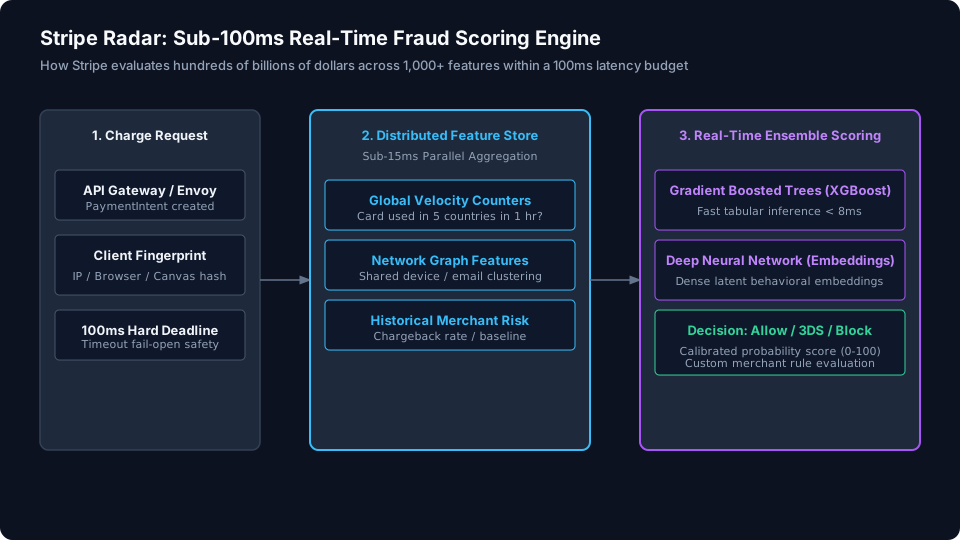
Inside Stripe Radar: Sub-100ms Real-Time ML Fraud Detection Architecture
How Stripe Radar scores payments in under 100 milliseconds: distributed feature stores, global network graphs, and real-time ensemble inference.

The Tech Stack Powering Wise: Standard Chassis, Canary Deploys, and Observability
How Wise scales cross-border payments with over 850 engineers: microservice chassis, automated canary analysis, and financial ledger idempotency.

AWS Lets Coding Agents Start Account Setup. The Approval Boundary Still Matters
AWS account setup now fits coding agents, but people must still review identity, permissions, cost, and deployment.
/* Comments */
Comments are offline right now — we reconnect automatically, nothing is lost.