
Lambda’s Customer-Managed Runtimes Turn Runtime Updates Into a Platform Contract
AWS Lambda can distribute shared runtimes without per-function redeploys, while runtime publishers gain code authority under each function’s execution role.
On this page
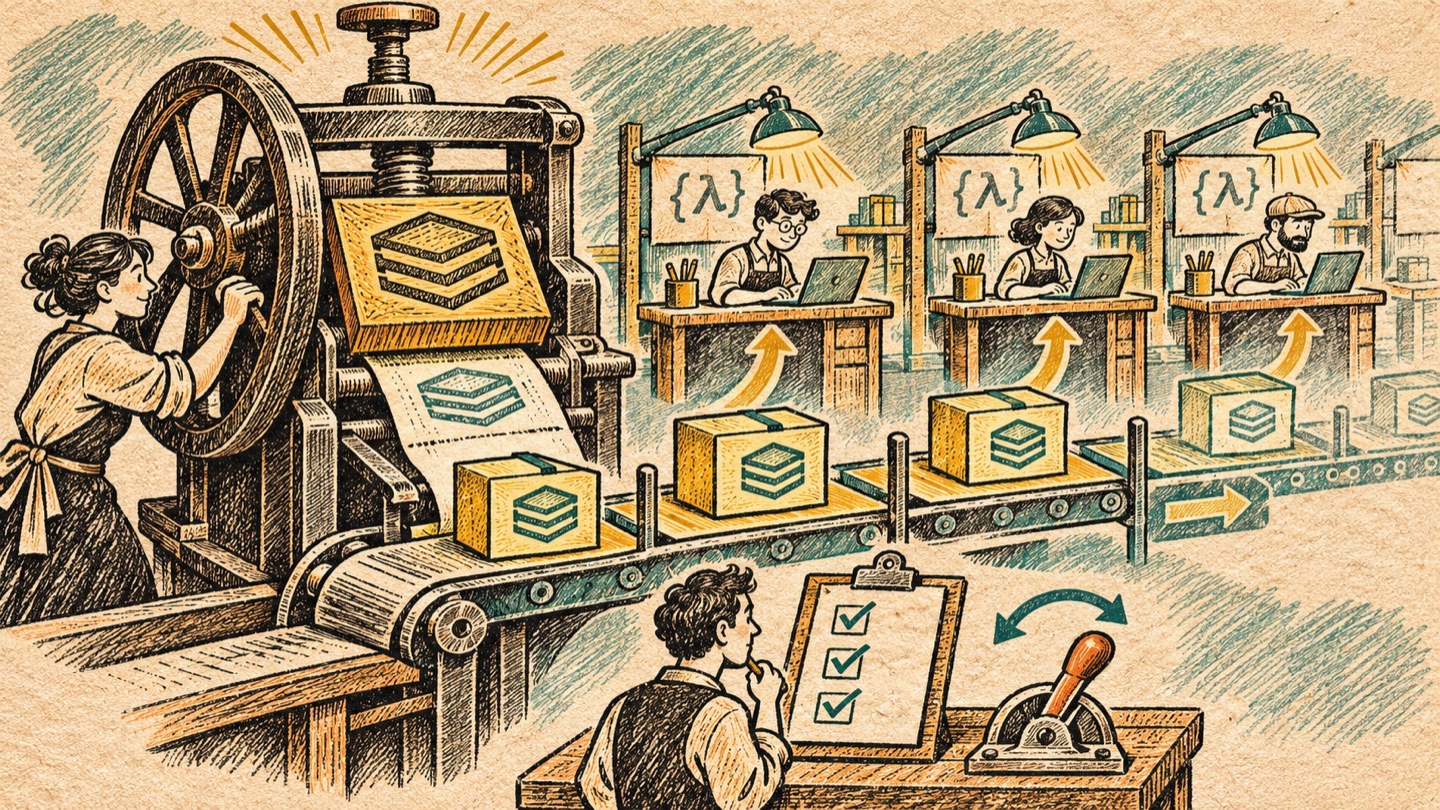
A shared runtime update can fix a certificate, SDK or monitoring agent once instead of asking every application team to redeploy. AWS Lambda’s new customer-managed runtimes make that central update path generally available across commercial AWS Regions. The runtime publisher packages an OCI image in ECR, creates a version and alias, and shares it with function consumers. Application teams continue to deploy their function code as a ZIP archive and select the runtime alias. [1]
That separation is attractive for platform engineering, but it creates a security and change-management contract. AWS explicitly warns that a runtime publisher can push code into the execution environments of every function using that runtime, and that code runs with each function’s execution-role permissions. A trusted publisher is therefore part of the workload’s software supply chain, not merely a convenience service. [3]
Runtime control moves to a publisher
A publisher owns the runtime contents, versions, access policy and lifecycle. It can include an organization’s approved SDKs, certificates and security tooling, or supply a language runtime Lambda does not manage. Consumers configure their functions to use the runtime ARN and alias. They do not manage the underlying container image and can keep the familiar ZIP deployment path. [2]
When the publisher advances an alias, functions pick up the new runtime version at a future cold start by default. Existing execution environments keep running the prior version until Lambda replaces them. A rollout can therefore be gradual: different warm environments may temporarily execute different runtime versions. Teams must design compatibility across that transition instead of assuming every instance changes at once. The developer guide explains that alias updates do not use Lambda’s two-phase rollout for managed runtimes; the publisher controls timing. [4]
This model changes the division of responsibility. The publisher now owns patching every component inside the runtime image, including security patches if it starts from a Lambda base image. It also owns alias rollout, monitoring, rollback and consumer communication. AWS notes that standard ECR storage pricing applies to retained runtime images, while customer-managed runtimes add no separate Lambda charge. [3]
The security boundary is the execution role
A runtime update can deliver code with the same permissions as the application handler. If a central team manages a runtime shared by dozens of services, a compromised publisher pipeline or an unsafe update could reach all of those functions. AWS’s trust warning is direct: only use runtimes from publishers you trust. For critical workloads or third-party runtimes, the documentation suggests copying publisher images into an ECR repository you control. [4]
That argues for separation between the runtime publisher and application teams. Protect image build and release credentials; review runtime diffs; restrict who can change aliases or sharing policies; and define which teams may consume each runtime. If security and monitoring libraries are injected centrally, document what telemetry they collect and how their configuration changes. These steps are recommendations inferred from the documented publisher authority, not additional Lambda enforcement claims.
Test the rollout, including rollback
Start with one noncritical function. Publish a runtime version, point a staging alias at it and confirm the function picks it up after a cold start. Test a change that is backward-compatible with the current handler, and monitor invocation success while old and new execution environments coexist. Then rehearse alias rollback and verify that the function returns to the prior runtime version without redeploying the handler.
Also test access revocation and deletion procedures. The documentation describes deletion guardrails and warns that removing an alias or version still in use can put a function into an inactive state, where cold-start invocations fail. Check runtime invocation metrics before scheduling deletion and keep a recovery window appropriate to your operational process. [3]
Customer-managed runtimes reduce per-function deployment work by creating a shared, centrally managed layer. The trade is deliberate: application teams gain simpler consumption while platform teams inherit patching, rollout, compatibility and trust responsibilities. Treat the runtime alias as a production dependency with an owner, release process and rollback plan.
Frequently asked questions
Do customer-managed runtimes remove runtime patching work?
No. They centralize updates, but the runtime publisher owns runtime contents and security patches, rollout, monitoring and compatibility.
Can a runtime publisher affect the function’s permissions?
Yes. AWS warns that publisher code runs with the permissions of each consuming function’s execution role, so trust and release controls matter.
Sources & further reading
Keep reading
AWS Lambda’s 30-Minute Timeout Changes the Ceiling, Not the Whole Request
AWS Lambda doubled on-demand timeouts to 30 minutes, but caller limits, socket deadlines and idle connections still govern a long request.
How Netflix Uses AI Agents for Performance Engineering
How Netflix deploys autonomous AI agents to parse flame graphs, diagnose latency spikes, analyze canaries, and optimize cloud infrastructure.

AWS STS GetScopedCredentials Gives Agents Less Access, Not New Identity
AWS STS can derive narrower, shorter-lived temporary credentials while preserving caller identity, a useful least-privilege boundary for agents.
/* Comments */
Comments are offline right now — we reconnect automatically, nothing is lost.