
AWS Lambda’s 30-Minute Timeout Changes the Ceiling, Not the Whole Request
AWS Lambda doubled on-demand timeouts to 30 minutes, but caller limits, socket deadlines and idle connections still govern a long request.
On this page
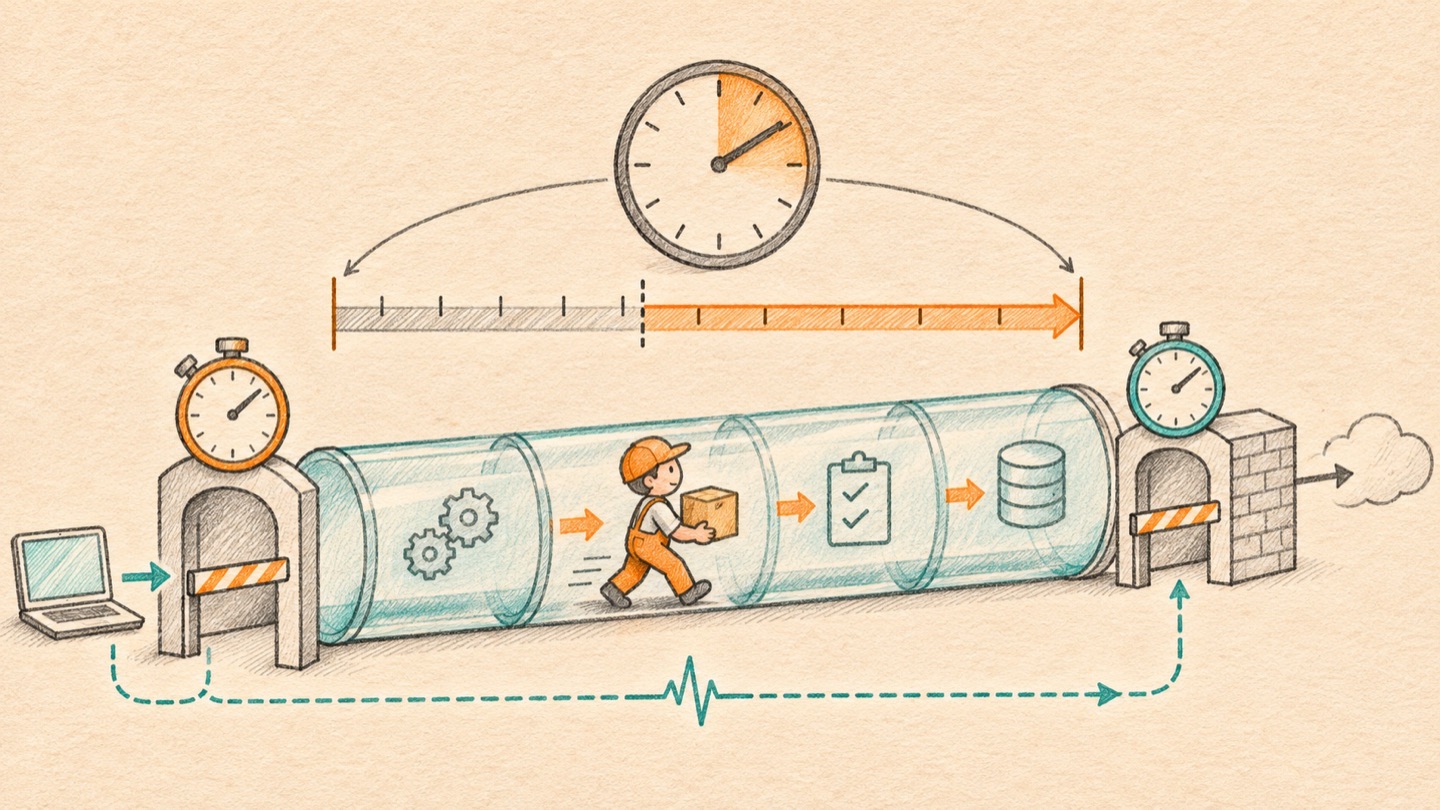
A longer function timeout can remove a workaround from a system diagram, but it does not lengthen every link around that function. AWS’s November 19 change raises the maximum timeout for on-demand Lambda Event Functions from 15 to 30 minutes. The practical limit for an HTTP-triggered job is still the shortest timeout across the function, caller, network path and any upstream service.
That distinction matters because “Lambda can run for 30 minutes” is easy to misread as “a request can wait 30 minutes.” The new ceiling is available for synchronous, asynchronous and event source mapping invocations of on-demand Event Functions. Synchronous invocations on Lambda Managed Instances also gain the 30-minute limit; asynchronous and event source mapping invocations there retain the separate 90-minute maximum introduced earlier. AWS says the release is available in commercial Regions and uses standard Lambda pricing. [1]
The timeout is one link in a chain
For a synchronous API request, the caller needs to remain willing to wait. AWS calls out service-side limits, client read and socket timeouts, and a 350-second idle-connection timeout on NAT gateways. A function that spends a long interval without sending bytes can lose its network connection long before its compute timeout expires. Keep-alives may help with the idle connection, but they do not override a client or proxy deadline. [2]
A simple example: an endpoint starts a 22-minute media conversion and holds the response open. The function limit now permits the work. But if the load balancer closes the request after a shorter interval, the client sees a failure while the function may continue consuming compute. Retrying can then duplicate work unless the operation has an idempotency key or durable job record. The timeout setting alone does not provide cancellation or exactly-once behavior.
This makes the new limit most useful when the surrounding contract is designed for a long request: the caller’s timeout is longer, every network hop is understood, idle connections stay active where necessary, and retries are safe. For user-facing APIs, a queued job with a status resource often remains easier to operate. Return a job identifier quickly, store progress durably, and let clients poll or subscribe rather than tying up one request for tens of minutes. That pattern is also the core reason teams adopt durable workflow orchestration for work that must survive pauses and retries.
When a longer invocation helps
The change can simplify workloads that already fit an event-driven function model but narrowly exceeded 15 minutes: some inference, conversion, and batch processing jobs are AWS’s examples. It may reduce the need to split one naturally bounded task into artificial chunks. That can remove orchestration state and partial-output handling, although it also creates a longer-lived failure unit.
Before changing production, measure duration distributions and cost per successful job. A 30-minute ceiling is a maximum, not a recommendation to let functions run longer. Confirm that a timeout does not leave an external operation half-complete, that duplicate delivery is handled, and that logs and tracing can identify a stalled stage. If the task must survive interruptions or span longer workflows, Lambda durable functions can run for up to a year; that is a different execution model and deserves its own retry and checkpoint design. [2]
A practical rollout check
Try one representative job in a non-production environment. Set the function timeout, then inspect the limits of its caller, API gateway or service integration, SDK, NAT path and external dependencies. Test a slow response that sends no data for several minutes. Then test a client disconnect and a retry while the first invocation is still running. The expected result should be defined before raising the timeout.
The useful change is real: more work can fit inside one Lambda invocation. The operational boundary has simply moved outward, not disappeared. For systems that need a human to wait on the response, the end-to-end deadline still belongs to the whole path.
Frequently asked questions
What is the main operational change?
The maximum timeout for on-demand Lambda Event Functions rose from 15 to 30 minutes; Lambda Managed Instances gain that ceiling for synchronous calls, while their asynchronous and event source mapping paths retain a 90-minute limit.
What should teams test before raising a timeout?
Check the caller, proxies, sockets, NAT idle behavior and duplicate-work handling. A longer function limit does not extend those surrounding deadlines.
Sources & further reading
Keep reading

Lambda’s Customer-Managed Runtimes Turn Runtime Updates Into a Platform Contract
AWS Lambda can distribute shared runtimes without per-function redeploys, while runtime publishers gain code authority under each function’s execution role.
How Netflix Uses AI Agents for Performance Engineering
How Netflix deploys autonomous AI agents to parse flame graphs, diagnose latency spikes, analyze canaries, and optimize cloud infrastructure.

AWS STS GetScopedCredentials Gives Agents Less Access, Not New Identity
AWS STS can derive narrower, shorter-lived temporary credentials while preserving caller identity, a useful least-privilege boundary for agents.
/* Comments */
Comments are offline right now — we reconnect automatically, nothing is lost.