
AWS VPN Defaults Narrow in 2027. Existing Tunnels Stay Put
From March 2027, new AWS Site-to-Site VPNs default to a narrower cryptographic set; existing tunnels stay unchanged.
On this page
A default is an invisible configuration decision until a new connection fails to negotiate. AWS has announced that, starting March 1, 2027, newly created Site-to-Site VPN connections will offer only its recommended cryptographic algorithms by default. An on-premises appliance that supports only older negotiation options can then fail to establish a tunnel unless the deployment explicitly requests compatible settings. The change is prospective: AWS says it will not rewrite existing VPN configurations. [1]
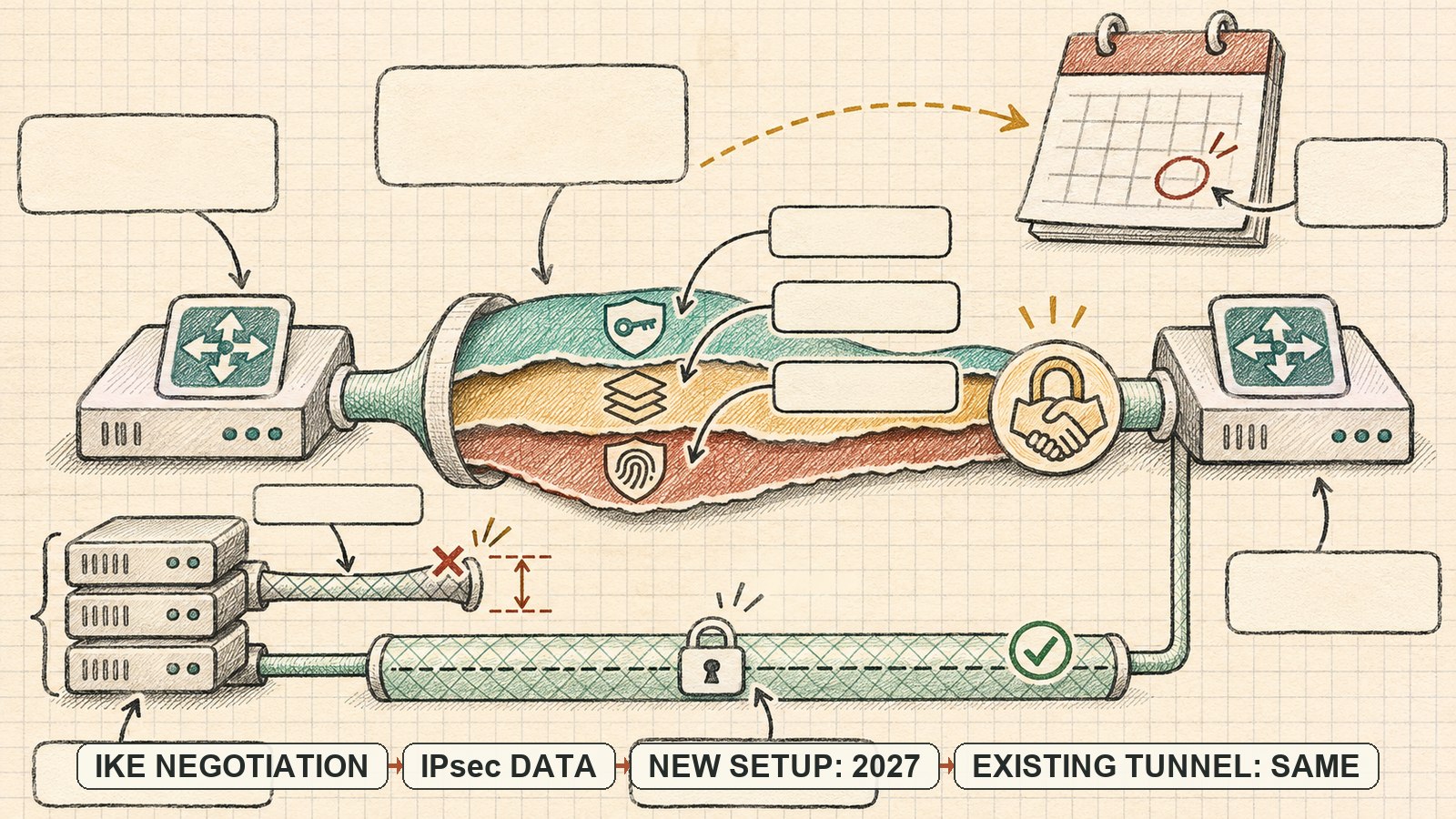
The default narrows; the protocol roles do not
A Site-to-Site VPN uses IKE to negotiate tunnel parameters and IPsec to protect traffic across the data plane. The allowed algorithm lists determine what the AWS side and customer gateway can agree on. AWS says the new default will use IKEv2, AES256-GCM-16, SHA2-384 and Diffie-Hellman group 20 for the relevant phases, rather than enabling every supported option. [1]
Each choice serves a different function. AES-GCM provides authenticated encryption; SHA2-384 is used for the pseudorandom function and integrity; Diffie-Hellman group 20 provides an elliptic-curve key exchange. These are not interchangeable labels for “stronger encryption.” A peer has to support the negotiated suite on both sides of the tunnel. NIST’s key-management guidance is useful background for evaluating cryptographic transitions, while the AWS guide defines the service’s actual tunnel options. The negotiation idea also appears in TLS handshakes, though IKE/IPsec is a separate protocol with different control and data planes. [1] [2] [3]
The compatibility implication is concrete. If an appliance cannot use IKEv2 or the selected group, a new connection that relies on AWS’s defaults may fail to negotiate. AWS says non-recommended algorithms remain available when explicitly requested. This applies to console-created connections and infrastructure-as-code via CloudFormation, CDK or Terraform; a template that omits options is still relying on defaults, even if its source has not changed. [1]
Existing tunnels are not silently changed
AWS says existing connections retain their current configuration on March 1, 2027. That means the announced date is not a forced cutover for every active tunnel. A team can continue operating an existing connection while planning a separate migration. AWS notes that updating a tunnel causes brief downtime for that tunnel, so changes should be performed deliberately and one tunnel at a time where redundancy allows. [1]
This is a useful distinction for change planning: the new-creation default affects future provisioning, while a crypto migration changes a running connection’s negotiated suite. A deployment system may recreate a tunnel during a replacement or disaster-recovery exercise, however, so “existing connection unaffected” does not guarantee that an old configuration will survive every later rebuild.
Teams can start with an inventory. AWS’s post points to GetActiveVpnTunnelStatus for checking the algorithms currently negotiated, and includes a read-only audit script across enabled Regions. Compare the result with the supported set on each customer gateway, including firmware and high-availability pairs. Do not infer compatibility from a product family name alone; vendors can vary support by firmware and configuration. [1]
Make automation explicit before the deadline
Search infrastructure repositories for CreateVpnConnection, tunnel options, VPN modules and environment-specific templates. Where the desired algorithms are the recommended set, encode them explicitly and validate the customer device before provisioning. Where a legacy peer requires an older suite, specify that exception in code and document its owner and review date. This avoids having an implicit default silently become a breaking change.
For an existing-tunnel migration, AWS outlines a safer sequence: inspect negotiated status, configure the customer gateway, confirm the tunnel re-establishes with the target algorithms, then narrow the AWS-side options. The order matters because the peers need an overlapping supported set while changes are applied. AWS’s audit and status APIs provide a way to confirm what is active rather than trusting the intended configuration alone. [1]
Teams should test the exact provisioning path in a non-production environment, including replacements and recovery workflows. Record the current negotiated options, target options, rollback settings and expected interruption. If the tunnel is one of two redundant paths, verify traffic failover before changing either side; the article’s guidance here is a planning recommendation, not a guarantee that a given network topology will fail over cleanly.
What this does and does not mean
The change is an AWS service default, not evidence that every legacy algorithm instantly becomes insecure or that every current tunnel must be replaced. AWS’s stated rationale is to apply its recommended configuration automatically to new connections. The service still allows explicit choices for interoperation. The useful operational response is to identify the peers that cannot negotiate the recommended suite and make those exceptions visible.
The longer-term question is how cryptographic defaults will evolve. AWS says it expects to update preferences, including post-quantum algorithms. That is a direction statement, not a date or a commitment that this specific transition includes post-quantum key exchange. Keep the change separate from post-quantum planning, and follow the actual service documentation for supported combinations. [1]
A VPN is only as deployable as the compatibility between its peers. Audit now, encode assumptions explicitly, and treat the March 2027 default as a provisioning change with a clear blast radius rather than a surprise outage.
Frequently asked questions
When do AWS Site-to-Site VPN defaults change?
Starting March 1, 2027, newly created connections default to the recommended IKEv2, AES256-GCM-16, SHA2-384 and Diffie-Hellman group 20 algorithms.
Will AWS change cryptography on my existing VPN tunnels?
No. AWS says the new default applies only to new connections. Existing tunnel settings remain as configured unless an operator chooses to migrate them.
Can a new AWS VPN still use older algorithms after March 2027?
Yes. AWS says customers can explicitly opt in to non-recommended algorithms when needed for interoperability, but automation must specify them instead of relying on the changed defaults.
Sources & further reading
Keep reading

Git’s Six November Fixes Make Recursive Clones a Supply-Chain Checkpoint
Git 2.56.1 and maintenance releases address six vulnerabilities. Recursive clones deserve attention, but upgrading Git alone does not vet repositories.

AI Agents Proved Signal Properties Down to Machine Code. The Specification Still Needs You
AlphaProof Code connects Lean proofs to libsignal’s compiled binary. What it proves, what remains trusted, and how teams can use the pattern.

Managed Security Across Tenants Needs More Than a Single Sign-In
Microsoft says granular delegated access for Sentinel and Defender XDR is generally available in its Defender portal. Customer-approved scope remains essential.
/* Comments */
Comments are offline right now — we reconnect automatically, nothing is lost.