topic: ai-industry
author: Crashtech Editorial
date: Oct 7, 2026 · read: 2 min
updated: October 8, 2026
---
Big Tech’s Nuclear Pivot: Power Contracts, Reactor Restarts and SMRs
Microsoft, Google and Amazon are backing nuclear supply through different commercial structures. Power contracts do not remove grid and licensing constraints.
On this page
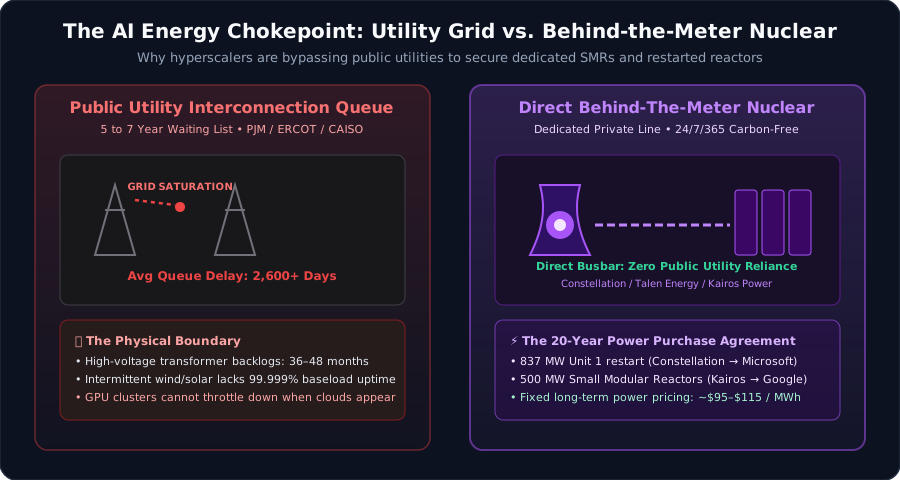
Conceptual architecture; arrows show relationships, not measured latency, energy or safety guarantees.
Microsoft’s agreement supports a restart
Constellation’s September 2024 announcement describes a 20-year Microsoft power purchase agreement supporting the restart of Three Mile Island Unit 1, renamed the Crane Clean Energy Center. The announced capacity is approximately 835 MW. Unit 1 is distinct from Unit 2, the reactor involved in the 1979 accident. [1]
The original announcement targeted 2028 and explicitly required regulatory approvals. Later financing and schedule developments should not be confused with an operating plant: the Department of Energy’s project page records a November 2025 loan supporting the restart. This article does not report that the reactor is already supplying Microsoft. [5]
Google is backing a development program
Google’s October 2024 Kairos agreement described up to 500 MW of new nuclear capacity, with the first deployment targeted for 2030 and further deployments through 2035. These are development targets, not existing output. Google’s announcement describes electricity added to US grids; it does not establish that every reactor will sit beside a data center. [2]
SMR is a size and deployment category, not one universal coolant or safety design. Licensing, manufacturing, financing and construction remain material constraints.
Amazon’s arrangement changed
Talen’s June 2025 announcement expanded its Amazon relationship to as much as 1,920 MW through 2042. It described a transition of the Pennsylvania campus to a front-of-the-meter arrangement after grid connection, with an interim behind-the-meter arrangement. Describing the whole deal as permanent independence from the public grid would be inaccurate. [3]
Read queue statistics carefully
Berkeley Lab’s 2024 report found a five-year median request-to-operation duration for generation projects completed in 2023. That is a dated statistic about generators seeking interconnection. It is not a universal five-year waiting time for a new data-center load. [4]
For an infrastructure decision, separate contracted energy, deliverable capacity, grid access and the facility’s required uptime. A long-term nuclear contract can improve supply planning without eliminating transmission constraints or the need for backup systems. Compare the complete power and cooling design rather than treating one fuel source as a shortcut around every bottleneck.
Frequently asked questions
Is Microsoft buying Three Mile Island?
Microsoft signed a 20-year power purchase agreement with Constellation. That supports the planned restart of Unit 1; it is not a purchase of the plant or proof of a direct private wire to a data center.
Does nuclear power bypass interconnection delays?
Not automatically. A project still needs the applicable licensing, grid, construction and commercial approvals. Generator interconnection queue statistics also do not directly measure data-center connection times.
/* Comments */
Comments are offline right now — we reconnect automatically, nothing is lost.