
topic: distributed-systems
author: Crashtech Editorial
published: Nov 17, 2026 · read: 4 min
---
High-Performance Rate Limiting at Databricks: In-Memory Local Coordination
How Databricks engineered ultra-low-latency distributed rate limiting: trading strict atomic precision for microsecond in-memory evaluations.
On this page
When building an API gateway for a cloud data intelligence platform like Databricks, handling rate limiting is not just about preventing abuse; it is about surviving massive, legitimate client bursts without adding latency to high-performance customer pipelines.
The naive rate-limiting pattern taught in textbooks is straightforward: on every incoming HTTP request, the gateway makes an atomic round-trip call to a centralized Redis cluster running a sliding-window Lua script.
At Databricks scale, this textbook pattern fails catastrophically:
- Making a network call to Redis on every single request adds 3 to 15 milliseconds of latency to every API call.
- Under traffic surges of hundreds of thousands of requests per second, the central Redis cluster becomes a massive CPU bottleneck and a single point of catastrophic failure. If Redis experiences network jitter, the entire global API gateway grinds to a halt.
To solve this, Databricks engineered a distributed rate limiter that makes a deliberate, brilliant systems trade-off: trading strict single-request precision in exchange for microsecond in-memory performance and high fault tolerance.
The Precision Trap vs Operational Reality
Why do software engineers instinctively demand that a rate limit of 1,000 requests per minute be enforced with exact atomic precision?
Ask yourself: Does it matter to the health of your backend database if an abusive client manages to slip 1,012 requests through instead of exactly 1,000?
The answer is almost always no. The purpose of rate limiting is coarse-grained resource protection: preventing denial-of-service collapse and ensuring fair tenant sharing. Demanding 100% mathematical precision on every microsecond forces you into expensive distributed synchronization locks that hurt innocent users.
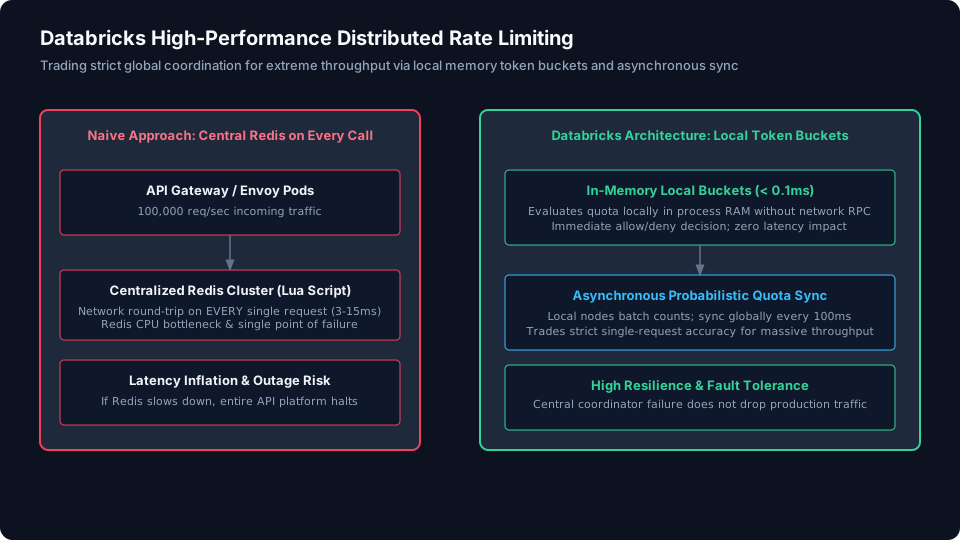
The Databricks Architecture: Local Token Buckets
Instead of coordinating globally on every request, Databricks moves rate evaluation directly into the local memory of each gateway worker node.
1. In-Memory Evaluation (< 0.1ms Latency)
When an API request lands on a gateway pod, the pod checks an in-process token bucket residing in local RAM. Because the lookup requires only an in-memory lock or atomic CAS (Compare-And-Swap) CPU instruction:
- The rate check takes less than 100 microseconds.
- Zero network I/O is performed in the critical request path.
- If downstream coordination services crash, gateway nodes continue serving traffic smoothly using local token reserves.
2. Quota Sharding and Dynamic Allocation
If an organization has a global quota of 10,000 requests per minute and Databricks operates 10 gateway pods, how do the pods divide the quota?
- Static Fractional Slicing: A naive approach divides 10,000 by 10, giving each pod 1,000 tokens. But traffic is rarely balanced uniformly across pods. If all user requests route to Pod 1, that pod throttles the user prematurely while Pods 2 through 10 sit idle.
- Dynamic Asynchronous Borrowing (The Databricks Way):
- Each pod maintains a local cache of tokens.
- When a pod consumes 80% of its local reserve, it fires an asynchronous background request to a central coordinator service to “borrow” a fresh chunk of quota from the global pool.
- The user’s request is approved immediately using the remaining local reserve without waiting for the network sync.
3. Asynchronous Sync and Probabilistic Throttling
During steady-state operation, gateway nodes batch token consumption counters and report them to the central coordination tier every 100 to 200 milliseconds.
If an attacker launches an aggressive DDoS attack that overwhelms a single pod:
- The local pod exhausts its token reserves within milliseconds.
- The local pod denies requests immediately (
429 Too Many Requests) without contacting the central coordinator. - The abusive traffic is dropped directly at the edge, shielding internal platform microservices from load spikes.
Architectural Comparison Matrix
| Dimension | Central Redis Architecture | Databricks In-Memory Local Sync |
|---|---|---|
| Latency Cost | 3 to 15 ms network round-trip. | < 0.1 ms in-memory CPU check. |
| Failure Mode | Central Redis outage crashes entire API. | Central outage degrades to local fallback; API stays up. |
| Precision | 100% exact atomic count. | Soft consistency (~98% accuracy during sudden spikes). |
| Throughput Ceiling | Bound by Redis single-thread CPU and NIC. | Scales linearly with gateway CPU cores and memory. |
Key Lessons for Systems Architects
- Trade Perfection for Performance: In high-throughput distributed systems, strict consistency is the enemy of low latency. Identify where soft consistency is acceptable.
- Keep the Hot Path Local: Never place a remote network call in the critical request path if an in-memory calculation can approximate the answer.
- Decouple Policy from Reporting: Make fast enforcement decisions locally; reconcile global reporting asynchronously in the background.
Keep reading
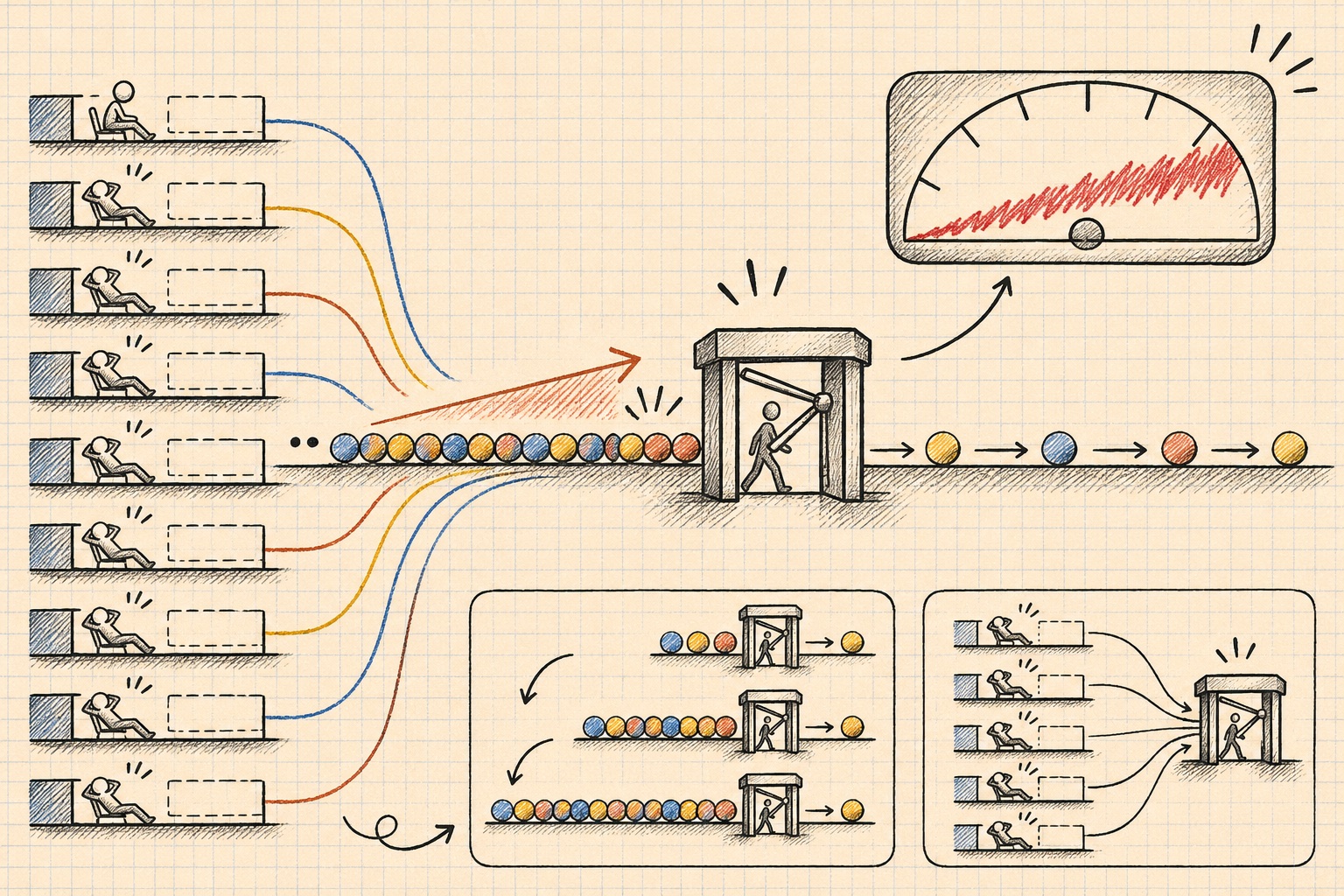
Inside the Microsoft 365 Gateway Failure: Lock Contention to Cascade
A technical reconstruction of how a gateway lock defect, shifted load and shrinking capacity can turn queued requests into fleet-wide failure.
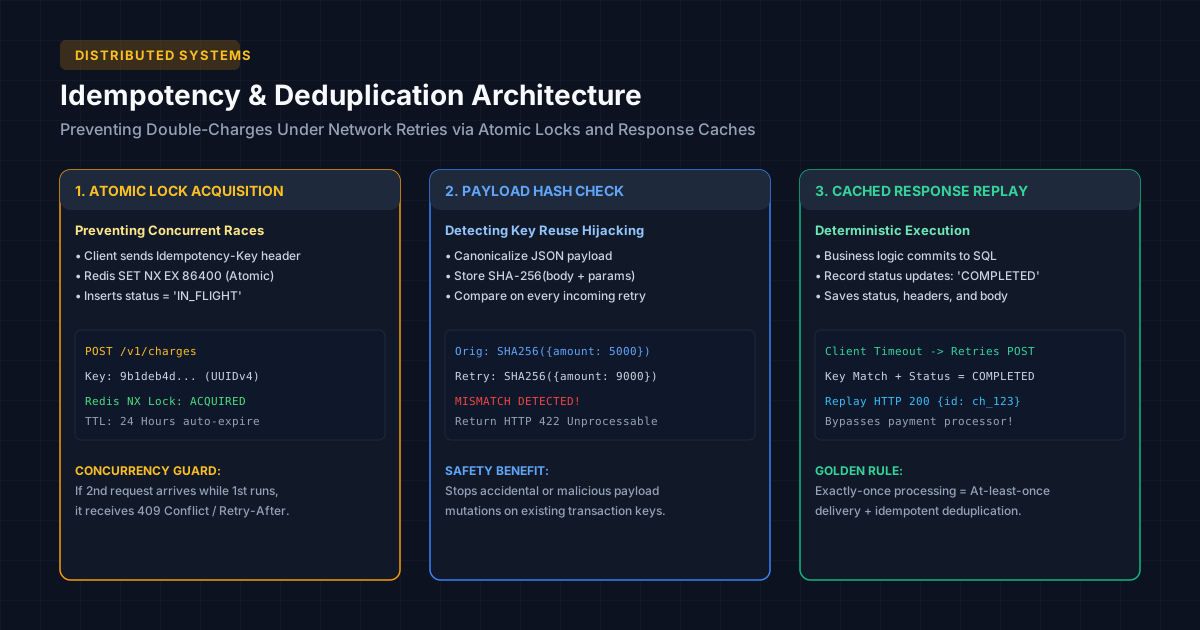
Retry Without Double-Charging: Idempotency Keys, Delivery Guarantees, and Deduplication
How payment gateways and distributed APIs prevent double charges: idempotency keys, at-least-once delivery, and atomic locking.
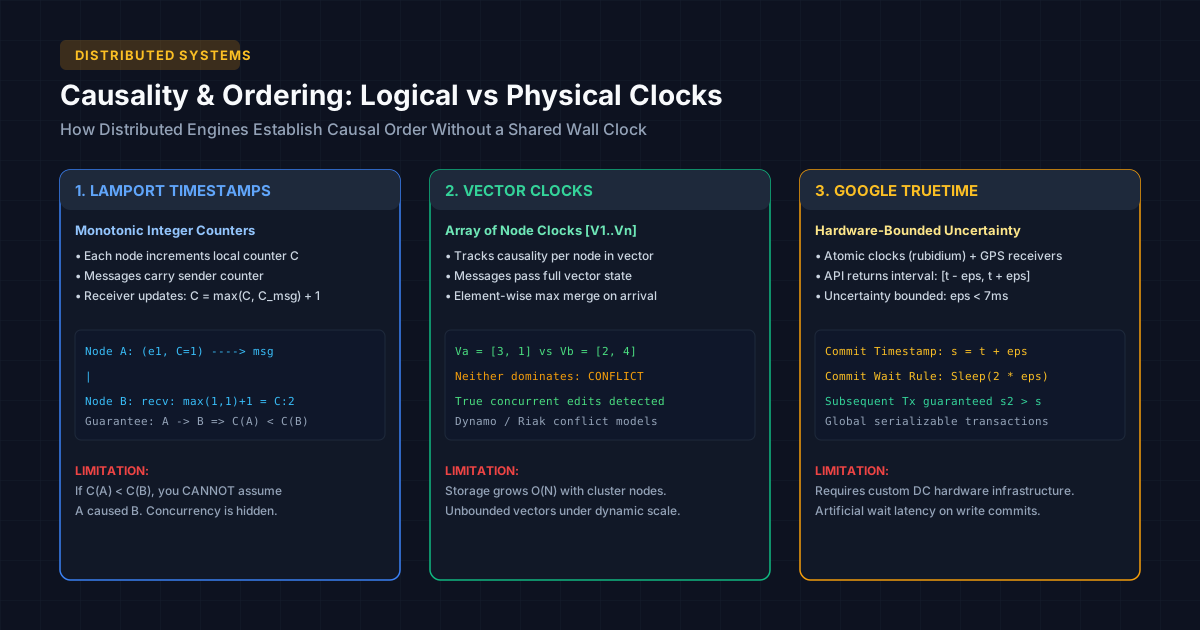
Whose Clock Is Right? Ordering Events Across Machines Without a Shared Time Source
Why physical clocks drift in distributed systems, and how Lamport timestamps, vector clocks, and TrueTime establish causal order.
/* Comments */
Comments are offline right now — we reconnect automatically, nothing is lost.