
Thousands of AI Agents Read a Brain-Cell Dataset in Parallel. What Did That Actually Buy?
OpenAI and Scripps describe parallel agents linking mouse brain-cell data to research literature and generating hypotheses for lab tests.
On this page
A large biological experiment can contain more patterns than a research team has time to investigate. OpenAI, PerturbAI and Scripps Research report using thousands of AI agents to explore a dataset covering millions of mouse brain cells, connecting gene perturbations to published research. The result is best understood as an expanded hypothesis search: a way to help scientists decide what might be worth testing next.
What the agents did
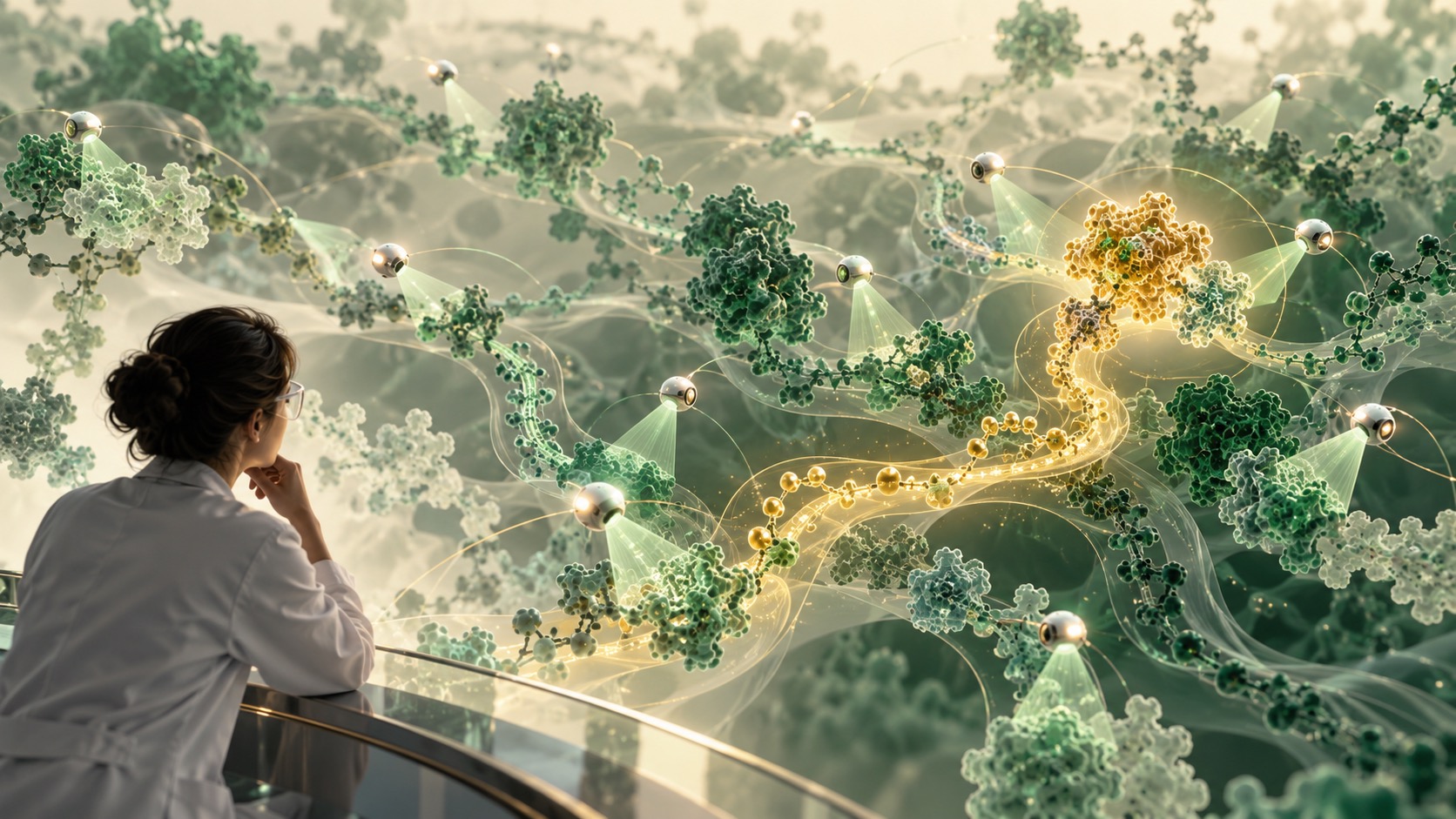
The researchers divided a whole-brain CRISPR atlas across many agents. Each investigated a gene disruption, examined cellular responses, searched scientific literature and proposed an explanation. The resulting “reasoning atlas” links gene perturbations, cell effects, papers and possible mechanisms. OpenAI says the analysis took 32 minutes and that the team estimated a comparable human review one perturbation at a time could take months to a year. [1]
The scale comparison needs careful handling. The reported human time is an estimate, not a randomized measurement of expert productivity. The agents’ task was not to run experiments or establish causation; it was to synthesize existing data and literature into candidate explanations. The preprint describes the work as distributed AI reasoning and reports a comparison with a single-agent condition. [2]
One example involves Tsc1 and Tsc2, genes associated with mTOR regulation. The researchers say the agents found different effects in cerebellar neurons after perturbation, and connected the observation to disease-related questions. Another lead links Dctn1 disruption with cholesterol-related gene expression. These are starting points for follow-up experiments; neither observation on its own demonstrates a disease mechanism or suggests that a treatment will work. [1] [2]
Why parallel agents could help
A single agent given a very large dataset must choose what to inspect first. Parallel workers can examine many perturbations at once and retrieve literature for each slice. In the reported comparison, OpenAI says the distributed setup cited more than 700 references at its largest workload, while the single agent cited 11. The paper reports that human experts preferred distributed-agent interpretations in blinded comparisons 75 percent of the time. These are study-specific metrics, not proof that more agents always yield better science. [1] [2]
Parallelism changes the search budget, but it also creates coordination work. Researchers must define what counts as evidence, deduplicate repeated findings, detect citation errors and distinguish a plausible narrative from a result supported by the underlying experiment. A larger reference list is valuable only if the sources are relevant and the interpretation is faithful to them.
The best role for this kind of system may be broad first-pass coverage. It can help researchers notice a relationship across data and disciplines that would otherwise be overlooked. Domain experts can then evaluate the strongest leads, inspect the raw measurements and design a test that could disconfirm the proposed mechanism.
The validation ladder
A useful way to read the work is as a ladder of evidence. First, an agent-generated connection is a candidate. Second, a researcher checks that the underlying data and cited paper say what the report claims. Third, an independent analysis tests whether the pattern survives alternative explanations and controls. Fourth, laboratory work examines the proposed mechanism. Only after repeated validation can a hypothesis support clinical or therapeutic conclusions.
The report currently occupies the first steps of that ladder. OpenAI says the reasoning atlas is available for researchers to explore. The preprint is the more detailed scientific account, and it remains a preprint rather than a peer-reviewed journal paper. Readers should preserve that distinction when comparing the results to established disease knowledge. [1] [2]
What research teams can take from it
Teams considering AI-assisted literature analysis should start with a bounded dataset and a question that can be checked. Preserve links from every claim to the source record, include uncertainty and conflicting findings, and sample outputs for expert review before using the tool to prioritize expensive experiments. Measure coverage and error types as well as speed.
Most of all, judge the system by whether it helps produce better experiments. Minutes of computation matter only if the saved time is spent validating hypotheses and learning from biological evidence. Distributed agents may widen the set of ideas scientists can examine. They cannot substitute for reproducibility, controls or the experimental work that turns a lead into knowledge. The same operating questions about delegation and human oversight appear in our guide to always-on AI agents and local agent privacy boundaries.
Frequently asked questions
What is the practical takeaway?
Verify the current source documentation and your own deployment or account configuration before acting. Announcements describe planned or reported behavior and do not replace product-specific validation.
Sources & further reading
Keep reading

OpenAI’s 12-Hour Prompt Cache Trades Cheaper Reuse for a Pricier Write
OpenAI adds a 12-hour cache option to Responses API. Learn when the higher write charge can pay back and what to measure.

OpenAI’s Orchestra Bio Deal Targets the Work Between a Discovery and a Trial
OpenAI is bringing Orchestra Bio into Rosalind. The acquisition targets drug-program coordination, while clinical outcomes remain unproven.

ChatGPT Ads Adds 26 Markets, but Advertiser Access Still Needs Checking
OpenAI says ChatGPT Ads is adding 26 countries. Advertisers should check where campaigns can actually be purchased.
/* Comments */
Comments are offline right now — we reconnect automatically, nothing is lost.