
Menu Digitization at Scale: OCR, LLMs and Guardrail Classifiers in Production
How DoorDash turns messy restaurant menu photos into structured JSON using OCR, multimodal LLMs, and a gradient-boosted LightGBM confidence guardrail.
On this page
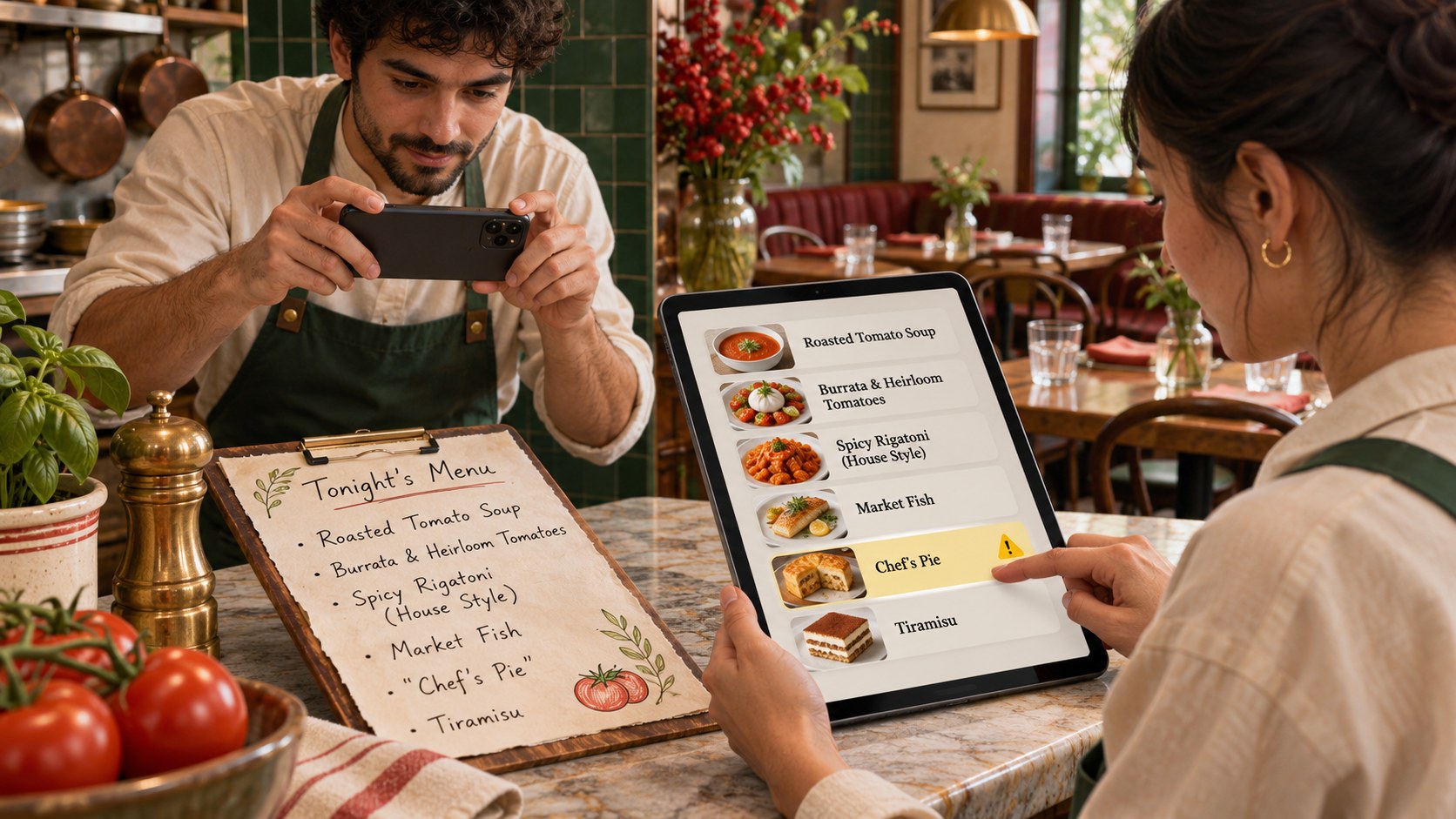
On delivery platforms, stale or incorrect menus directly cause customer cancellations, driver delays, and refund disputes. Because hundreds of thousands of independent restaurants update specials, seasonal items, and prices on physical chalkboards and printed paper, manual data entry cannot keep pace. Automating this transformation demands handling imperfect real-world inputs.
The Baseline MVP: Why Pure OCR + LLM Breaks Down
The initial digitization prototype connected a standard document scanner or mobile photo to Optical Character Recognition (OCR), feeding extracted raw text strings into an LLM prompt instructed to output structured JSON:
[Menu Photo] ---> [Cloud OCR Engine] ---> [Text Stream] ---> [LLM Parser] ---> [Structured JSON]While effective on synthetic digital PDF menus, the pipeline fractured when exposed to real-world merchant uploads. Production failure modes fell into three distinct buckets:
| Failure Mode | Physical Cause | Downstream Error |
|---|---|---|
| Inconsistent Structure | Multi-column layouts, rotated headers, handwritten daily specials | OCR reads horizontally across columns, interleaving ingredients from unrelated items |
| Incomplete Capture | Cropped smartphone camera angles, partial pages | LLM hallucinates parent categories or invents prices for missing modifier sections |
| Degraded Image Quality | Flash glare on laminated plastic, greasy lenses, dim ambient lighting | OCR generates garbage unicode fragments; LLM attempts to interpret noise as dishes |
Human quality assurance audits revealed that when OCR tokens lost geometric context, downstream LLMs confidently hallucinated realistic-sounding but completely fabricated menu items.
The Architectural Solution: A Tri-View Guardrail Classifier
To achieve high automation throughput without polluting the live production catalogue with hallucinations, engineering teams introduce a Guardrail Classifier.
Instead of trusting the LLM’s self-reported confidence, the guardrail operates as an independent binary classifier:
- Predicts High Accuracy: The structured menu JSON is directly committed to the production catalogue.
- Predicts Potential Error: The photo and machine-generated draft are escalated to a human operations queue for rapid verification.
                  [Menu Photo Upload]
                           |
            +--------------+--------------+
            |                             |
      [Vision Pipeline]           [Transcription Engine]
    (Brightness, Blur, Glare)      (OCR + Multimodal LLM)
            |                             |
            |                     [Structured Schema]
            |                             |
            +------------+----------------+
                         |
             [Tri-View Feature Extraction]
             - Image Quality Vectors
             - OCR Token Confidence & Entropy
             - LLM Internal Consistency Metrics
                         |
                         v
            [LightGBM Guardrail Classifier]
                         |
           +-------------+-------------+
           | (Score >= Threshold)      | (Score < Threshold)
           v                           v
     [Auto-Publish to DB]     [Human Review Queue]
Feature Engineering: Fusing Image, Text and Schema Signals
The guardrail classifier inspects features across three separate stages of the pipeline:
1. Image-Level Signals
- Photometric Analysis: Laplacian variance (blur detection), histogram equalization spread, luminance percentiles (detecting underexposure or blinding camera flash).
- Geometric Sanity: Aspect ratio bounds, detected document boundary corners, and perspective skew angles.
2. OCR-Derived Signals
- Confidence Distribution: Mean, median, and 10th percentile character-level recognition confidence scores from the OCR bounding boxes.
- Lexical Coherence: Ratio of dictionary-valid words to non-alphanumeric character noise (filtering out garbage tokens produced by glare).
- Spatial Dispersion: Density of bounding box clusters and horizontal alignment variance across columns.
3. LLM Schema Signals
- Price-to-Item Ratios: Ratio of detected numerical price entities to extracted item titles (detecting missing price columns).
- Category Cardinality: Total count of parent categories versus leaf items; uncharacteristically flat or excessively deep hierarchies indicate structural parsing failures.
- Formatting Entropy: Perplexity markers and JSON schema validation retry counts.
Model Selection: Why LightGBM Beat Deep Neural Networks
During architectural exploration, engineers evaluated several multimodal deep learning architectures against classical gradient boosting:
| Architecture | Model Family | Production Accuracy | Inference Latency | Training Data Hunger |
|---|---|---|---|---|
| Vision Transformer (ViT) + MLP | Pure Transformer | Low-Medium | 140ms | Extremely high (overfits easily) |
| Document Image Transformer (DiT) | Layout-aware Transformer | Medium-High | 210ms | High |
| ResNet-50 + Dense Fusion | CNN + Tabular MLP | High | 65ms | Moderate |
| LightGBM (Gradient Boosted Trees) | Decision Tree Ensemble | Highest | sub-5ms | Low (thrives on small datasets) |
The Data Constraint Reality
Deep vision-language fusion models require hundreds of thousands of meticulously annotated training examples to learn subtle correlations between image artifacts and text transcription errors.
In contrast, extracting domain-engineered tabular features (token densities, blur variances, schema cardinality) allowed LightGBM to construct robust decision boundaries with only a few thousand labeled samples. Furthermore, sub-5ms CPU inference enabled the guardrail to execute within the synchronous ingestion loop without provisioning expensive GPU clusters.
The Production Routing Loop
In production, the platform pairs the fast OCR pipeline with multimodal LLM validation:
- Multimodal LLM Verification: For complex multi-column menus, a vision-language model inspects the full image directly, preserving spatial relationships that linear text OCR destroys.
- Deterministic Threshold Tuning: The classification threshold on the LightGBM model is tuned against business constraints. Raising the auto-publish bar eliminates customer-facing errors while increasing human review volume; lowering it boosts automation speed.
- Active Learning Feedback: Any corrections submitted by human operators are serialized as new feature rows, continuously retraining the LightGBM classifier on edge cases.
By combining automated multimodal extraction with a rigorous tabular guardrail, engineering teams convert fragile AI experiments into reliable, self-healing enterprise production pipelines.
This tiered architecture demonstrates that production AI maturity lies not in relying blindly on a single foundation model, but in surrounding generative models with deterministic feature extraction, statistical safety checks, and pragmatic human-in-the-loop escalation paths.
Frequently asked questions
Why did a simple OCR plus LLM pipeline fail on real-world menus?
Real menus feature multi-column layouts, decorative mixed typography, glare, and partial camera cropping. Optical Character Recognition (OCR) scrambled text reading orders, causing the LLM to hallucinate parent-child relationships and attach prices to incorrect food items.
What is the role of the guardrail classifier in the ingestion pipeline?
The guardrail classifier evaluates image quality metrics, OCR token confidence, and LLM schema consistency. It scores whether the automated transcription meets production accuracy thresholds, routing high-confidence outputs to instant publication and flagging uncertain menus for human operators.
Why did LightGBM outperform deep neural networks like ViT and ResNet for guardrailing?
In tabular multi-source feature environments with limited ground-truth labeled training data, gradient-boosted decision trees (LightGBM) converge faster, resist overfitting, and evaluate inference in sub-millisecond windows compared to multi-head transformer networks.
How do multimodal LLMs complement traditional OCR extraction pipelines?
Multimodal LLMs analyze visual spatial layout and graphical hierarchy directly, resolving complex multi-column blocks that break OCR. However, traditional OCR remains more resilient against low-light and high-noise images, making a hybrid ensemble optimal.
Sources & further reading
Keep reading

How Deep Research Agents Work: Orchestrators, Parallel Sub-Agents, and Cited Synthesis
Inside deep research architectures across OpenAI, Gemini, and Claude: planning supervisors, parallel search sub-agents, and verifiable claim attribution.

OpenAI Prompt Objects Scheduled to Shut Down November 30: A Migration Guide
OpenAI schedules its reusable prompt-object endpoint for shutdown on November 30, 2026. Here is how teams can migrate prompts into code and evals.

Inside Dropbox Dash’s RAG: Permission-Aware Search and a Minimal Agent Interpreter
Dropbox describes how Dash combines cross-app retrieval, access controls, ranking features, and a restricted Python interpreter for AI agents.
/* Comments */
Comments are offline right now — we reconnect automatically, nothing is lost.