
They Call It Dynamic Pricing. It’s Surveillance Pricing
Grocery chains are reportedly using cameras and AI to price basic goods based on your face, not supply and demand. Here's how the system works.
On this page
The paper price tag is disappearing from grocery store shelves, and what’s replacing it is not just a screen. According to reports, retailers including Kroger and Walmart have been deploying “Edge”-style electronic shelf label systems that can rewrite a product’s price instantly, store-wide, from a central algorithm. The pitch is operational efficiency. The practical effect, reporters and researchers increasingly argue, is a system capable of pricing you — not the product.
How does a grocery store change your price without touching a sticker?
The short answer: electronic shelf labels (ESLs) replace paper tags with small digital displays wired into a central pricing system, and that system can push a new number to every shelf in the store in seconds. Layer in a camera or a loyalty-app signal that estimates who’s standing there, and the “market price” quietly becomes a personal one.
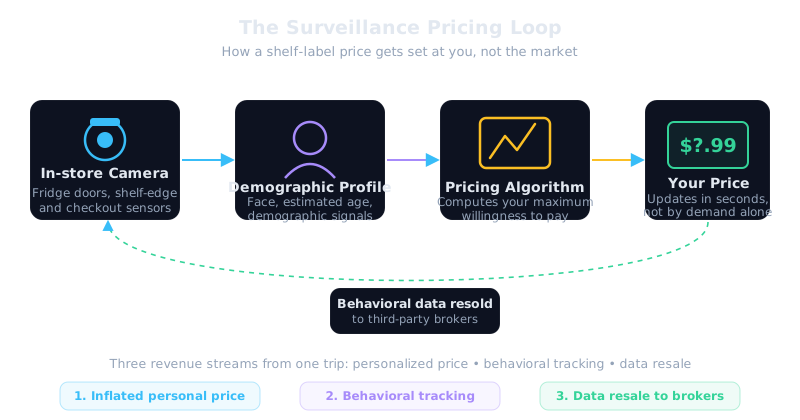
That single image is the whole controversy in one loop. According to reports, Kroger has specifically partnered with technology companies including Microsoft to embed facial-recognition-adjacent sensors inside digital refrigerator and cooler doors — ostensibly for inventory tracking and targeted advertising, but built on infrastructure that can also estimate a shopper’s age, gender, and other demographic signals in real time.
- Camera or sensor captures a shopper
A camera embedded in a cooler door, shelf edge, or overhead fixture reportedly detects a face or body in frame — no loyalty card or app login required.
- The system estimates a demographic profile
Age range, apparent gender, and other visual signals get run through a classification model to build a rough profile of “who is buying right now.”
- A pricing algorithm computes your ceiling
Rather than asking “what does this product cost,” the system reportedly asks “what is the most this specific shopper will tolerate paying,” using demographics, time of day, weather, and local demand signals as inputs.
- The electronic shelf label updates instantly
The new price is pushed to the digital tag in seconds — no restock, no printed sticker, no paper trail of what the price was five minutes ago.
Airlines have adjusted seat prices by demand for decades — that’s aggregate, time-based, and transparent-ish. Surveillance pricing is different: it’s reportedly individualized, based on who the camera thinks you are, and applied to something as mundane as a gallon of milk. The underlying good hasn’t changed. You have.
Why does this create a discrimination problem, not just a privacy one?
Because the demographic-estimation models doing the classifying are reportedly imperfect, and their errors are not evenly distributed. If a flawed facial-analysis system misreads someone’s age or ethnicity more often for one group than another, and that misread feeds directly into a price, the same bias that makes facial recognition unreliable for identification becomes a mechanism for systematically overcharging the groups it already misclassifies most.
That’s the part that moves this from “annoying” to “legally dangerous.” Basic household goods — bread, milk, diapers — could reportedly surge in price for reasons that have nothing to do with supply and demand: the weather outside, the time of day, or simply who the system believes just walked up to the shelf.
Same price for everyone in a given window. Airlines, ride-share surge pricing, hotel rooms — price moves with collective demand, visible to all shoppers equally.
Price reportedly varies person to person, in the same store, at the same moment, based on a camera’s best guess about who you are.
There’s also a quieter, second-order risk: economists and consumer advocates have pointed out that when every major retailer in a region runs its own AI pricing engine reacting to the same signals, prices can drift upward in near-lockstep without anyone picking up a phone to collude. The algorithms don’t need to talk to each other — they just need to respond to the same inputs the same way, softening the competitive pressure that’s supposed to keep grocery prices honest. It’s a dynamic our coverage of what happens when AI runs the country touches on more broadly: systems that optimize for efficiency at scale tend to produce outcomes no single actor explicitly chose, and no single actor is clearly liable for.
What’s actually in it for the retailer — beyond the higher price?
This is the part that gets underplayed in most coverage: a single shopping trip under a surveillance pricing system reportedly generates three separate revenue streams, not one.
| Revenue stream | What it captures | Who benefits |
|---|---|---|
| Personalized price | The maximum an individual shopper will tolerate paying, per item | The retailer, at checkout |
| Behavioral tracking | Dwell time, routes through the store, what you looked at and didn’t buy | The retailer’s internal analytics |
| Data resale | Aggregated or profiled shopper data sold onward | The retailer, plus third-party data brokers |
The price you pay at the register is, in this model, just the most visible of the three. The camera doesn’t stop working once you’ve decided what’s in your cart — it’s reportedly still logging dwell time, gaze direction, and route through the store, and that behavioral exhaust has value to advertisers and data brokers independent of anything you actually purchase. A grocery trip stops being a single transaction and starts looking like a data-harvesting session with a retail transaction attached. That’s a version of the same pattern we’ve tracked in the AI backlash getting worse — infrastructure marketed as convenience quietly repurposed as a data pipeline.
Do
- Check whether your grocery chain discloses ESL/camera systems in its privacy policy
- Pay attention to price differences between visits, not just between stores
- Support state-level bans with actual enforcement teeth, not symbolic ones
Don't
- Assume “dynamic pricing” language on shelf tags is harmless demand-based adjustment
- Treat opting out of a loyalty app as opting out of in-store camera tracking
- Wait for retailers to self-regulate a system this profitable
Did Maryland actually fix this — and why isn’t it enough?
Maryland reportedly became the first U.S. state to ban dynamic pricing in grocery stores, establishing a real legal precedent that surveillance-based grocery pricing is a problem worth legislating against. That matters symbolically. But according to reports, the law was passed without fines or an enforcement mechanism attached — meaning a multi-billion-dollar retailer that ignores it faces essentially no financial consequence for doing so.
Passing a law is not the same as changing incentives. Without fines, audits, or a regulator empowered to investigate complaints, Maryland’s ban reportedly functions more like a formal objection than a deterrent — a polite request a company with billions in quarterly revenue can simply decline.
That gap is the real story here, and it’s one national infrastructure debates keep running into: power infrastructure fights like the one in the Lake Tahoe area show the same pattern — local and state pushback registers as a headline, but without federal weight or enforcement funding behind it, the underlying build-out barely slows down. Surveillance pricing looks headed the same way unless something changes at a level bigger than one state legislature.
What would real protection against surveillance pricing actually look like?
It would need three things Maryland’s law reportedly doesn’t have: mandatory disclosure of camera-based pricing systems, financial penalties large enough to change a retailer’s cost-benefit math, and a federal floor so retailers can’t simply route the practice to states without a ban. Anti-discrimination statutes already on the books could, in principle, apply if surveillance pricing is shown to systematically disadvantage protected groups — but that requires someone with standing, evidence, and resources to bring the case, which is a much higher bar than a store simply not doing this in the first place.
Absent that kind of coordinated federal response, the trajectory is fairly predictable: more chains adopt electronic shelf labels for the legitimate reasons (labor costs, markdown automation, inventory accuracy), the camera and demographic-inference layer gets bundled in because the hardware increasingly supports it by default, and the line between “smart shelf” and “surveillance pricing” gets blurrier every fiscal quarter. The predictability that’s supposed to define buying a gallon of milk — the idea that the price on the tag is the price everyone pays — is exactly what’s at stake.
Grocery pricing used to be one of the few remaining transactions where the number on the tag was the number for everyone. Surveillance pricing, deployed at scale and unpoliced, ends that. Not because any single price hike is dramatic, but because the system reportedly making the decision knows more about you than it does about the product — and until a law exists with real consequences attached, that asymmetry has no meaningful check.
Frequently asked questions
What is surveillance pricing at grocery stores?
Surveillance pricing is when retailers use cameras and AI to estimate a shopper's age, demographics, or behavior, then set an individually tailored price for the same product — rather than one price for everyone based on supply, demand, or cost. It's reportedly enabled by electronic shelf labels that update instantly.
Is dynamic pricing in grocery stores legal?
In most of the United States, yes. Maryland is reportedly the first state to ban dynamic pricing in grocery stores, but the law has no fines or enforcement mechanism attached. Everywhere else, retailers can legally change prices per shopper as long as they don't violate existing anti-discrimination statutes.
Did Kroger use facial recognition to set prices?
Kroger has reportedly partnered with technology companies, including Microsoft, on digital shelf and cooler-door systems capable of facial-recognition-adjacent demographic detection. Kroger has publicly denied using the technology to charge individual shoppers different prices, but critics note the infrastructure supports exactly that capability.
Can electronic shelf labels change prices based on who is standing there?
Electronic shelf label (ESL) systems can technically push a new price to a display in seconds, and when paired with in-store cameras or loyalty-app tracking, that price change can theoretically be triggered by who the system believes is standing in front of it, not just time of day or inventory levels.
Why is surveillance pricing considered discriminatory?
Facial recognition and demographic-estimation models have documented, reportedly higher error rates for women and people with darker skin tones. If those flawed classifications feed a pricing algorithm, the same errors that misidentify people could also systematically overcharge them for milk, bread, and other essentials.
/* Comments */
Comments are offline right now — we reconnect automatically, nothing is lost.