
The AI Engineering Stack: From GPU Warps and FlashAttention to Agents and MCP
A cohesive architectural map of modern AI engineering: connecting GPU streaming multiprocessors, KV cache memory, RAG, and multi-agent protocols.
On this page
In the fast-moving landscape of artificial intelligence, software engineers are bombarded with an overwhelming firehose of technical buzzwords: Streaming Multiprocessors, Warps, HBM3, GQA, PagedAttention, KV Cache, RAG, MCP, Autonomous Agents, and Large Reasoning Models.
Too often, these terms are presented in isolation as random glossary entries or hype-laden marketing jargon. In reality, modern AI engineering is an interconnected, deeply logical software and hardware stack. A bottleneck at the silicon GPU memory hierarchy directly explains why the KV cache exhausts server RAM; the physics of the KV cache directly explains why engineers need prompt caching; and the limitations of static prompt caching directly dictate why systems evolve into agentic retrieval loops.
To succeed as an AI systems engineer, you must understand how each layer of the modern AI stack mechanically connects to the layer below it.
The Full AI Engineering Stack
+-----------------------------------------------------------------------------+
|                          THE MODERN AI SYSTEMS STACK                        |
+-----------------------------------------------------------------------------+

 [Layer 5: Multi-Agent Collaboration & Protocols]
   - Model Context Protocol (MCP), Agentic Workflows, Human-in-the-Loop Gateways

 [Layer 4: Application Cognitive Harness]
   - Agentic RAG, Memory Reflection, Tool Invocations, Guardrails, Evals

 [Layer 3: Model Inference & Serving Optimizations]
   - Continuous Batching, PagedAttention, vLLM, Speculative Decoding, Prompt Cache

 [Layer 2: Foundation Model Architecture]
   - Grouped-Query Attention (GQA), Mixture of Experts (MoE), RoPE, Normalization

 [Layer 1: Silicon Hardware Execution]
   - GPU Streaming Multiprocessors (SMs), Tensor Cores, HBM Memory, PCIe Bus
Layer 1: Silicon GPU Architecture (The Physical Reality)
Every AI model ultimately compiles down to physical matrix multiplication executing on silicon accelerators (NVIDIA GPUs, Google TPUs, or Apple Silicon):
+-----------------------------------------------------------------------------+
|                         NVIDIA GPU SILICON ARCHITECTURE                     |
+-----------------------------------------------------------------------------+

 [High-Bandwidth Memory (HBM3): 80 GB at 3,350 GB/s]
                             |
                             v (L2 Cache: ~50 MB)
 +---------------------------------------------------------------------------+
 |                    STREAMING MULTIPROCESSORS (SMs)                        |
 |                                                                           |
 |  [Warp Scheduler] ---> Dispatches 32 threads in lockstep (A Warp)         |
 |  [L1 Cache / Shared SRAM: ~256 KB per SM]                                 |
 |  [Tensor Cores]   ---> Hardwired 4x4 FP16/FP8 matrix-multiply-accumulate  |
+---------------------------------------------------------------------------+- Streaming Multiprocessors (SMs): The primary compute engines of a GPU. An H100 GPU contains 132 SMs running in parallel.
- Warps & Warp Scheduling: Threads on a GPU execute in lockstep groups of 32 called a Warp. If code branches (if-else divergence), both branches must execute sequentially, halving efficiency.
- Memory Bandwidth Bottleneck: Tensor Cores can execute math at astronomical speeds (petaflops), but they spend most of their time starved for data, waiting for weights to be copied from external HBM memory across the bus into local on-chip SRAM registers.
Layer 2: Model Architecture (Designing for Memory Efficiency)
Modern model architectures are explicitly designed to minimize the memory bandwidth bottleneck discovered at Layer 1:
+-----------------------------------------------------------------------------+
|                     ATTENTION EVOLUTION: MHA TO GQA                         |
+-----------------------------------------------------------------------------+

 Multi-Head Attention (MHA - Llama 1)
   - 64 Query Heads, 64 Key Heads, 64 Value Heads.
   - Massive KV cache footprint; exhausts VRAM during multi-turn chats.

 Grouped-Query Attention (GQA - Llama 3)
   - 64 Query Heads share ONLY 8 Key and 8 Value Heads!
- 8x reduction in KV cache memory bandwidth with ZERO loss in reasoning power.- Mixture of Experts (MoE): Instead of activating all 400 billion parameters on every token, the model activates only a small routing subset (e.g., 2 experts out of 16, utilizing 39B active parameters). This grants the capacity of a massive model with the inference speed of a small model.
- Rotary Position Embedding (RoPE): Rotates Query and Key vectors in complex space to natively encode relative token distances, enabling context window expansion from 4k to 128k tokens.
Layer 3: Serving & Inference Systems
At the serving layer, engines like vLLM and TensorRT-LLM bridge hardware constraints to real-time client requests:
- PagedAttention: Solves physical memory fragmentation by allocating the KV cache in non-contiguous virtual memory blocks (identical to virtual memory paging in operating systems), reclaiming 60% of wasted GPU headroom.
- Continuous (Iteration-Level) Batching: Instead of waiting for an entire batch of requests to finish generating before starting new ones, the engine injects new prompts dynamically at every single iteration tick.
- Speculative Decoding: Uses a lightweight 1B “draft model” to speculatively generate 5 tokens at ultra-fast speeds, and uses the heavy 70B “target model” to verify all 5 tokens in a single parallel forward pass, accelerating inference 2.5x to 3x.
Layer 4 & 5: The Cognitive Agent Harness and MCP
Once fast inference is solved, the model is wrapped in an autonomous agent harness:
- The Agent Loop: Perception (ingesting environment state), Planning (decomposing goals into sub-tasks), Tool Execution (invoking external APIs), and Reflection (evaluating if the goal was achieved).
- Model Context Protocol (MCP): The open industry standard connecting models to data sources and tools. Rather than proprietary API wrappers, MCP standardizes
tools/listandtools/callover JSON-RPC 2.0, allowing agents to plug into GitHub, databases, terminal shells, and corporate systems universally.
Architectural Takeaway
The AI engineering stack is a unified continuum:
- Hardware memory bandwidth limits dictate why models adopt Grouped-Query Attention (GQA) and 4-bit quantization.
- Inference runtimes use PagedAttention and prefix caching to maximize token throughput across those hardware limits.
- Cognitive application harnesses use Agentic RAG and MCP to ground models in real-world tools and enterprise systems.
- Mastering the stack requires looking beyond prompt engineering and understanding the full mechanical pipeline from silicon gates to multi-agent protocols.
Keep reading
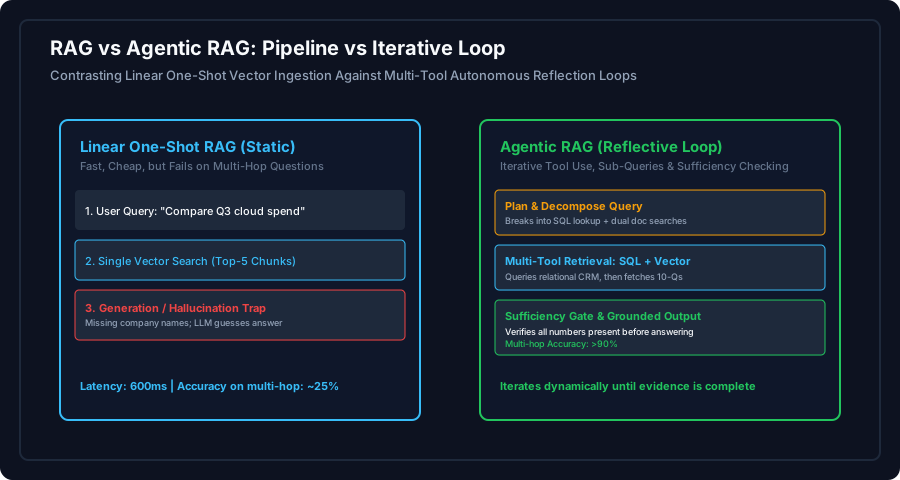
From One-Shot Retrieval to Agent Loops: How RAG Differs From Agentic RAG
Why static one-shot RAG fails on multi-hop questions, and how Agentic RAG introduces iterative planning, query rewriting, and sufficiency checks.
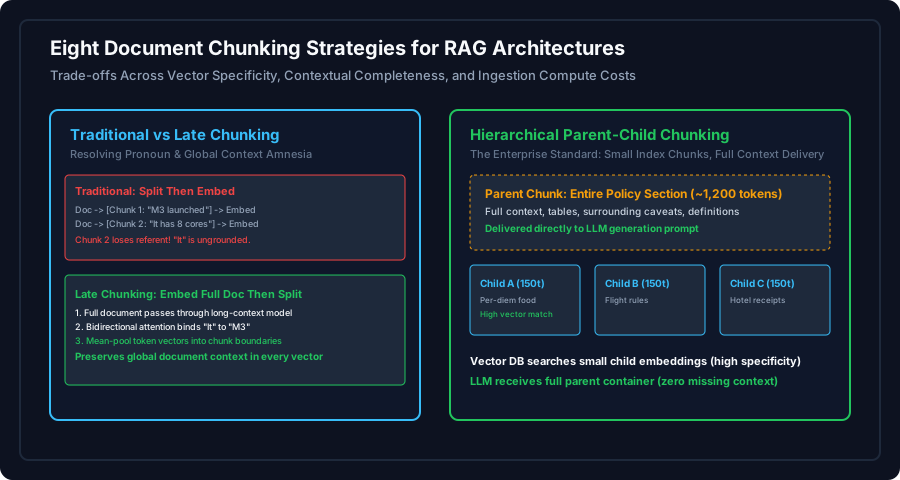
Choosing a Chunking Strategy for RAG: Fixed, Semantic, Late, and Hierarchical
A comprehensive architectural evaluation of eight document splitting strategies for RAG agents: trade-offs across retrieval recall, cost, and boundary noise.
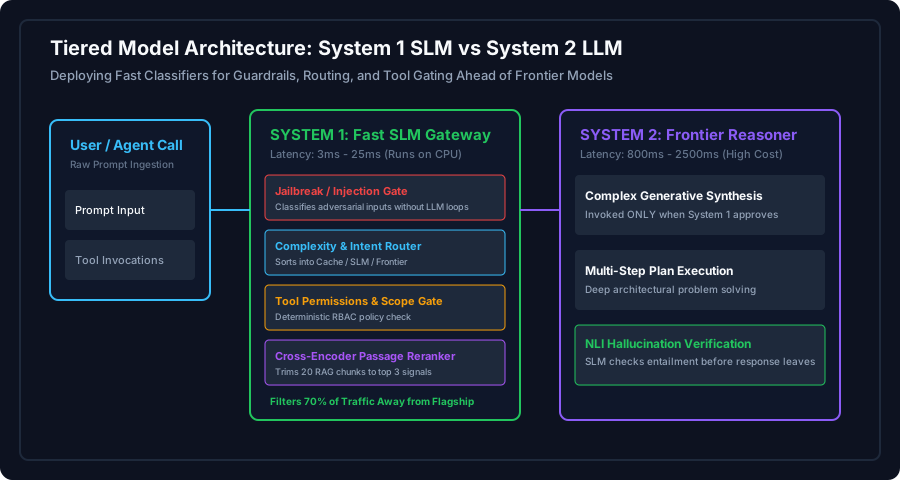
Where Small Fast Models Beat Frontier LLMs: Routing, Guardrails, and Tool Gating
Why deploying lightweight specialized models for triage, reranking, and safety gating outperforms monolithic frontier LLMs in latency, reliability, and cost.
/* Comments */
Comments are offline right now — we reconnect automatically, nothing is lost.