
From One-Shot Retrieval to Agent Loops: How RAG Differs From Agentic RAG
Why static one-shot RAG fails on multi-hop questions, and how Agentic RAG introduces iterative planning, query rewriting, and sufficiency checks.
On this page
Standard Retrieval-Augmented Generation (RAG) is a linear assembly line. A user submits a query, an embedding model turns the query into a vector, the vector database retrieves the top-5 nearest neighbor chunks, and an LLM synthesizes an answer.
For simple factual lookups (“What is our policy on parental leave?”), this linear pipeline works adequately.
However, when presented with real-world enterprise research questions, standard RAG fails consistently. Consider the question: “Compare the Q3 cloud infrastructure expenditures of our two largest European logistics clients.”
- A standard RAG pipeline executes a single vector query.
- It pulls generic chunks mentioning “cloud”, “Europe”, and “logistics”.
- It cannot know who the two largest European logistics clients are without first querying a relational database, finding their names, and then executing two secondary targeted document searches for their respective Q3 10-Q reports.
Linear RAG cannot solve multi-hop questions because answer quality is permanently capped by retrieval quality.
To overcome this, modern architectures transition from static one-shot RAG to Agentic RAG: an autonomous, reflective loop where an agent dynamically plans search strategies, executes multi-step tool calls, evaluates evidence sufficiency, and corrects its own course before generating an answer.
Architectural Anatomy: Linear RAG vs Agentic RAG
+-----------------------------------------------------------------------------+
|                          LINEAR RAG VS AGENTIC RAG                          |
+-----------------------------------------------------------------------------+

 [LINEAR ONE-SHOT RAG (Deterministic Pipeline)]
   Query ---> [Embed] ---> [Vector Search] ---> [Top-5 Chunks] ---> [LLM] ---> Answer
   - Execution: Static single pass
   - Failure Mode: If retrieved chunks are noisy or incomplete, LLM hallucinates.

 [AGENTIC RAG (Cyclical Multi-Step Loop)]
   Query ---> [Agent Planning Brain] <-----------------------------+
                     |                                             |
                     v                                             |
        [Tool Selection & Query Rewriting]                         |
         - Tool 1: Vector Search (Semantic)                        |
         - Tool 2: SQL DB Query (Tabular Structured)               | (Evidence
         - Tool 3: Web Scraper / Internal API                      |  Insufficient)
                     |                                             |
                     v                                             |
        [Candidate Evidence Retrieved]                             |
                     |                                             |
                     v                                             |
        [Sufficiency & Reflection Evaluator]                       |
         - Does this evidence actually answer the prompt?          |
         - Are there missing entities or conflicting facts? -------+
                     |
                     v (Evidence Sufficient & Verified)
        [Grounded Synthesis & Cited Response Delivery]
The Four Capabilities That Define Agentic RAG
Agentic RAG transforms information retrieval from a passive search into an active investigation:
1. Dynamic Query Planning and Sub-Query Decomposition
Faced with a complex question, the agent decomposes the prompt into discrete dependency tasks:
- Sub-Query 1: Query the CRM database via SQL to identify the top two European logistics clients by annual revenue.
- Sub-Query 2: Search the financial filing index for Client A’s Q3 cloud infrastructure line items.
- Sub-Query 3: Search the financial filing index for Client B’s Q3 cloud infrastructure line items.
- Sub-Query 4: Compute the percentage difference and synthesize comparative analysis.
2. Multi-Modal and Multi-Tool Retrieval
Linear RAG is trapped in a single vector database. Agentic RAG treats vector databases as just one tool in a broad toolbox:
- If the question asks for a specific numerical total: invokes a SQL tool against PostgreSQL.
- If the question asks for conceptual descriptions: invokes a dense vector search tool against Milvus.
- If the question contains exact part numbers or error codes: invokes a BM25 sparse lexical search tool against OpenSearch.
3. Self-Correction and Query Rewriting
When a vector search returns low-confidence scores or irrelevant chunks, linear RAG gives up and generates a hallucinated answer. Agentic RAG executes a Self-Correction Loop:
- The agent inspects the retrieved results and recognizes that the technical term used in the query (“K8s pod crash”) does not match the formal nomenclature in the documentation (“OOMKilled container lifecycle termination”).
- The agent rewrites the search query using formal synonyms and re-executes the search.
4. Evidence Sufficiency Checking
Before attempting generation, a dedicated verification step evaluates: “Do I have enough factual evidence to answer every part of the user’s prompt without guessing?” If evidence is missing, the agent continues searching. If repeated searches fail to surface the facts, the agent emits an explicit disclosure rather than confabulating.
The Cost, Latency, and Predictability Tradeoff
Agentic RAG is not free. It introduces significant operational tradeoffs that architects must weigh carefully:
| Metric | Linear One-Shot RAG | Agentic RAG |
|---|---|---|
| P50 Latency | 400ms to 900ms | 2,500ms to 8,000ms |
| Token Consumption | ~2,000 tokens ($0.005) | ~15,000 to 40,000 tokens ($0.15) |
| Execution Determinism | High (Predictable path) | Moderate (Dynamic loop iterations) |
| Multi-Hop Accuracy | 18% to 32% (Severe failure) | 86% to 94% (Near-perfect resolution) |
If your workload consists of straightforward lookups across clear FAQs, deploying Agentic RAG is an expensive mistake that will alienate users with 6-second wait times. However, for complex compliance research, financial audits, and multi-document intelligence analysis, Agentic RAG is the only architecture capable of producing reliable results.
Architectural Takeaway
Choose your retrieval architecture based on query complexity:
- Deploy Linear RAG for high-throughput, low-latency applications where queries map cleanly to single document passages.
- Deploy Agentic RAG when queries require multi-step reasoning, cross-system data joins (SQL + Vector), and autonomous self-correction.
- Cap agent search loops with strict iteration limits (e.g., maximum 3 tool iterations) and total time budgets to prevent infinite search loops.
Keep reading
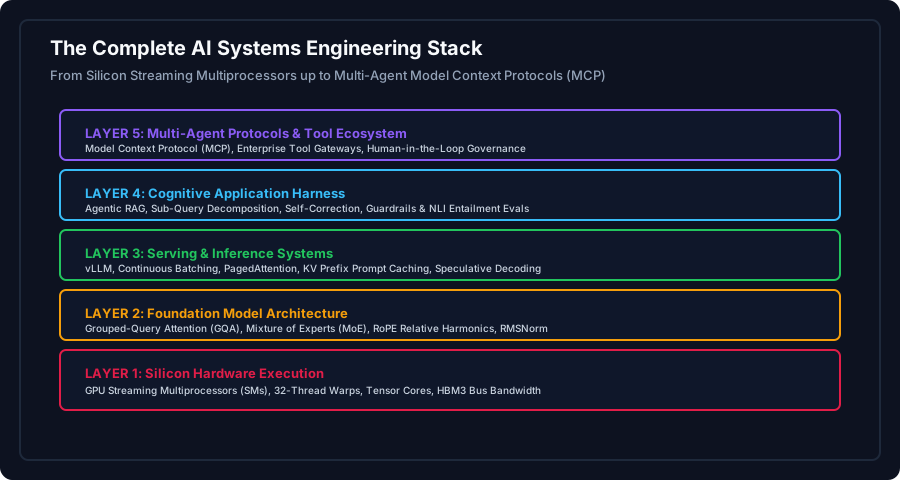
The AI Engineering Stack: From GPU Warps and FlashAttention to Agents and MCP
A cohesive architectural map of modern AI engineering: connecting GPU streaming multiprocessors, KV cache memory, RAG, and multi-agent protocols.
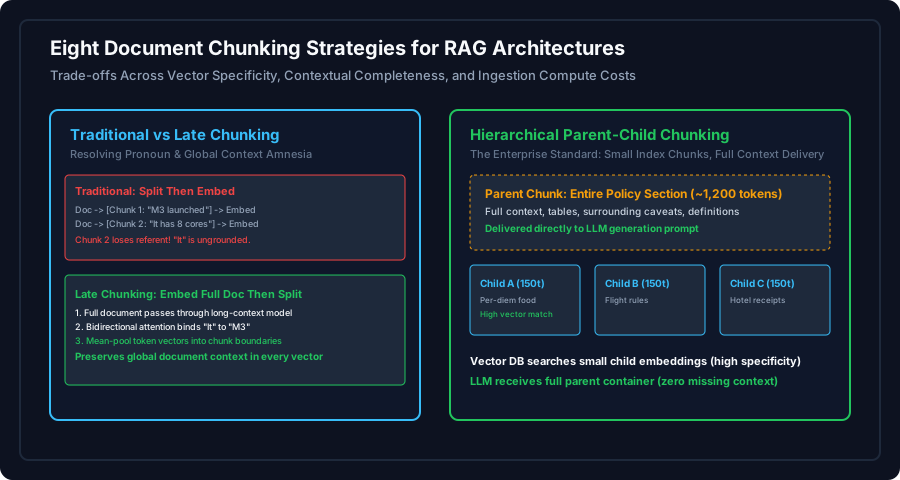
Choosing a Chunking Strategy for RAG: Fixed, Semantic, Late, and Hierarchical
A comprehensive architectural evaluation of eight document splitting strategies for RAG agents: trade-offs across retrieval recall, cost, and boundary noise.
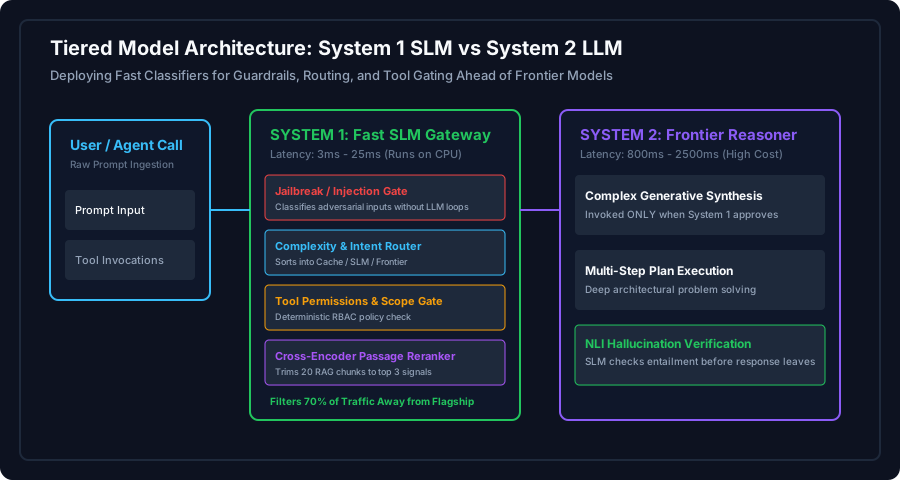
Where Small Fast Models Beat Frontier LLMs: Routing, Guardrails, and Tool Gating
Why deploying lightweight specialized models for triage, reranking, and safety gating outperforms monolithic frontier LLMs in latency, reliability, and cost.
/* Comments */
Comments are offline right now — we reconnect automatically, nothing is lost.