
API Design Decisions That Decide Reliability: Protocols, Idempotency, and Versioning
Moving from API consumer to trusted API author: REST vs gRPC vs WebSockets, cursor pagination, idempotency keys, and contract stability.
On this page
Most software engineers spend the first several years of their careers consuming APIs built by other people: fetching records from Stripe, triggering builds on GitHub, or querying Twilio.
When you consume an API, good design feels effortless: the endpoints make intuitive sense, error messages clearly state what went wrong, pagination is smooth, and breaking changes never arrive unannounced.
However, moving from an API consumer to the author of an enterprise API that thousands of external engineers depend upon is a profound engineering transition.
Early in development, API choices look deceptively small: Should we use offset pagination or cursor pagination? Should dates be timestamps or ISO-8601 strings? How should error codes be structured?
In production, these early decisions are almost impossible to change. Once an external company writes client software against your API, your endpoints become an immutable contract.
Understanding the foundational architecture of reliable API design (protocol selection, cursor pagination, idempotency, structured error envelopes, and contract versioning) is what separates hobbyist endpoints from enterprise infrastructure.
+--------------------------------------------------------------------------+
|                  THE PILLARS OF DEPENDABLE API DESIGN                    |
|                                                                          |
|  1. Protocol Contour     : REST (Public) vs gRPC (Internal) vs WS (Stream)|
|  2. Cursor Pagination    : O(1) B-tree seeks; zero offset page-drift bugs|
|  3. Idempotent Retries   : Safe network replay without double-execution  |
|  4. RFC 7807 Errors      : Machine-readable problem detail envelopes     |
|  5. Additive Versioning  : Expand & contract; zero breaking endpoint URLs|
+--------------------------------------------------------------------------+
Decision 1: Choosing the Right Transport Protocol
Do not default to REST for every architectural boundary. Match the protocol to the physical requirements of the communication path:
[External Web / Mobile Client] ===(REST / JSON over HTTPS)===> [Public API Gateway]
                                                                      |
                                                                      v
                                                         (Internal gRPC / Protobuf)
                                                         (Sub-millisecond binary RPC)
                                                                      |
                                             +------------------------+------------------------+
                                             |                                                 |
                                             v                                                 v
[Order Microservice] [Billing Microservice]- REST (JSON over HTTP/1.1 or HTTP/2): The universal standard for public developer APIs. Human-readable, firewall-friendly, and universally supported across every programming language on earth.
- gRPC (Protocol Buffers over HTTP/2): The gold standard for internal service-to-service communication. Binary serialization is 5x to 10x faster than JSON, schemas are strictly compiled and type-checked, and multiplexing minimizes socket exhaustion.
- WebSockets / Server-Sent Events (SSE): Essential for bi-directional streaming, real-time collaboration, and streaming LLM token generation.
- Webhooks: The standard for asynchronous, event-driven push notifications (“Call me back when the card payment clears”).
Decision 2: Pagination Architecture (Offset vs. Cursor)
Every list endpoint (GET /v1/transactions) must be paginated. The fatal mistake is implementing Offset-Based Pagination:
-- The Offset Trap:
SELECT * FROM transactions ORDER BY created_at DESC LIMIT 20 OFFSET 100000;
The Two Deadly Flaws of Offset Pagination
- The $O(N)$ Disk Scan: The database engine must read all 100,020 rows from disk, sort them, and discard the first 100,000 just to return 20 records. On large tables, page 5,000 causes a 5-second database freeze.
- The Page Drift Bug: A user is browsing Page 1. While they read, three new transactions are inserted. The user clicks “Next” to load Page 2 (
OFFSET 20). Because three rows were inserted at the top, the top three items of Page 2 are identical to the bottom three items of Page 1. The user observes duplicate records.
The Solution: Keyset (Cursor-Based) Pagination
Always use Cursor-Based Pagination anchored to an indexed unique column:
-- The High-Speed Cursor Query:
SELECT * FROM transactions
WHERE (created_at, id) < ('2026-09-19T10:00:00Z', 'txn_8821')
ORDER BY created_at DESC, id DESC
LIMIT 20;- The cursor is an opaque base64-encoded string containing the timestamp and unique ID of the last item on the page:
cursor=eyJsYXN0X2lkIjoidHhuXzg4MjEifQ==. - The database executes a direct $O(\log N)$ B-tree index seek. Performance on page 10,000 is identical to page 1 (under 2 milliseconds), and newly inserted rows never cause duplicate page drift.
Decision 3: Standardized Error Envelopes (RFC 7807)
Nothing degrades developer trust faster than inconsistent error shapes.
- Endpoint A returns:
{ "error": "Invalid user" } - Endpoint B returns:
{ "message": "User not found", "code": 404 } - Endpoint C crashes and returns a raw HTML stack trace:
<html><body>500 Internal Error</body></html>
Enterprise APIs implement the RFC 7807 Problem Details Standard:
{
  "type": "https://api.crashtech.internal/errors/insufficient-funds",
  "title": "Insufficient Funds",
  "status": 422,
  "detail": "Account acc_441 holds $12.50, but transaction requires $50.00.",
  "instance": "/v1/charges/req_9921b",
  "invalid_params": [
    {
      "name": "amount_cents",
      "reason": "Exceeds available balance"
    }
  ]
}
Machine clients can parse the stable URI type string to trigger automated handling without brittle regex parsing on human-readable error messages.
Decision 4: Idempotency Keys on State Mutations
Any endpoint that executes an irreversible state change (charging a card, booking a flight, creating an order) must support client-supplied Idempotency Keys:
POST /v1/charges HTTP/1.1
Idempotency-Key: 9b1deb4d-3b7d-4bad-9bdd-2b0d7b3dcb6d
If a mobile client experiences a network timeout after sending the payment, it retries the exact same request with the identical key. The server detects the key, replays the cached HTTP 200 response, and prevents the customer from being double-charged.
Decision 5: Non-Breaking Evolution Over Hard Versioning
Engineers often believe that releasing a new feature requires incrementing the API path: /v1/orders becomes /v2/orders.
Hard URL versioning is an organizational nightmare. Migrating 500 enterprise customers to a /v2 endpoint takes years. You are forced to maintain two parallel codebases, two database models, and two documentation sites.
High-scale API platforms (Stripe, GitHub) favor Additive Non-Breaking Evolution:
- Rules of Non-Breaking Evolution:
- You may add new endpoints at any time.
- You may add new optional request parameters.
- You may add new fields to response JSON payloads.
- You may NEVER rename an existing field, change a field’s data type, or remove an existing key.
- If a fundamental breaking change is unavoidable, gate it via Account-Level Version Headers:
X-API-Version: 2026-09-19The internal gateway transforms the response payload dynamically based on the caller’s registered contract date, allowing the underlying backend services to stay clean and unified.
An API is not just code; it is a long-term business contract. Build with discipline, validate with schemas, and treat your consumer’s developer experience as your primary architectural invariant.
Keep reading
Must-Know Cross-Cutting Concerns in API Development: Gateway vs Middleware
Learn how to architect authentication, logging, rate limiting, and validation across API routes using gateway policies and middleware filters.
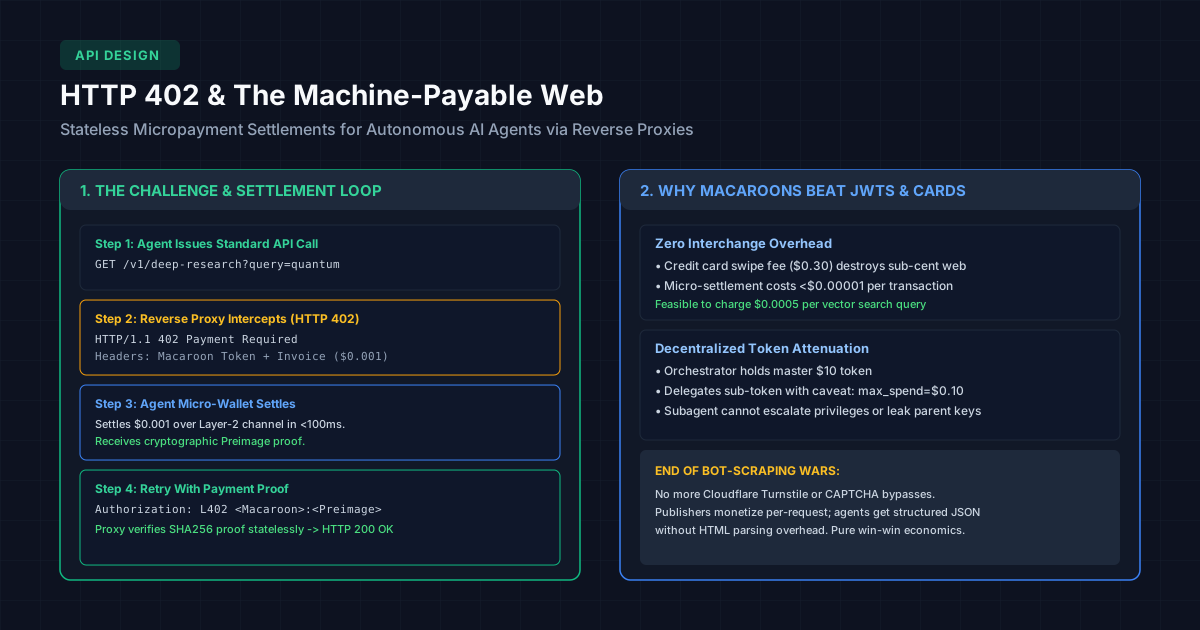
Settling the Request Itself: How Reverse Proxies Turn HTTP 402 into a Machine-Payable Web
The architecture of micropayments for AI agents: turning HTTP 402 Payment Required into zero-trust, reverse-proxy token billing.

Cloud Armor’s CDN Edge Rules Can Filter Before Cached Content Is Served
A November Preview adds ASN, threat-intelligence and HTTP filtering to Cloud Armor edge policies for Cloud CDN. The cache boundary changes where policy applies.
/* Comments */
Comments are offline right now — we reconnect automatically, nothing is lost.