Flocci Bento: The Link-in-Bio That Refuses to Flatten You
A guest-first bento-grid builder where humans, undo, and AI all edit one document — with bank-grade auth hiding under a friendly canvas.
On this page
You get one link. It goes in the bio, under the talk, at the bottom of the cold email — and it has to be the whole of you. Not a slice. The whole thing: the work, the numbers, the thing you shipped last spring, the way you actually think. And what does the internet hand you to carry all that weight? A vertical stack of identical pill-shaped buttons. Name, avatar, seven rounded rectangles in a column, a wash of gradient behind them. Every “link page” on earth is the same page wearing a different color. The medium that was supposed to represent you flattens you into a list.
The tyranny of the stack
The link-in-bio genre made a quiet bargain, and most people never noticed they’d signed it. In exchange for setup that takes ninety seconds, you agreed to look exactly like everyone else. The tools optimize for that. They give you buttons because buttons are safe, uniform, and impossible to get wrong — which is also why they’re impossible to make yours.
But a person, or a product, or a portfolio, is not a stack. It has proportion. Some things are big and some things are small, and the arrangement of big and small is where meaning lives. A hero project deserves more real estate than a contact link. A chart that took you three years to earn should not be the same size as your Twitter handle. This is the whole idea behind the bento grid — the Japanese lunchbox logic that took over interface design because it’s simply how humans read importance: by area, by adjacency, by rhythm.
The problem is that building a real bento grid in a general-purpose design tool is a small war. You’re bolting rectangles onto an infinite canvas that has no idea what a grid is. There are no charts on hand, no device mockups, no clean way to let a machine help you without it producing a separate file you then have to reconcile. You spend your afternoon fighting the tool instead of composing the thing. The friction isn’t the design. The friction is the software.
A link page should represent you at full resolution, not compress you into a column of buttons. Flocci Bento treats grid composition as a first-class primitive — big and small, chart and mockup, human edit and AI edit, all speaking one language on one canvas.
Grid-native, not shapes-bolted-on
Bento’s editor — the aptly named BentoEditor — is built on react-grid-layout, which means the grid is the substrate, not an afterthought you impose on a blank rectangle. Panels snap, resize, and reflow because the canvas natively understands rows and columns. That single architectural choice is what separates “a design tool you can make a grid in” from “a grid you compose in.”
And the panels aren’t dumb boxes. Each one can hold a genuine content type, ready to go, no plugin hunt required.
Real data visualizations rendered inside a panel — the metric you’re proud of, sized to matter, not screenshotted from somewhere else and pasted in blurry.
Drop your work into a phone or browser frame that scales cleanly. Vector, not a fuzzy PNG of a mockup you found.
Headlines, body, emphasis — edited in place on the panel, so the words live where they’ll be read.
Upload, crop, and place. The asset pipeline handles ingest, thumbnails, and dedup so identical media is stored once.
That asset pipeline deserves a line of its own. Bento accepts uploads, inline base64, and even external URLs through a proxy; it generates thumbnails with sharp; and it runs sha256 deduplication so the same image dropped into ten projects is stored exactly once per owner. This is plumbing you’re never supposed to notice — which is precisely the point.
The AI edits your document
Here is where Bento does something most tools only pretend to. Almost every product with an “AI assistant” bolts it on the side: you ask, it thinks, and it hands you back a separate draft that you then have to reconcile with the thing you were actually working on. Two documents, one of them stale, and a merge you do by hand.
Bento refuses that. Its AI features — text rewrite, layout suggestion, copy-fill, and async image generation — don’t produce a rival draft. The layout and copy endpoints return their changes as JSON-Patch operations, in the exact same wire format that your own human edits travel in. Your click, your undo, and the AI’s suggestion all flow through one identical mutation pipeline. The AI isn’t a consultant handing you a memo. It’s a co-editor with its hands on the same document.
Human edits, undo/redo transport, and AI suggestions are all JSON-Patch ops through a single pipeline. That’s why the AI feels like a collaborator instead of a vending machine — it speaks the same language your keyboard does.
And it’s free. Not free-with-an-asterisk — the AI is routed through the shared Flocci intelligence service with charge: false, meaning no credit accounting happens at all. The app owns no AI keys and no Google client of its own; it reaches the intelligence service through the platform gateway. You get an editing collaborator without a meter running in the corner.
Start as a guest, commit when you’re ready
The other friction Bento removes is the one that kills more projects than any design problem: the signup wall. You shouldn’t have to prove your identity to a tool before it has proven anything to you.
- Just start building
Open the canvas and compose. No account, no email, nothing. Your work persists in the browser’s localStorage as you go, so a refresh won’t cost you.
- Decide the tool is worth it
Get the layout to a place you’re proud of — on your own time, with zero commitment asked of you up front.
- Sign up, and your work comes with you
On signup, an idempotent
POST /v1/migrate/localcarries your guest state into the cloud. Because it’s idempotent (scoped through an IdempotencyKey), it can’t duplicate your project no matter how the network behaves. - Now you get the cloud powers
Members with owner/editor/viewer roles, tokenized public share links for view, comment or edit, and full version history — up to 100 snapshots and 20 named drafts per project, with persistent undo/redo on top.
That migration detail — idempotent — is the kind of thing you only appreciate after a tool has once eaten your work on a flaky connection. Bento was built by people who clearly have that scar.
The friendly canvas hides a security product
Now for the part worth slowing down on. Flocci Bento presents as a cheerful little drag-and-drop grid maker. Under the hood, it is quietly one of the most platform-hardened codebases in the Flocci estate.
The auth is not a basic access-token-plus-refresh pair. It’s family-based refresh-token rotation with reuse detection: refresh tokens are 48 random bytes, stored only as sha256 hashes, and rotated on every use. If a token that has already been rotated gets replayed, Bento treats it as a break-in and mass-revokes the entire token family — attacker and legitimate user alike get torched, because the safe assumption is that the session is compromised. Password storage itself is delegated to the shared Flocci identity service: the app keeps no password hashes of its own, verifying a legacy hash only long enough to migrate an old local account across. This is the posture of a banking session, wearing the skin of a v0.1 design toy.
Do
- Trust it with real client work — the session security genuinely exceeds what a young design tool would carry
- Start as a guest and migrate later; the cloud path is idempotent and safe
- Use the AI freely; it consumes no credits and edits your live document
Don't
- Expect a finished server-side high-DPI export today — that renderer is stubbed; exports fall back to client-side html-to-image and jspdf
- Assume it’s “just a link page” — the arrangement is the message; use the grid’s proportions deliberately
The discipline continues into the schema. Bento already models AuditEvent, TelemetryEvent, Webhook and IdempotencyKey tables at v0.1 — a recordAuditEvent() call fires on nearly every mutating route. In the KB it’s described as the most Graph-ready schema in the estate, which means when the Flocci Graph outbox arrives, adoption for Bento is connect, not build. Sixteen Prisma models, sixty-three registered /v1 endpoints, a Fastify 5 backend and a React/Vite front end. That is not the anatomy of a weekend hack.
Bento rides the Flocci estate
Bento doesn’t stand alone, and that’s the point. It authenticates through the shared Flocci identity service, so one Flocci login and Google OAuth work across every app in the estate — with legacy accounts lazy-migrating to the shared identity on first sign-in. It reaches AI through the intelligence service via a single gateway client. It targets the notification service for its (currently stubbed) password-reset and invite emails. It stays resolutely free — no PayU, no credit accounting, charge: false on every AI call. It runs on registry port 5010 against a local flocci_app_bento database and deploys on Vercel against the public gateway.
In other words, Bento takes the boring-but-hard problems — identity, security, AI routing, audit — and inherits them from the platform instead of reinventing them. What’s left for the product to be about is the only thing that should be: the canvas.
The whole of you, at full resolution
The link page was never a bad idea. It was a good idea that got compressed until it lost its shape. One link should be able to carry the whole of you — but only if the medium has room for proportion, for the big thing next to the small thing, for a chart that gets to be a chart and a headline that gets to breathe.
Flocci Bento gives that medium a grid-native canvas, a co-editing AI that speaks your document’s language, a guest-first door with no wall, and a backend built with the paranoia of a security team. Some of it is still arriving — the high-DPI export is a promise, the invite emails a stub — and the roadmap says so plainly. But look past the cheerful drag-and-drop surface, and the real shape of the thing comes through: this friendly little design toy is quietly serious infrastructure. Banking-grade session security, an audit trail on nearly every mutation, the most Graph-ready schema in the estate — all of it inherited from the platform and hidden under a canvas that just wants to help you look like yourself. That is not a link-page gadget. It is the way you show up on the internet, built to outlast the version number on the door. One canvas. Full resolution. The whole of you.
Frequently asked questions
What is Flocci Bento?
A free, browser-based bento-grid builder for composing infographic and portfolio layouts. You arrange panels on a grid and fill them with charts, device mockups, rich text and images, with AI assistance, cloud save, sharing and full version history.
Do I need an account to start?
No. Bento is guest-first: you can build immediately with your work saved locally in the browser, and when you sign up your guest project migrates into the cloud idempotently through POST /v1/migrate/local, so nothing is lost or duplicated.
What can the AI do, and how is it different?
It can rewrite text, suggest layouts, fill copy and generate images. The layout and copy features return their edits as JSON-Patch operations in the same wire format as your own edits, so the AI applies changes through the exact same pipeline you do — it edits your document rather than producing a separate draft.
Can I collaborate and share my work?
Yes. You can add members with owner, editor or viewer roles, create tokenized public share links (view, comment or edit), and rely on full version history — up to 100 saved snapshots and 20 named drafts per project — plus persistent client-side undo and redo.
Can I export my bento layout?
Today exports run client-side in the browser via html-to-image and jspdf for formats like PNG and PDF. A server-side high-DPI renderer is on the roadmap but currently stubbed, so downloads use the client fallback for now.
Sources & further reading
Keep reading
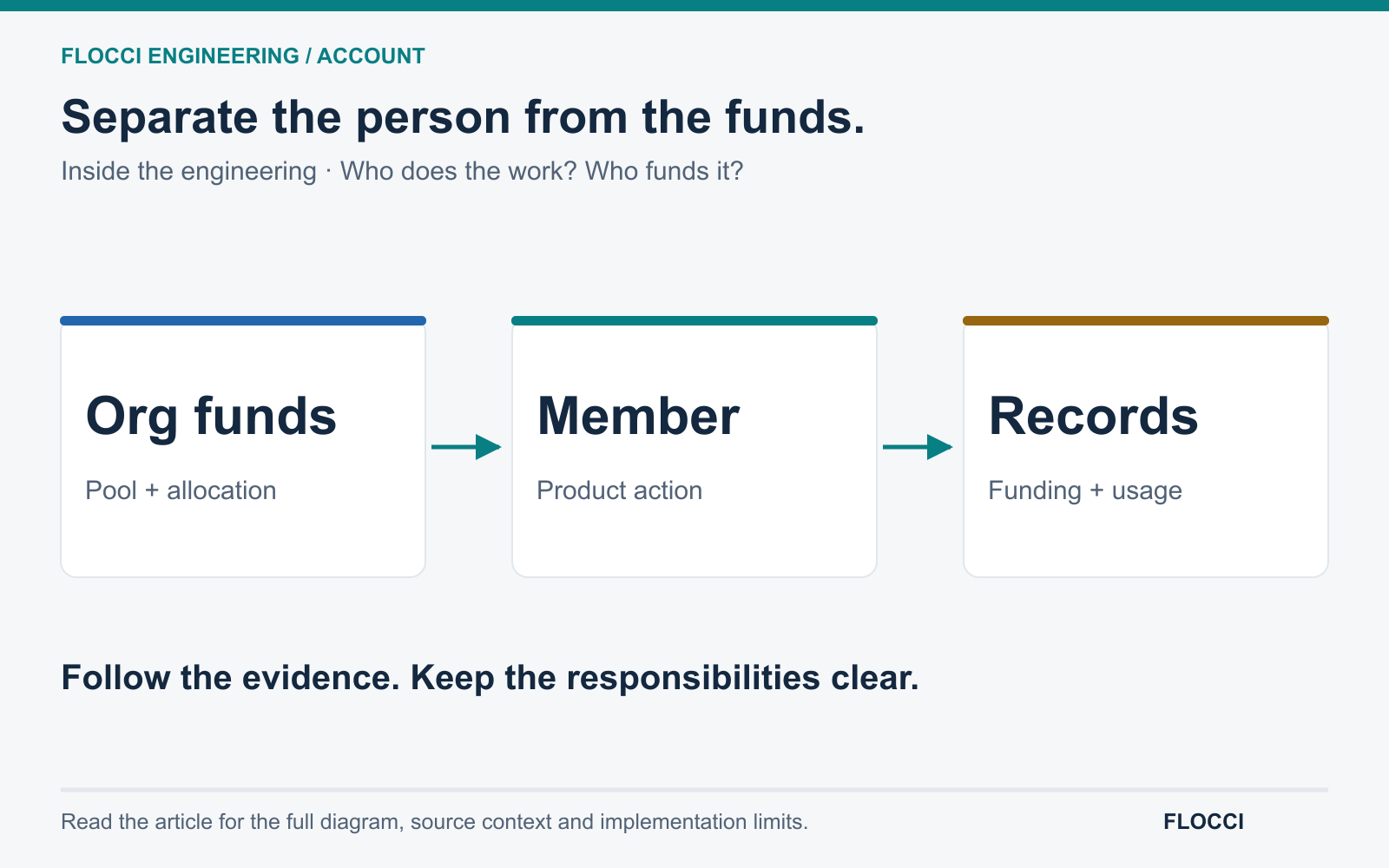
Freedom to Use AI, Control Over Its Cost: Inside Flocci Account
How Flocci Account and shared payment capabilities connect personal credits, organization funding, allocations and accountable spending across products.
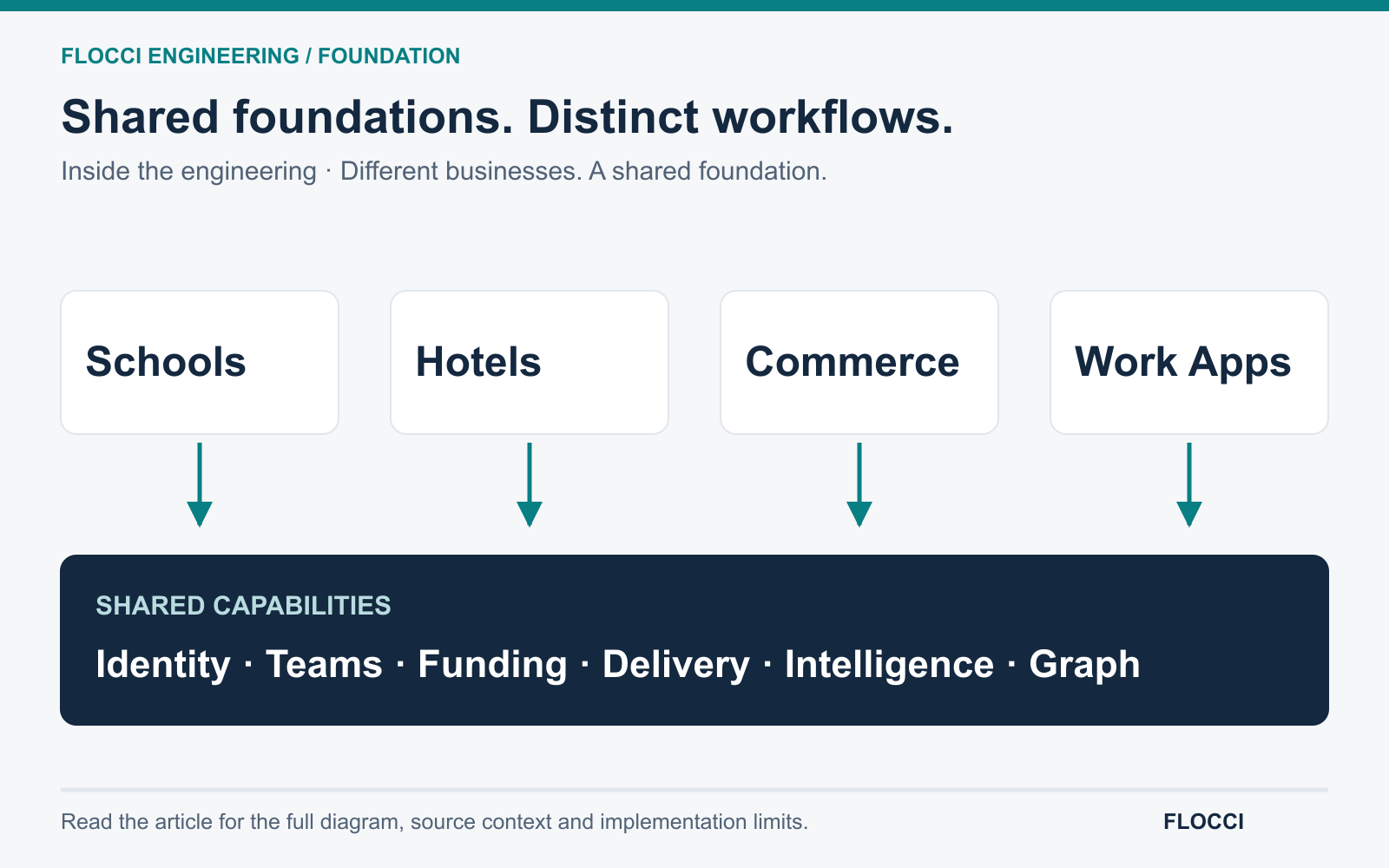
Inside Flocci: The Shared Foundation Beneath Very Different Businesses
How Flocci connects specialized business products through reusable identity, spending, delivery and intelligence while preserving distinct workflows.
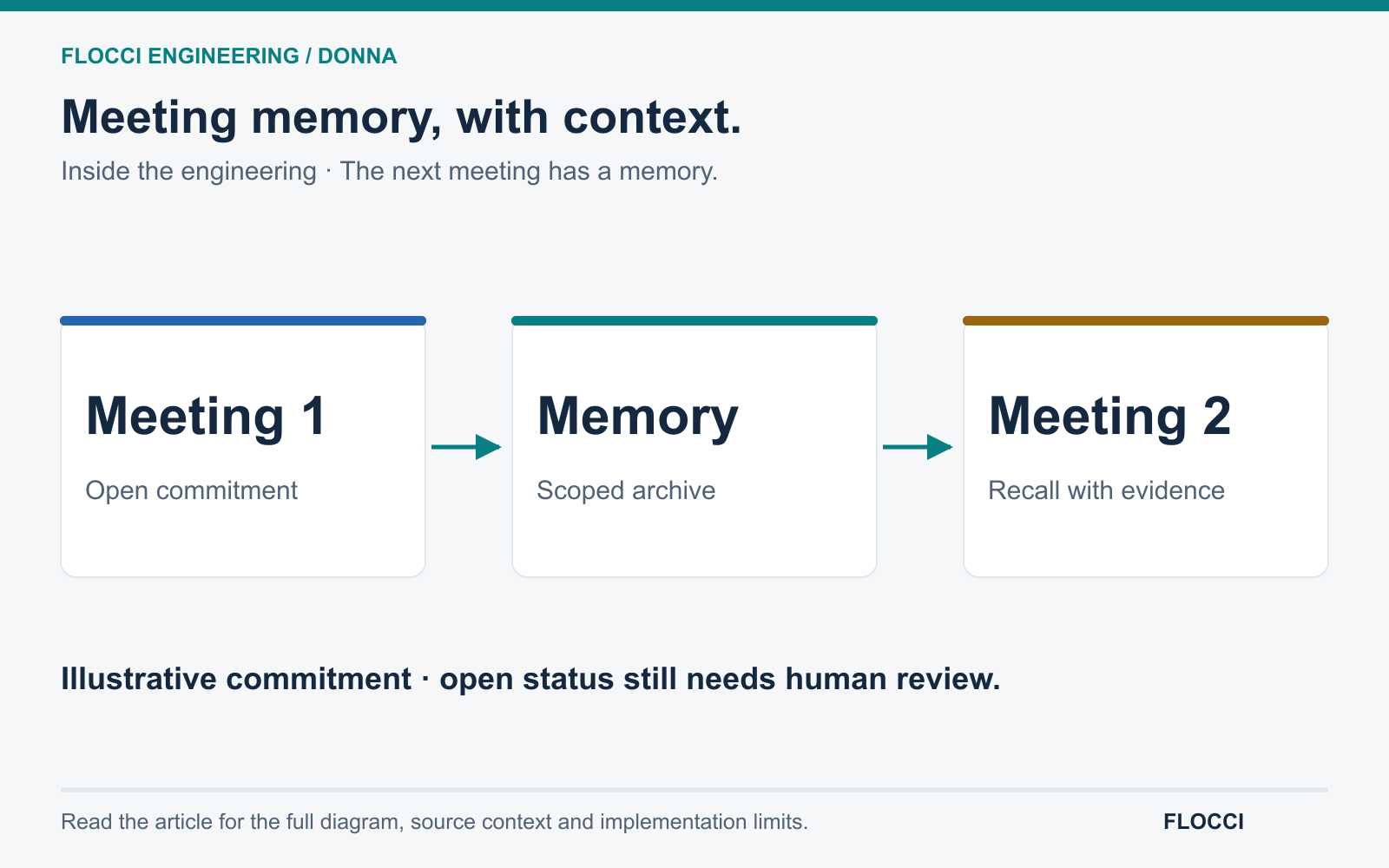
The Meeting Ends. The Commitments Stay: Inside Flocci Donna's Memory
Donna brings unresolved commitments and earlier questions into later meeting analysis, giving recurring conversations a memory with context and evidence.
/* Comments */
Comments are offline right now — we reconnect automatically, nothing is lost.