
Flocci Is on RevenueBase’s India Integration List. Here’s What That Signal Really Means
RevenueBase lists Flocci among India integration-platform companies. What does that signal—and how do its apps, Intelligence, Graph and Graph Search fit?
On this page
A company directory can be a useful map. It is not a systems architecture review. RevenueBase’s page for integration-platform companies based in India includes Flocci at No. 18 in the snapshot checked on November 19, 2026. The page describes an exact category match, but the position is tied to the directory’s own company data and matching process. It should be read as a discovery signal: Flocci is appearing in a category buyers and researchers browse. It should not be mistaken for proof of a particular connector set, an independent performance audit, or an endorsement. [1]
What the listing says — and what it cannot say
The page’s category label raises a fair question: is Flocci an integration-platform-as-a-service product in the familiar sense of a Workato- or MuleSoft-style connector and workflow engine? The directory entry alone cannot answer that. A category match is a clue about how a database classifies a company; it does not establish that a product offers hundreds of external connectors, a visual ETL pipeline, or enterprise workflow orchestration.
Flocci’s public product story is more specific. It is a portfolio of specialist apps and industry systems built around shared foundations. The public catalogue describes Work Apps such as Library, Projects, Notes, Calendar, Infinity, Timesheets, and Draw, alongside products for areas such as support, recruiting, sales, and audience engagement. It also describes shared identity, organization and role context, a credit wallet, Intelligence, Notifications, and the Graph. [2]
That distinction matters. Shared platform context is not the same thing as a universal integration connector. A shared account can reduce the friction of moving between products; a link between a Project and a Library spec can preserve context; a common credit wallet can meter AI use consistently. None of those facts, by themselves, means every outside SaaS service can be connected or automated.
One platform, with each app still owning its work
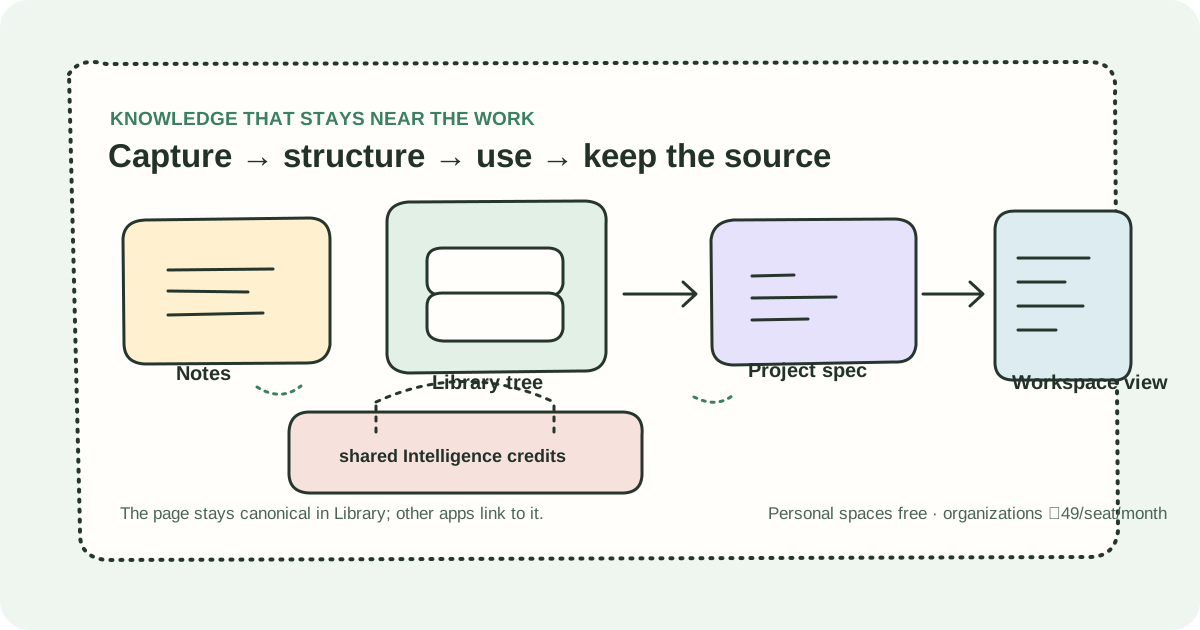
Think of the ecosystem as a set of specialist rooms built on a common foundation. Library holds team knowledge in spaces and nested pages. Notes is for quick capture. Projects owns delivery issues and boards. Workspaces can place live views of work on a shared canvas. The apps are related, but each remains the place where its records and actions belong. [2] [3]
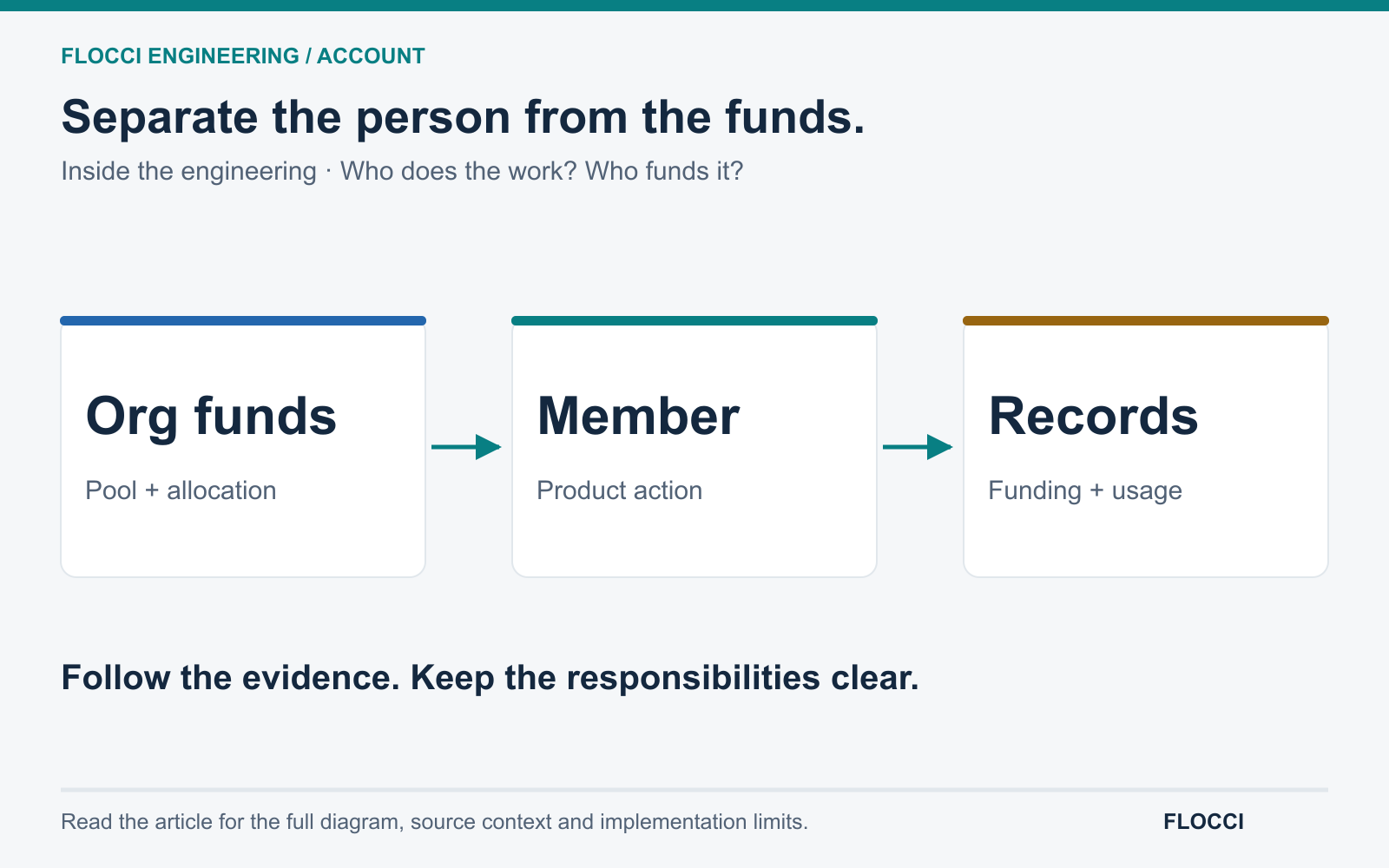
The platform layer handles cross-cutting needs. Flocci Identity supports a common sign-in and organizational context. Flocci Intelligence is the shared AI layer. Credits provide a shared way to meter eligible AI and other paid actions. Notifications centralizes transactional delivery. These services reduce the need for every app to invent a separate account, billing, or AI mechanism. They do not erase app boundaries or make an AI action free of cost simply because it is available in multiple products. [2]
Graph is an activity spine, not a content vacuum
Flocci Graph adds a different kind of connection. The public description says Graph carries counts and metadata about supported product activity, not the underlying messages, documents, or prompts. That can help the platform understand that work happened and make a suggestion more relevant without treating every private page as an automatically searchable record. The amount of activity represented can vary by product. [4]
This is an important boundary for buyers. A Graph event can help establish context — for example, that a team has activity in a given product — while the source app remains responsible for its content and permissions. A suggestion should guide a person back to the right product rather than silently editing a project or exposing a private document.
Graph Bar and Graph Search: one question surface, bounded by its sources
Graph Search gives that model a human-facing entry point. Instead of remembering which Flocci app might hold a useful piece of context, a user can start with one bar and explore the supported results surfaced to them. It is best understood as a navigation and context layer over the Graph and connected Flocci surfaces — not as a promise that every third-party system, every Library page, or all app content is indexed in one corpus. [5]
That framing is useful for technical evaluation. Ask which source types are supported, what the Graph stores, how access is enforced, whether an item opens in its owning app, and which actions require an explicit confirmation. Those questions reveal more than a broad “integration platform” label can.
A more useful way to read the recognition
Being present in RevenueBase’s list can help a researcher discover Flocci, especially if they are already exploring India-based integration and workflow companies. The practical follow-up is to inspect the actual product surfaces and their boundaries: which apps share sign-in, which workflows have a direct link, what Intelligence meters, what Graph records, and what Graph Search can actually return.
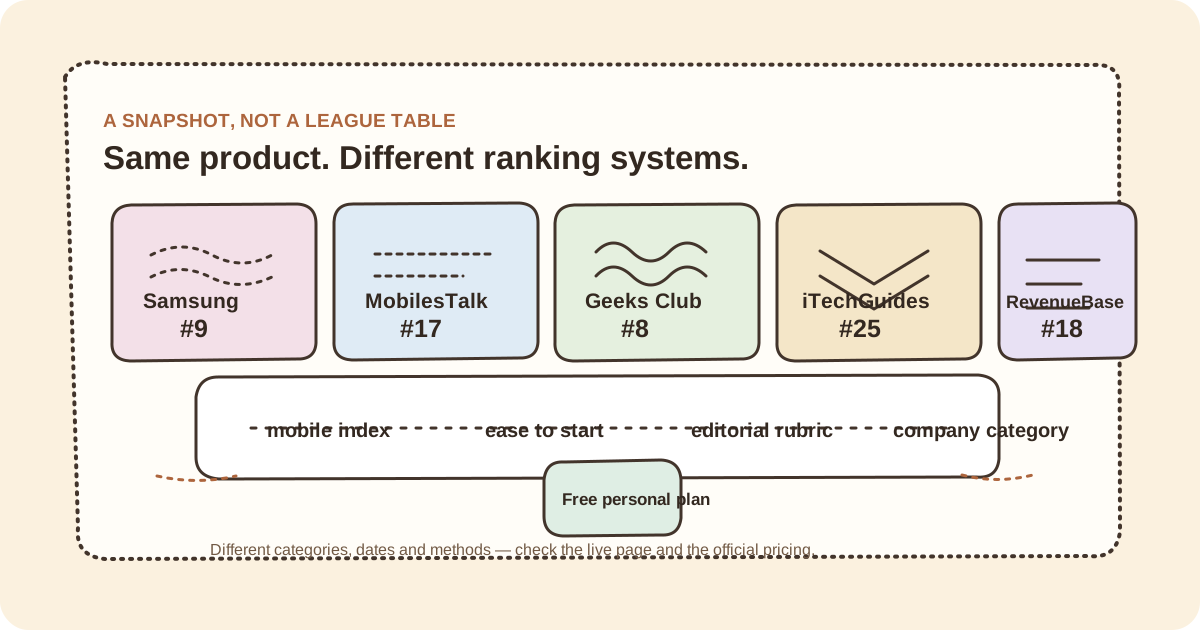
For a closer look at the knowledge product in this ecosystem, read how Flocci Library fits into the 2026 knowledge-base rankings. We also compare the independent directory snapshots — including Samsung Mobile US Press, MobilesTalk, and The Geeks Club — in what the Library rankings do and don’t establish.
RevenueBase’s No. 18 entry is evidence of directory visibility. Flocci’s architecture story should be judged on its published app capabilities, shared platform contracts, and specific supported connections — not inferred from a category label alone.
Frequently asked questions
Does RevenueBase’s listing prove that Flocci is an enterprise iPaaS product?
No. It is a company-directory classification and discovery signal. The listing does not by itself verify connector coverage, workflow orchestration, customer outcomes, or product quality.
What does Flocci connect across its products?
Flocci products share platform foundations such as identity, organizations, credits, Intelligence, notifications, and the Graph activity layer. Individual apps remain responsible for their own records and actions.
Does Flocci Graph Search read every document in every app?
No. Flocci describes Graph as carrying activity counts and metadata rather than user content. Graph Search should be understood as a way to explore supported context, not universal full-text search across every app.
Sources & further reading
Keep reading
Flocci Library Appears in Five Knowledge-Base Rankings — Why the Numbers Differ
From Samsung Mobile US Press’s #9 to iTechGuides’ #25, Flocci Library appears in five directories. Compare their dates, methods, free-plan facts, and limits.
Flocci Library on iTechGuides’ 2026 List: A Free Personal Wiki With a Team Path
iTechGuides ranks Flocci Library #25 of 25 in its 2026 list. Here’s what the free personal plan includes, what teams pay for, and how the Work Apps connect.
Freedom to Use AI, Control Over Its Cost: Inside Flocci Account
How Flocci Account and shared payment capabilities connect personal credits, organization funding, allocations and accountable spending across products.
/* Comments */
Comments are offline right now — we reconnect automatically, nothing is lost.