
Gemini Robotics 2.5 Targets the Awkward Work That Slows Factory Lines
Google DeepMind says Gemini Robotics 2.5 reached 96% success in a factory kitting pilot. What the result does and does not show.
On this page
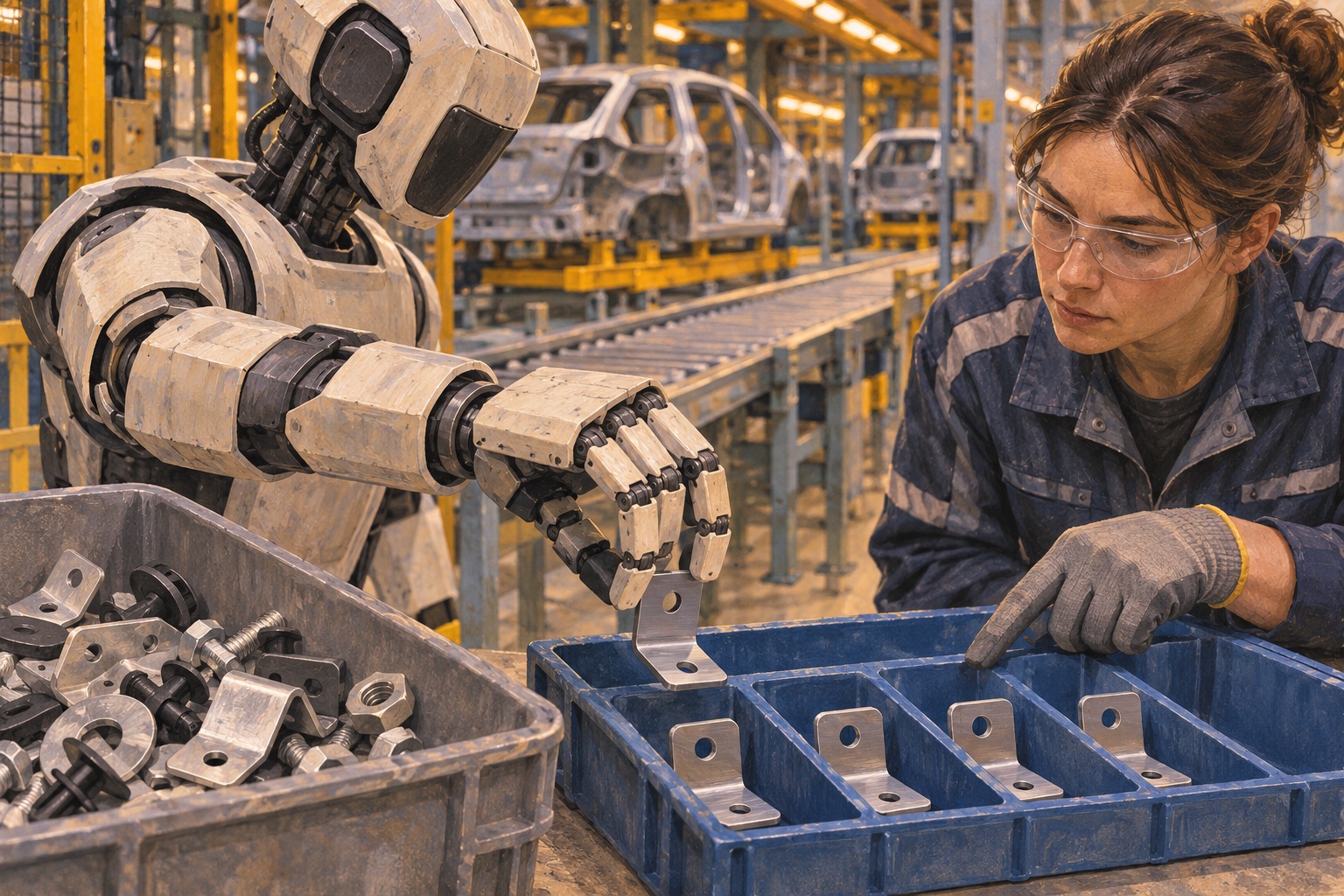
A factory line can stop looking “automated” at the moment a worker has to find one small bracket in a mixed bin, check its orientation, and place it in the tray for the next vehicle. That repetitive handoff is the kind of task Google DeepMind says Gemini Robotics 2.5 helped an Apollo 2 humanoid perform in a Mercedes-Benz pilot.
What the factory pilot actually did
DeepMind describes “automotive kitting”: Apollo 2 selects individual metal brackets from bulk bins and sorts them into organized trays in the exact order needed by the vehicle assembly process. The company says the proof of concept ran on active production lines in Kecskemét, Hungary, and Sindelfingen, Germany, and achieved a 96% success rate.
The system combines two models. Gemini Robotics ER tracks the multi-step workflow, while Gemini Robotics 2.5 controls the robot’s hands and arms. DeepMind says the robot could detect gaps and adjust while placing parts. This is a meaningful distinction: the work is not just recognizing an object, but coordinating perception, sequencing, movement and correction in a space where parts and conditions vary.
Still, “96%” is not a complete production metric. The announcement does not state how many trials were counted, how long the pilot ran, what qualified as success, how often a technician intervened, or what happened after a failed pick. Those details determine whether 96% is enough for a line-side workflow and how much supervision it requires. A pilot result is evidence of feasibility, not a plant-wide reliability guarantee.
Dexterity is a practical reliability problem
DeepMind says it tested the model on more than 200 distinct tasks, including using tongs, tying bows and pipetting. In selected comparisons with its prior model, the company reports task success rates rose by 30% to 100%, with tasks completed 20% to 30% faster. Those are the company’s own evaluations; the headline figures should not be read as a universal improvement across every robot or worksite.
Flexible objects make the challenge obvious. A ribbon, garment or bag changes shape as it is touched. A rigid part in a bin presents a different problem: occlusion, collisions and uncertain grasp points. A system that can handle a broader range of objects could reduce the amount of task-specific programming, but every factory still needs validation against its own parts, tolerances and safety rules.
The safety question moves from refusal to motion
Language models can refuse a dangerous instruction in text. A robot also has to avoid causing harm through movement. DeepMind says inference-time reasoning guidance improved safe task completion around obstacles by 33% and around nearby people by 43% in its evaluations. It also introduced ASIMOV-Jailbreak, a benchmark for testing disguised unsafe instructions in robot scenarios.
These are promising layers, but they do not replace industrial risk assessment, guarding, speed limits, emergency stops or human supervision. Benchmarks can expose classes of failures; they cannot prove that an entire machine cell is safe under every shift, object, operator or software update.
For manufacturers, the useful next question is not whether a robot can do a task once. It is whether it can do it often enough, recover predictably, and remain safe when the bin is different, the part is damaged or a person steps into the work area. Gemini Robotics 2.5 gives partners new evidence to test against those questions. The public announcement leaves the operational details open. For context on the labor and adoption side, see our analysis of robot work exposure, cost and adoption and the humanoid robot games in Beijing.
A pilot is also a workflow-design exercise
A robot’s useful work depends on what surrounds it. Someone must load bins, confirm the correct part family, keep trays in sequence, notice when supply is depleted and decide what should happen after a pick fails. If the robot is technically capable but forces workers to inspect every placement or reset the cell repeatedly, its measured success rate may not translate into time saved.
That is why the handoff between people and machines deserves as much attention as the robot’s gripper. A robust deployment would make its state visible, allow a worker to stop or redirect a task, and preserve a safe fallback for uncertain objects. The system should also log enough information to analyze failures without turning a technician into a full-time monitor.
Factory managers should compare this kind of pilot with simpler alternatives: redesigned bins, part feeders, machine vision paired with a fixed arm, or software changes to the sequence process. Humanoids may be attractive where existing workspaces are built for people and tasks change often. But a conventional automation cell may be cheaper and easier to certify when a station is stable and high-volume. The public announcement does not compare those options.
The broader lesson is to ask for a task-level case, not a humanoid-level claim. What job is removed from the technician’s day? How many minutes are recovered? What is the failure recovery time? Which objects require human judgment? A credible pilot should answer those questions with the customer, not just show a robot completing a motion.
Frequently asked questions
Is Gemini Robotics 2.5 generally available?
Google DeepMind says Gemini Robotics 2.5 is rolling out to robotics partners. Its announcement describes partner access and a proof of concept, not a generally available robot product for factories.
What did the Mercedes-Benz pilot measure?
DeepMind reports a 96% success rate for Apollo 2 performing automotive kitting: picking metal parts from bins and placing them in the sequence needed for a vehicle. The post does not publish the trial count or a detailed independent evaluation protocol.
Sources & further reading
Keep reading

Agent Skills Can Travel Between Tools. Your Permissions Still Cannot
GitHub’s guide to portable agent skills points to reusable workflows, but teams must separately review tools, context, permissions and risk.

Intel and RadixArk’s SGLang Deal Puts the Inference Stack in the Spotlight
Intel and RadixArk say they will optimize SGLang for Intel systems. What the announcement promises—and what operators still need to measure.
Building a RAG App: The Five Decisions That Decide Quality
Model, orchestration, vector storage, document extraction and embeddings. Where RAG apps actually fail, and the choices that matter more than the framework.
/* Comments */
Comments are offline right now — we reconnect automatically, nothing is lost.