
Google Is Moving More Links Into AI Search Answers. What Should Publishers Change?
Google's October AI Search update adds more visible inline sources, official links and news carousels. Here is what changed and what publishers should measure.
On this page
An answer that cites your reporting only helps a reader if the citation is visible, understandable and worth opening. On October 15, Google announced changes to AI Overviews and AI Mode that move some links higher in responses, test a prominent section for official websites, widen news carousels and make related articles more visually prominent. For publishers, this is a meaningful interface change, but it is not a distribution guarantee. The work remains to publish pages that answer a real question and make the evidence easy to inspect.
What Google says is changing
Google describes five changes. Inline links in AI answers should appear higher more often. A new display is being tested for queries where one or two official destinations are especially useful. Prominent carousels for timely articles are expanding to more places and languages. Some related-article links will gain thumbnails and a more clickable presentation. Google also began testing creator and publisher names on video results that link to Search profiles. These are stated product changes, with different rollout stages; the official-site module is explicitly a test. [1]
The announcement does not say every query will show these modules, that every publisher will be eligible for them, or that clicks will rise. Search interfaces vary by query, language and user context. A stronger link treatment can make a source easier to notice, but a searcher may still get what they need from the answer itself and leave without opening a page. Treat the announcement as a reason to observe, not as a forecast for your analytics.
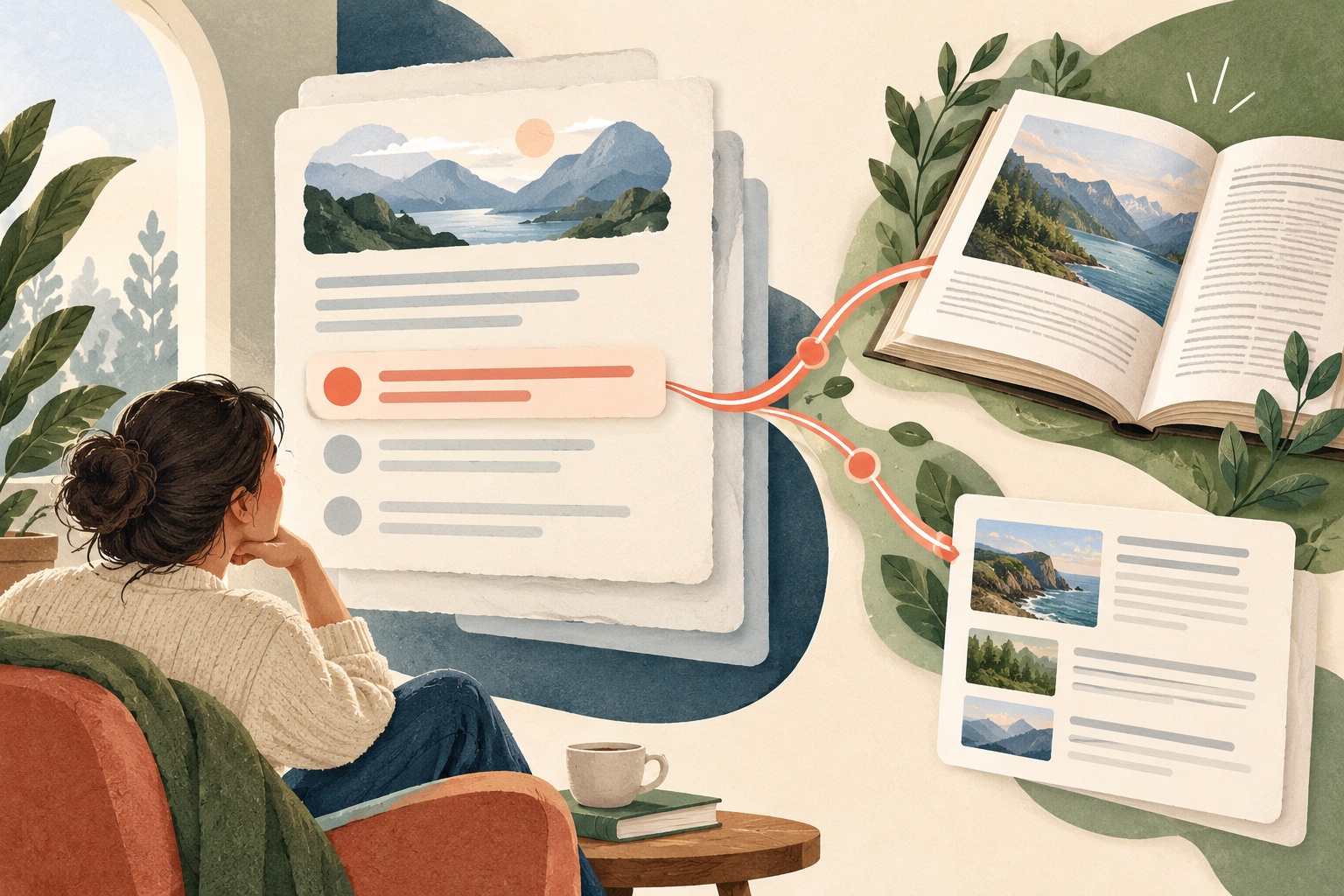
The change shifts attention to the source path
When a summary is the first thing on screen, source presentation affects whether readers can check a claim, find the original report or continue into related coverage. A useful citation needs more than a blue link: the reader needs enough context to understand why that page is relevant. Google’s official-site test says it will add context about why a destination may help; its announcement also describes more prominent related links and news coverage. The likely product goal is to make exploration easier, but that is Google’s stated intent, not independently measured publisher impact. [1]
This matters especially for stories where the underlying material is the value: a policy document, release note, research paper, court filing or dataset. A concise article that explains the finding and links to the primary document can serve both readers who need a fast orientation and readers who want to verify details. A page that merely repeats an AI summary gives little reason to click through or return.
Google’s own Search Central guidance is notably restrained. It says existing SEO fundamentals apply to AI features, with no extra technical requirements or special schema needed. A page must still be indexed and eligible to appear in Search, and eligibility does not guarantee crawling, indexing or serving. Google also says these visits are included in the overall Search Console Web performance report rather than a separate AI-only search type. [2] [4]
A practical publisher checklist
First, make the page self-contained. Put the answer and the essential context in visible text, name the event and date accurately, link to primary evidence, and explain what remains uncertain. Google recommends useful, reliable, people-first material and ordinary crawlability; there is no supported shortcut that makes an article eligible for AI answers. [2] [3]
Second, make the next useful step easy to find. Link to earlier coverage that supplies background and to the original documents that support the current claim. That helps a person follow the story even if the search interface changes again. Keep those links editorially relevant; a dense mesh of loosely related pages does not substitute for a clear answer.
Third, measure outcomes you can actually observe. In Search Console, compare the Web search type over a consistent period and segment by page, query, country and device where the data supports it. Look at impressions and clicks together: a new surface can change visibility without changing visits in the same direction. Pair Search Console with first-party analytics if you need to understand whether visitors read, navigate or convert. Do not attribute a change to one interface announcement without accounting for seasonality, news demand, ranking changes and rollout timing. [4]
The useful test is whether readers can verify and continue
Google’s October update acknowledges a familiar weakness of answer-first search: a source can be present yet difficult to notice. More prominent citations and related links could improve that path. They could also leave publishers with the same underlying uncertainty about how often a page is selected and whether its appearance results in a visit. The announcement resolves neither question.
For now, publishers should do the durable work: publish evidence-led reporting, show what supports each claim, maintain crawlable pages, and track their own results. If the new placements improve discovery, that work gives a reader a worthwhile destination. If they do not, the same page remains useful beyond a particular search layout.
Related reading: why technical SEO still matters for AI search.
Frequently asked questions
Did Google promise more traffic to publishers from this update?
No. Google described interface changes that make some links and news results more prominent, but it did not promise traffic or inclusion for any individual site. Publishers should measure their own Search Console data after rollout.
Does Google require special markup for AI Overviews or AI Mode?
Google Search Central says there are no additional technical requirements or special structured data for these AI features. Pages still need to be eligible for Search and follow existing technical and content guidance.
What should a publisher do first?
Keep important reporting crawlable and useful on its own, make related coverage easy to find, and compare impressions, clicks and engagement in Search Console over time. Do not assume a new AI result placement guarantees visits.
Sources & further reading
Keep reading

Claude Structured Outputs on Bedrock Can Enforce Shape, Not Business Truth
Bedrock adds schema-constrained Claude output, but route and model support vary and valid JSON still needs domain validation.

GitHub’s SSH Brownout Starts Nov. 4: Check the Client Before Replacing Keys
GitHub is phasing out older SSH signatures and key exchange; distinguish RSA key files from the SHA-1 signature algorithm before changing access.

Go 1.27.3 and 1.26.10 Update Certificate-Chain Verification
Go’s Oct. 19 security patches make crypto/x509 reject chains containing a small set of intermediates; rebuild affected binaries to apply the change.
/* Comments */
Comments are offline right now — we reconnect automatically, nothing is lost.