
Google’s Africa Skills Hub Puts Offline Learning in the Product Brief
Google says its digital-skills hub aims to reach three million people by 2030 and offers offline lessons. Completion matters more than sign-ups.
On this page
A training platform built for reliable broadband can still be unreachable to someone who has to ration data or share a phone. Google’s new Skilling Africa hub says it is designed around that constraint: learners can download short lessons over Wi-Fi, continue offline, and use a lightweight mobile experience. The company says it aims to reach three million people by 2030. The design responds to a real access problem, but only learner outcomes will show whether it solves one.
Offline mode is a product choice, not a connectivity fix
Google describes the hub as a free collection of digital and AI-skills training for people across Africa. It says lessons can be downloaded while connected and completed offline, with low-bandwidth optimization and support for entry-level smartphones. The announcement also introduces SCOUT, a study assistant intended to answer learner questions and suggest next steps. Google’s stated reach target is three million people by 2030, building on earlier digital-skills programs. [1]
The offline design matters because network access is uneven even where mobile coverage exists. ITU’s 2025 regional report estimated that 38% of Africa’s population used the internet in 2024 and describes differences between urban and rural connectivity. GSMA’s 2026 report likewise points to a large usage gap: people may live within a coverage area but still not use mobile internet because of device and data affordability, skills or other barriers. These measures use different definitions, but both show why a learning product cannot assume a continuous connection. [2] [3]
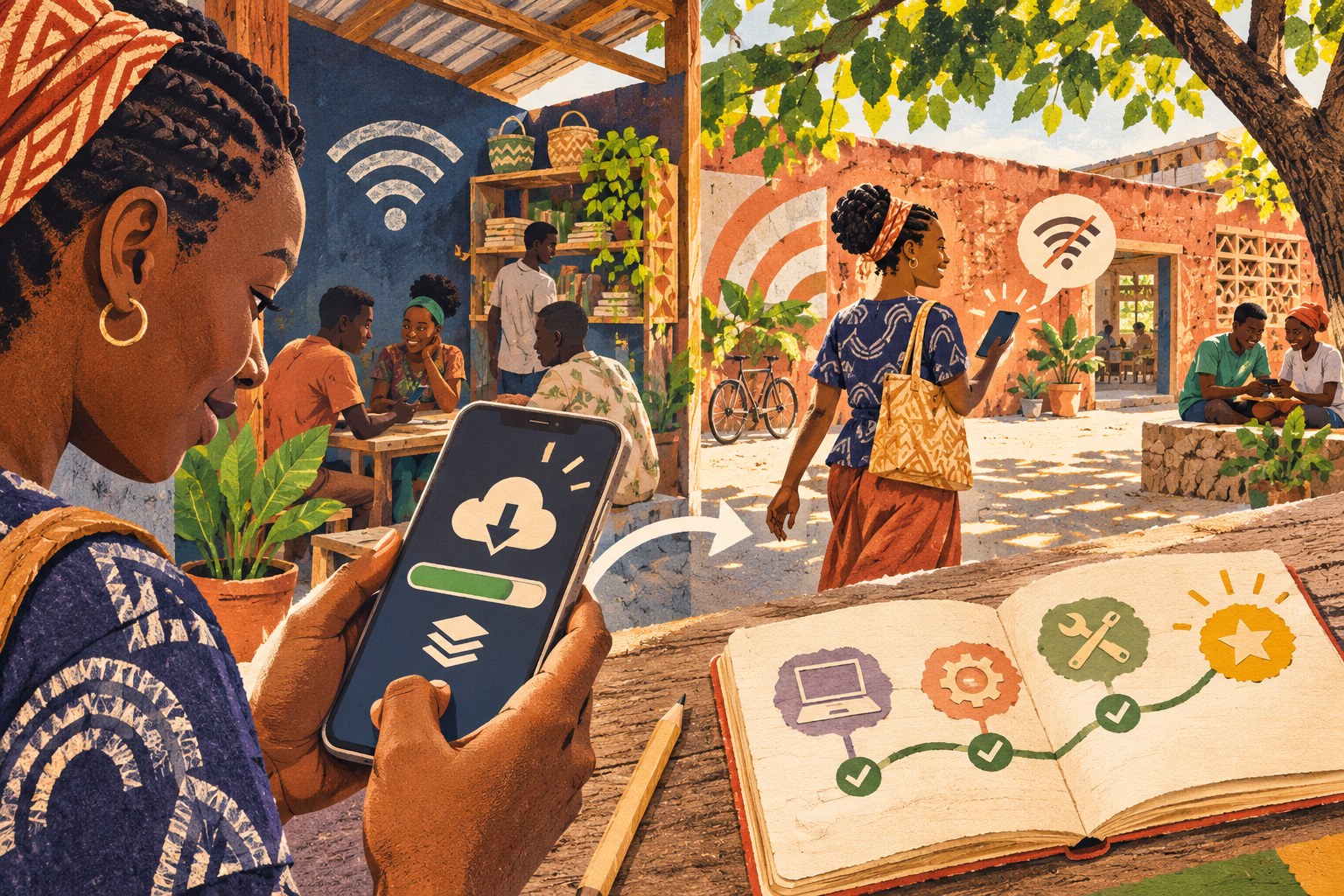
Offline access can reduce repeated data costs, but it does not make the service independent of infrastructure. People still need a compatible device, enough storage, charging, and an occasional connection to download content and sync progress. Shared devices raise another question: can multiple learners keep their accounts and achievements separate? A study assistant also depends on how it handles mistakes and supports people who are learning in a language other than the one most represented in its content.
Measure learning, not just reach
A three-million-person target is a useful statement of ambition, not evidence of three million completed courses. Enrollment counts can include people who try one lesson and stop. More useful reporting would show distinct active learners, course completion, assessment gains, regional and language coverage, accessibility, device constraints and whether participants use the skills afterward. Google has announced the goal and product design, but the launch post does not provide a baseline or a public evaluation plan. [1]
The platform’s value will also depend on who chooses the curriculum and recognizes the credentials. Digital and AI training is most useful when it maps to local jobs, public services or a learner’s next step, rather than teaching generic tool familiarity. Governments, educators, employers and local training groups can help establish that fit. Google’s hub can widen access to content; it cannot by itself guarantee that a learner has a device, affordable data, mentoring or a job pathway.
A practical checklist for learners and partners
Learners can test the basics before committing time: whether the courses are available in a preferred language, whether materials can be downloaded on their device, how progress syncs after going offline, and whether any certificate is recognized by an employer or training institution. Local partners can ask for downloadable materials, transparent completion statistics and a clear process for reporting incorrect or outdated content.
This is a promising design direction because it treats connectivity as a normal condition rather than an edge case. The hard question is whether offline-first access will be paired with inclusive content and visible outcomes. Google has stated a large goal; learners and local institutions should judge the hub by what people are able to learn and do after the headline fades.
For a broader view of AI education and classroom controls, see our coverage of Google’s Guided Learning rollout in schools. The two efforts address different audiences: one fits into school-managed accounts, while this hub targets wider adult and youth skills training across a continent.
Frequently asked questions
What is Skilling Africa with Google?
Google describes it as a free digital and AI-skills learning hub launching across Africa, with a target of reaching three million people by 2030.
Can learners use the new Google hub without a constant internet connection?
Google says lessons can be downloaded over Wi-Fi and completed offline, and that the service is designed for low bandwidth and entry-level smartphones.
Does Google’s three-million target show that three million people have been trained?
No. The number is a forward-looking company goal. Completion, learning outcomes and sustained access will require later reporting and independent evaluation.
Sources & further reading
Keep reading

Google Pay’s India Shopping Pilot Adds a New Job to a Payments App
Google is testing a personalized fashion feed, visual search and virtual try-on in Google Pay India. The pilot sends purchases to merchant sites.

Box’s Agent Guardrails Put Content Permissions Around AI Actions
Box’s new controls restrict agent actions such as uploads and sharing, while audit trails and threat detection remain part of its roadmap.

Changshin’s Palantir Deal Connects Shoe Design Decisions to Factory Feedback
Changshin plans to connect footwear development, sample planning, and production data with Palantir; the rollout is still underway.
/* Comments */
Comments are offline right now — we reconnect automatically, nothing is lost.