
Google’s 1-Gigawatt Virtual Power Plant Is Really a Demand-Response Story
Google and Voltus plan to aggregate flexible loads across PJM, showing how virtual power plants can support grids without behaving like generators.
On this page
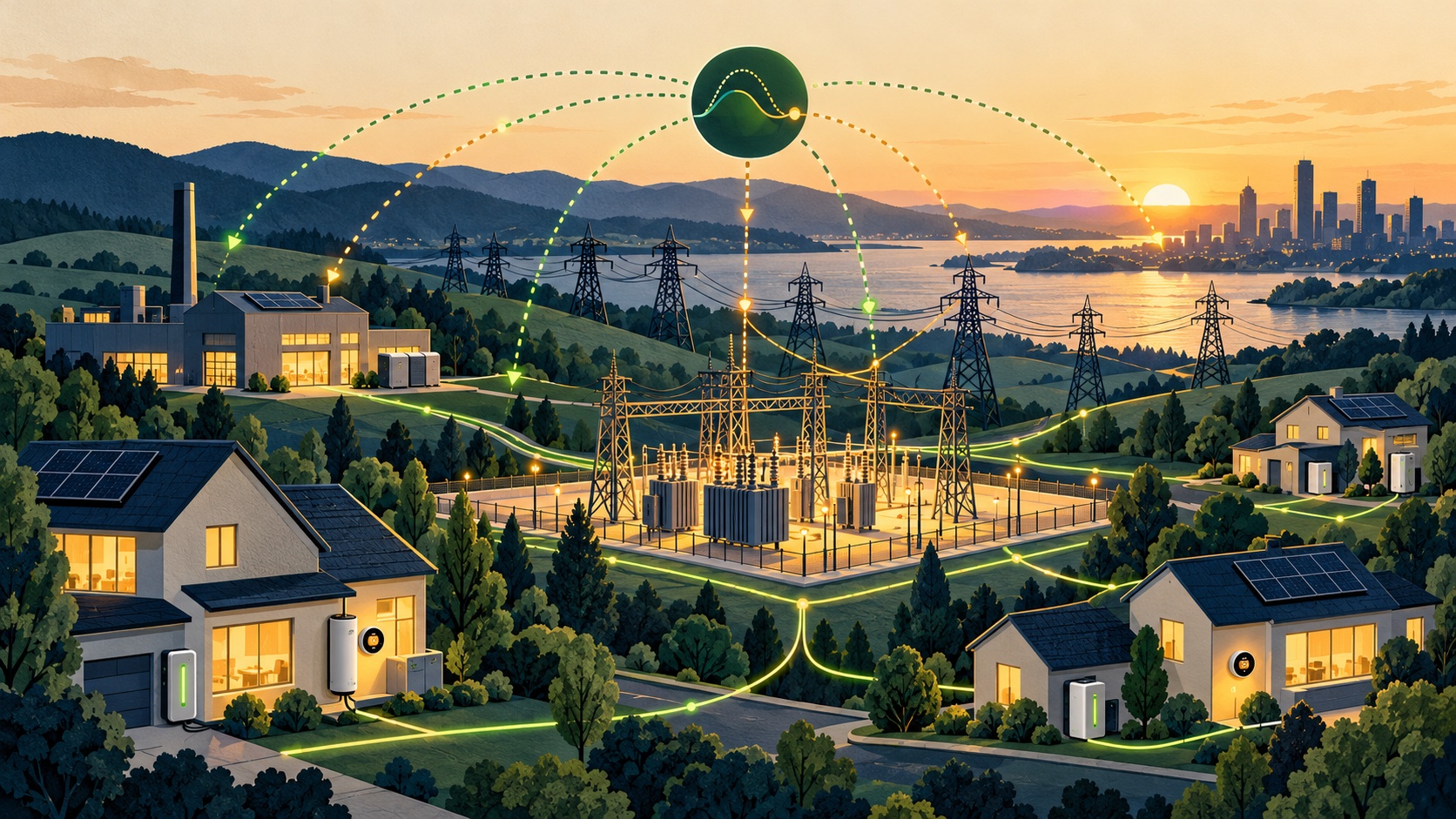
A virtual power plant sounds like a giant generator hidden in software. Google and Voltus’s October 22 announcement points to a different mechanism: coordinate many smaller customer resources so they can change when they consume electricity. The important engineering problem is not simply aggregation. It is making a distributed set of homes and businesses respond predictably at the moment a regional grid needs flexibility.
What the one-gigawatt figure means
Google says the expanded agreement with Voltus will build a 1-gigawatt portfolio across the PJM region, which serves roughly 67 million people in 13 states and Washington, D.C. The companies describe a tenfold expansion from an earlier 100-megawatt agreement. Voltus aggregates flexible capacity from businesses and homes, including smart thermostats, batteries, and industrial assets. During peak demand, those resources can temporarily reduce electricity use; participating customers may receive bill savings or payments. [1]
The distinction between capacity and energy matters. A generator can produce energy over time, subject to fuel, equipment, and operating limits. Demand response can instead lower load for a defined period, and some portfolios may combine load reduction with batteries or other distributed resources. A headline capacity number does not tell a reader how long the resource can respond, how often it can be called, or how much energy is actually shifted.
Google’s announcement describes an agreement to build a portfolio; it does not publish a full dispatch profile, realized performance, customer count, duration, or independent verification results. Those are the figures grid operators and customers will eventually need to assess performance. [1]
Why grids value a flexible load
Electricity systems must balance supply and demand continuously. When consumption peaks, reducing or shifting some demand can help lower the need for more expensive generation and support reliability. The Federal Energy Regulatory Commission describes demand response as a tool that can reduce price volatility, mitigate market power, and enhance reliability. PJM defines demand response as a voluntary program that lets end-use customers reduce usage during periods of high prices. [2] [4]
A smart thermostat might pre-cool a building before a peak and briefly reduce cooling later. An industrial site might reschedule a flexible process. A battery can discharge during a constrained interval. These are not interchangeable resources: each has a different response time, duration, customer impact, and measurement method. A good aggregator must make a portfolio behave in a way that grid operators can predict while honoring customer limits.
Aggregation is more than a software dashboard
The term virtual power plant describes coordination, not a single machine. FERC’s Order 2222 explainer describes how aggregators can combine smaller distributed energy resources into a market participant that satisfies regional requirements. It also notes that participation depends on metering, communication, location, coordination with utilities, and the relevant market rules. Implementation differs among regional grid operators. [3]
That regulatory framework should not be collapsed into the Google-Voltus agreement. The Google announcement specifically emphasizes demand response and flexible capacity in PJM; it does not state that every asset in the new portfolio will participate through the same wholesale-market mechanism governed by Order 2222. The practical point is that the hardware, telemetry, customer program, and market rules must fit together before a portfolio is dispatchable.
The customer side is equally important. A resource that cannot respond at the contracted time is not dependable capacity. A program also needs clear opt-in rules, compensation, privacy protections for usage data, and limits on how often a customer’s equipment can be controlled. For a business, the operational cost of curtailment may exceed the incentive if the schedule is poorly designed.
What to watch next
The 1-GW figure makes the agreement large, but the proof will come from operational details: how much capacity is enrolled and available, what response duration is guaranteed, how performance is measured, and how participants are compensated. Watch for those metrics as the portfolio is built rather than assuming nameplate capacity equals delivered energy.
For utilities and businesses, virtual power plants are most useful when they fit a local grid need and a customer’s real constraints. They may defer some peak costs or provide flexibility while generation and transmission are being planned, but they do not replace every source of dependable supply. A system still needs a mix of generation, storage, transmission, demand response, and reliability planning.
The broader lesson for technology readers is that software can make distributed equipment act more like a coordinated resource, but the physical system sets the boundaries. The hard work lies in telemetry, forecasting, dispatch, customer consent, settlement, and grid operations—not in naming a collection of devices a power plant.
Related reading: how cloud infrastructure depends on real-world energy constraints and designing reliable distributed systems.
Frequently asked questions
Does a one-gigawatt virtual power plant generate one gigawatt of electricity?
Not necessarily. Google and Voltus describe an aggregated portfolio that can temporarily reduce electricity use from flexible customer assets during peak demand. That capacity is different from a generator delivering a continuous one-gigawatt output.
Sources & further reading
Keep reading

Why AI’s Hardest Engineering Often Starts After the Demo
OpenAI’s forward-deployed engineers describe the integration, domain learning, and evaluation work that turns AI prototypes into production workflows.

OpenAI Models on Google Cloud Change Procurement Before They Change Model Choice
OpenAI models and Codex are planned for Google Cloud Model Garden, broadening enterprise procurement while general availability remains pending.

Amazon ECS Gateway Shares Ingress Plumbing, but Teams Still Own the Boundaries
AWS adds a shared ingress resource for ECS. See how connectors, ALB capacity, IAM and subnet compatibility shape adoption.
/* Comments */
Comments are offline right now — we reconnect automatically, nothing is lost.