$130 Billion in AI Data Centers Have Been Blocked or Delayed in 2026
A Data Center Watch tracker found $130 billion in AI data center projects blocked or delayed in Q1 2026 — the largest quarter of opposition on record.
On this page
For an industry that has treated zoning meetings as a formality and land deals as a foregone conclusion, 2026 opened with a shock: the money didn’t just slow down, it got turned away at the door. Data Center Watch’s first-quarter tally puts a hard number on a trend that had been building in scattered local news stories for a year — $130 billion in AI infrastructure that hyperscalers assumed they could build almost anywhere, and that communities decided, project by project, they couldn’t.
How much AI data center capacity has actually been blocked?
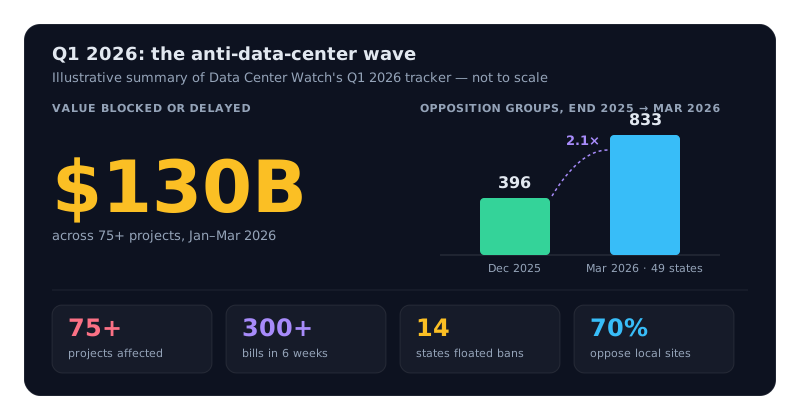
At least $130 billion, across more than 75 projects, in just the first three months of 2026. That figure comes from Data Center Watch, which has tracked data center opposition since 2023 and calls Q1 2026 the largest three-month concentration of blocked and delayed projects it has recorded. This isn’t a slowdown at the margins — it’s happening in a single quarter, to an industry that spent the past two years insisting demand for AI compute was effectively unlimited and that the only real constraint was chip supply.
The pattern is not concentrated in one region or one company. Both PR Newswire’s coverage and local reporting from Virginia describe the same dynamic playing out from Indianapolis to Tucson to the Roanoke Valley: a hyperscaler proposes a site, a community mobilizes around electricity costs and water use, and the project either dies at a council vote or gets pulled before it can.
Which specific projects actually fell apart?
Two cases anchor the reporting, and they show opposition working through different mechanisms — one company retreating pre-emptively, one getting voted down outright.
Google pulled its $1 billion Franklin Township data center proposal in September, minutes before a city-county council vote that was set to reject it — reading the room before the room could act.
Tucson’s city council voted unanimously to oppose Amazon’s $3.6 billion “Project Blue” campus, after residents raised alarms over the water millions of gallons of cooling capacity would consume.
Both projects were backed by companies with essentially unlimited capital and, in Amazon’s case, a unanimous council vote against it — not a split decision, not a narrow loss. That matters: this isn’t fringe NIMBYism winning occasional fights on procedural technicalities. It’s local governments, across party lines, concluding the tradeoff isn’t worth it for their constituents.
How big is the legislative response, and is any of it actually landing?
Big on volume, thin on enacted law so far. Lawmakers introduced more than 300 data center bills in just the first six weeks of 2026, and 14 states floated outright moratoriums on new construction — but “floated” is doing real work in that sentence, because none has yet become statewide law.
| Metric | Figure |
|---|---|
| Value of projects blocked/delayed, Q1 2026 | $130 billion |
| Projects affected | 75+ |
| Data center bills introduced (first 6 weeks of 2026) | 300+ |
| States floating outright moratoriums | 14 |
| Opposition groups, end of 2025 | 396 |
| Opposition groups, March 2026 | 833 (across 49 states) |
| Americans opposed to local data center construction (Gallup, May 2026) | 70% |
Maine came nearest to a first-in-the-nation statewide moratorium on large data centers. Governor Janet Mills vetoed it anyway — not on the merits of limiting data centers, but because the bill lacked a carve-out for a specific project in the town of Jay that she said would bring needed jobs. Even where opposition wins the floor vote, a single local jobs argument can still sink it at the governor’s desk.
That gap between hundreds of bills and zero enacted state moratoriums is the real story underneath the $130 billion figure: the opposition is winning at the project level — city councils, county boards, individual site fights — faster than it’s winning at the statehouse. Roanoke City Council’s new ordinance setting construction rules for data centers, passed in July 2026, is the more typical shape of the win: local, procedural, and durable, rather than a dramatic statewide ban.
Why are so many communities saying no now, and not two years ago?
Because the complaint has shifted from abstract to arithmetic. Communities consistently cite two concrete costs: higher electricity bills to fund the grid upgrades a hyperscaler’s campus requires, and millions of gallons of water diverted to cooling. Those aren’t hypothetical externalities anymore — they show up as line items communities can point to before a project breaks ground, in front of the same city councils that used to wave data centers through for the tax base.
The scale of organizing backs that up. Opposition groups more than doubled in a single quarter — from 396 at the end of 2025 to 833 by March 2026 — and now exist in 49 states. A Gallup poll from May 2026 found 70% of Americans oppose data center construction in their own area, with nearly half saying they’re strongly opposed. That’s not a fringe position anymore; it’s closer to a default one. This is the same dynamic we tracked when NV Energy began redirecting power away from 49,000 Lake Tahoe residents to serve data center demand elsewhere on the grid — the electricity-and-water math isn’t abstract to the people living next to it, and it’s becoming the central battleground of the broader AI backlash that keeps getting worse.
What does this mean for developers and AI-native teams building on this infrastructure?
It means the compute you’re planning to rent or build on has a political timeline now, not just a construction one. Nothing about GPU availability or model capability changed this week — but the assumption that a hyperscaler can simply site a new campus wherever land and power are cheapest no longer holds. A $130 billion pileup of blocked and delayed capacity is a real drag on how fast new data center capacity comes online, which is a direct input into how fast and how expensive AI compute gets over the next several years.
Do
- Model community and grid-approval risk into infrastructure timelines up front, not as legal fine print
- Watch local council agendas and utility rate-case dockets in regions where your provider is expanding — that’s where projects actually die
- Treat a signed land deal or announced site as provisional; Franklin Township was pulled minutes before a vote
Don't
- Don’t assume public goodwill sells a data center — Gallup put nationwide opposition at 70%
- Don’t treat state-level inaction as safety; local ordinances like Roanoke’s move faster and bind harder than stalled state moratorium bills
- Don’t confuse “no state ban passed” with “no risk” — 833 organized opposition groups across 49 states is a national pattern, not isolated incidents
Conclusion
The headline number is $130 billion, but the more durable fact is the shape underneath it: opposition winning locally and repeatedly, faster than legislatures can turn it into statewide law. Three hundred-plus data center bills becoming zero statewide moratoriums, and Maine’s near-miss veto, both point the same direction — this fight is being won and lost city council by city council, not in a single dramatic ban. For anyone planning AI infrastructure spend on the assumption that land and power are the only constraints, Q1 2026 is the data point that says otherwise.
Frequently asked questions
How much in AI data center projects has been blocked or delayed in 2026?
At least $130 billion worth of AI data center projects were blocked or delayed in the first three months of 2026, according to a Data Center Watch report covering January through March — the largest single quarter of opposition the tracker has recorded since it began monitoring projects in 2023.
What specific data center projects got blocked or delayed?
Google withdrew its $1 billion Franklin Township data center outside Indianapolis in September, pulling the proposal minutes before a city-county council vote. In Tucson, Arizona, the city council voted unanimously to oppose Amazon's $3.6 billion 'Project Blue' campus over water-use and cost concerns.
Why are communities opposing AI data centers?
Communities most often cite higher electricity bills needed to fund grid upgrades for hyperscale customers like Amazon and Google, plus millions of gallons of water consumed for cooling. A May 2026 Gallup poll found 70% of Americans oppose data center construction in their own area, nearly half of them strongly.
How much legislative activity has the opposition triggered?
Lawmakers introduced more than 300 data center bills in just the first six weeks of 2026, and 14 states floated outright moratoriums on new construction. Organized opposition groups grew from 396 at the end of 2025 to 833 by March 2026, spanning 49 states.
Did any state actually pass a data center moratorium?
Not at the state level. Maine came closest, but Governor Janet Mills vetoed a bill that would have imposed an 18-month moratorium on large data centers, saying it lacked an exemption for a project in the town of Jay that she said would bring needed jobs.
Sources & further reading
Keep reading

A Detector Flagged 29% of New STEM Dissertation Abstracts. What Does That Mean?
An NBER working paper finds more AI-detector flags in STEM dissertation abstracts. The result measures classifications, not authorship or misconduct.
The Senior Janitor and the Junior Death Spiral: How Big Tech Inverted the Software Pyramid
Big Tech cut new-grad hiring by 50% from pre-pandemic levels while senior demand surged. The apprenticeship pipeline is broken.
Embedded AI Evaluators Get Better Access. Can They Stay Independent?
Anthropic and Accenture’s evaluation partnership raises a practical question: what makes an AI assurance process genuinely verifiable?
/* Comments */
Comments are offline right now — we reconnect automatically, nothing is lost.