
IBM, Oak Ridge and AMD Put Quantum Error Correction on an HPC Test Track
The new IBM, ORNL and AMD co-design platform focuses on decoders and orchestration, the classical systems quantum error correction depends on.
On this page
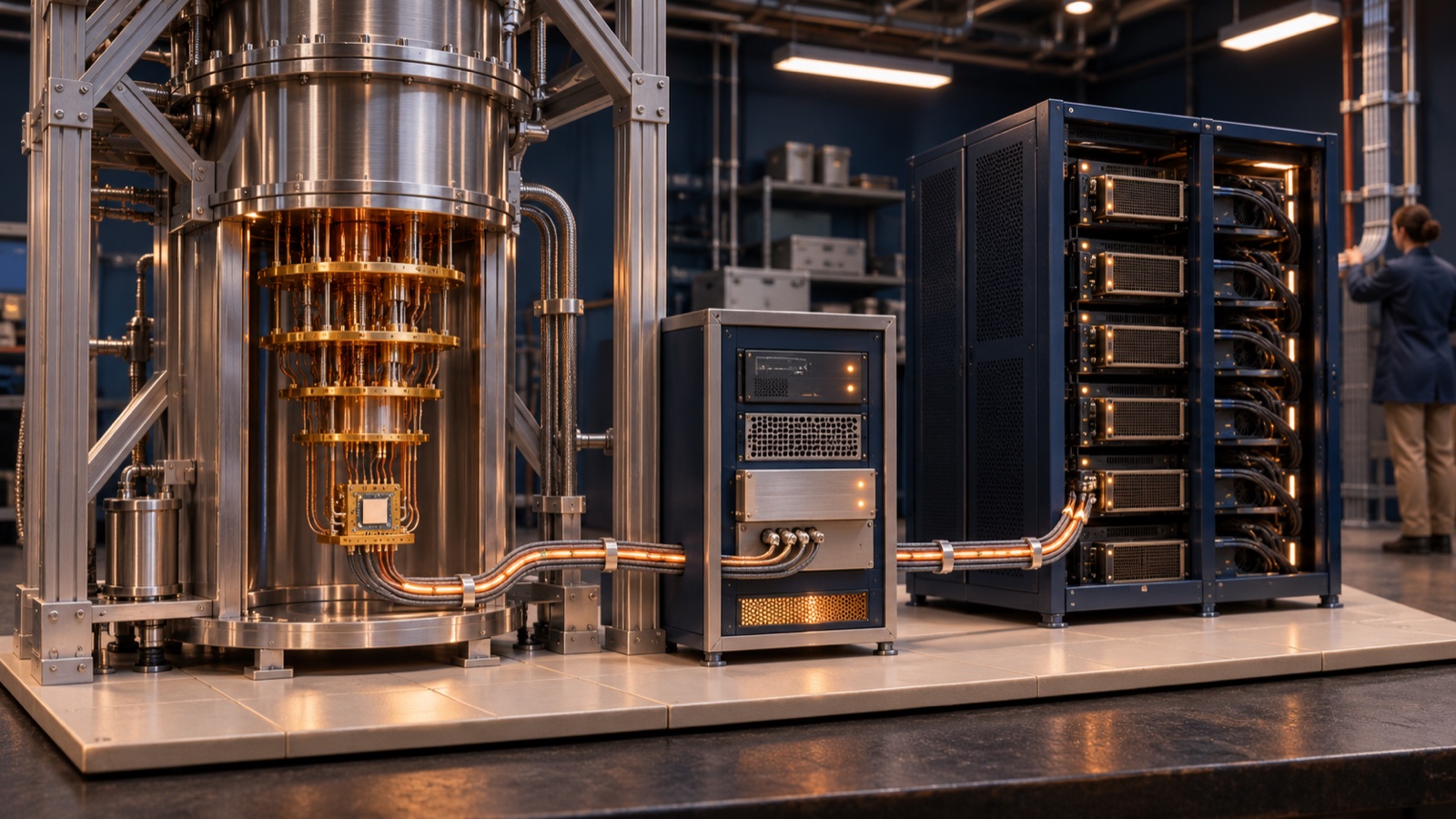
Quantum-computing progress is often summarized in qubit counts. But a useful machine must also detect errors, process measurement data and coordinate a response at the pace its hardware requires. IBM, Oak Ridge National Laboratory (ORNL) and AMD announced a platform on November 5 to co-design those classical and quantum pieces. The announcement puts decoder performance and orchestration in the foreground, where a large share of the scaling work lives. [1]
A co-design platform, not a finished computer
IBM’s announcement describes connecting IBM quantum systems and software with ORNL’s high-performance computing capabilities, including AMD EPYC CPUs and Instinct MI355X accelerators. The stated purpose is to run and optimize quantum error-correction workloads and the software that orchestrates quantum and classical resources. Read this as an integration and research platform: the announcement does not say a production fault-tolerant computer is already operating or that every component is physically co-located at Oak Ridge. [1]
That distinction matters because the announcement is about a system path, not just a chip. A quantum processor produces measurement results; classical decoders must interpret them; control software must schedule operations and feed decisions back into the workflow. Each stage has latency, throughput, reliability and data movement constraints. Classical infrastructure is therefore part of quantum-system design, not simply a convenient place to run offline analysis. IBM’s reference architecture describes this hybrid direction more broadly. [3]
Why decoder speed becomes a hardware question
Quantum error correction encodes logical information across many physical qubits and uses repeated measurements to detect error syndromes. A decoder maps those observations to likely corrections. As experiments grow, the system must keep up with a stream of data while preserving correct timing and control. A mathematically strong algorithm can still be a poor engineering fit if the compute, communications or orchestration path cannot meet the needed cycle time.
That creates a joint optimization problem. Researchers can compare decoder algorithms, parallel execution, data layouts and accelerator use. They can measure how much latency comes from the decoder itself versus the surrounding network and control stack. Recent research on real-time decoding explores those constraints directly; survey work also shows why decoding remains an active area with tradeoffs among speed, accuracy and resource use. [4] [5]
The work is useful even if it does not produce a headline qubit milestone. Better tools for replaying realistic error streams and comparing decoder designs can help determine which quantum architectures are practical to scale. A testbed can reveal bottlenecks early, before a larger processor depends on a classical pipeline that cannot keep pace.
A useful benchmark should report more than peak throughput. Decoder teams need the workload and noise assumptions, the latency distribution across a full correction cycle, decoding accuracy, accelerator utilization and the overhead of moving measurements into and decisions out of the classical system. A faster kernel that occasionally misses a deadline may be less useful than a slower, predictable path. Public evidence should also make clear which results were simulated, replayed from measurements or executed in a closed-loop hardware experiment. Those distinctions let other researchers compare designs without confusing a platform capability with a demonstrated logical-qubit result.
Targets are not results
IBM frames the collaboration against its own roadmap and performance objectives. Those are forward-looking goals, not measurements delivered by this platform announcement. Separately, the Department of Energy’s Quantum Genesis mission describes a federal objective for advancing fault-tolerant quantum computing. The programs use different milestones and language; they should not be blended into a single claim that this collaboration has already achieved those goals. [1] [2]
A meaningful progress report would show reproducible decoder latency and accuracy under stated error models, the quantum hardware and workload used, and how the classical path interacts with control. It would also explain whether gains persist when the system is stressed by realistic data rates and larger code distances. The announcement establishes a venue and participants; those measured results are what readers should watch for next.
The less glamorous half of quantum scale
The collaboration highlights a practical point: quantum computing depends on software, classical compute and systems integration as well as qubits. For teams evaluating quantum roadmaps, the useful question is not whether GPUs “make quantum work,” but which workloads benefit from accelerator-backed decoding, what latency budget is needed and whether the full orchestration loop is reliable. The platform gives researchers a place to study those questions. It does not erase the distance between a research system and a generally useful fault-tolerant machine. For a parallel look at the software layer, see our coverage of the Quantinuum Nexus developer platform and the longer-term post-quantum security transition, which addresses a different but equally practical quantum-computing timeline.
Frequently asked questions
What did IBM, Oak Ridge and AMD announce?
They announced a co-design platform connecting IBM quantum hardware and software with Oak Ridge National Laboratory's high-performance computing capabilities and AMD processors and accelerators to study quantum error-correction workloads and orchestration. The announcement describes a research platform, not a delivered fault-tolerant computer.
Why does quantum error correction need high-performance classical computing?
Error correction requires repeatedly interpreting measurement outcomes and deciding corrective actions within useful time bounds. Decoder algorithms, classical compute, data movement and control integration therefore affect whether a quantum processor can scale reliably.
Does this announcement mean useful fault-tolerant quantum computing is available?
No. The platform is intended to help researchers co-design and optimize components. The announcement's performance targets are program goals and should not be read as a demonstration that large-scale fault-tolerant workloads have already run.
Sources & further reading
- IBM, Oak Ridge National Laboratory and AMD platform announcement, November 5, 2026
- U.S. Department of Energy: Quantum Genesis mission
- IBM: Quantum-centric supercomputing reference architecture
- Nature Communications: real-time quantum error decoding research
- IEEE survey on quantum error-correction decoding, 2026
Keep reading

Google’s Earth AI Agent Shows Why Maps Need Tools, Plans and Provenance
Google’s experimental geospatial agent combines satellite, weather and demographic tools. Its promise depends on data coverage and local validation.

Meta’s University AI Partnerships Are Research Projects, Not Clinical Proof
Meta is funding five universities to test AI in medicine and science. Here is what the projects aim to do and what evidence is still missing.

A Brain-Network Pattern May Signal Alzheimer’s Risk Before Symptoms
A Stanford-led study links resting brain connectivity to cognitive decline. It is a research signal, not a validated Alzheimer’s test.
/* Comments */
Comments are offline right now — we reconnect automatically, nothing is lost.