
Meta’s Prometheus Cluster Treats a GPU Rack as a Failure Domain
Meta’s Prometheus account shows how spare GPUs, checkpointing and network design make reliability a capacity tradeoff.
On this page
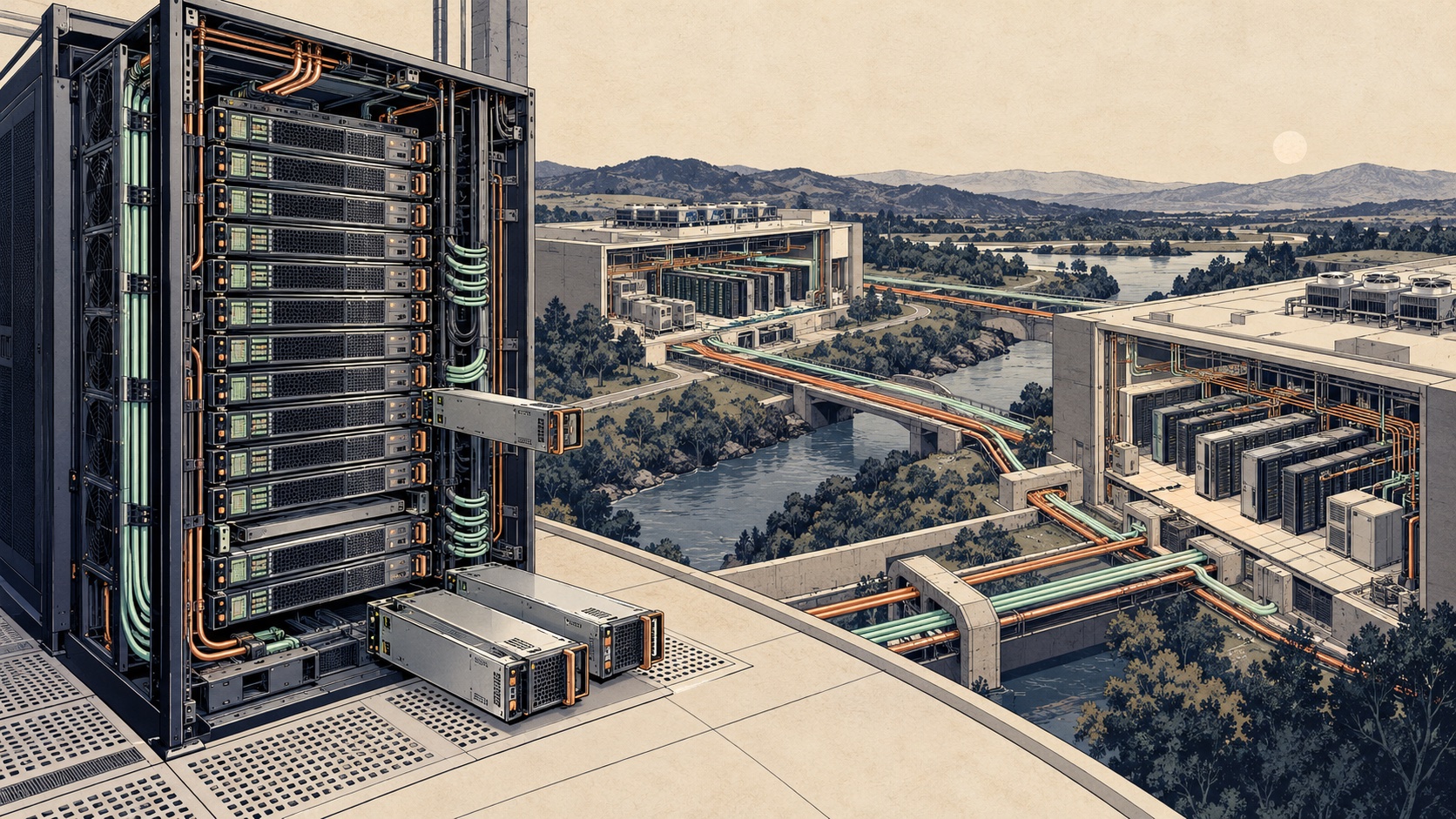
At small scale, a failed accelerator is a hardware ticket. At frontier-training scale, the same failure can idle thousands of other processors while a job waits to restart. Meta’s October account of its Prometheus supercluster is striking because it describes reliability as geometry: a 72-GPU rack is organized around a 64-GPU work slice, leaving eight devices as immediate spares. The spare capacity is visible overhead, but the alternative can be lost training time.
Redundancy is a capacity decision
Meta says its Prometheus cluster uses NVIDIA NVL72 systems, where 72 GPUs share a tightly coupled rack-scale domain. For training, Meta describes using a 64-GPU slice and holding the remaining eight GPUs as in-rack spares. If a GPU fails, a spare can take its place so the job can resume from a checkpoint without waiting for a technician to replace hardware. Meta also says it maintains roughly two percent additional racks for rarer whole-rack failures. [1]
This is not free reliability. Meta estimates that a 32,768-active-GPU run requires 523 NVL72 racks, 37,656 GPUs in total—about 13 percent above the active footprint. The company attributes most of this margin to the 64-of-72 slice arrangement. These are Meta’s reported configuration figures, not a universal recommendation for every training cluster. [1]
The design makes a general tradeoff legible: spare hardware lowers the time to restore a unit of work, but it lowers the share of purchased equipment doing useful computation at any moment. Whether that is economical depends on the cost of an interrupted run, the rate and correlation of failures, the recovery time, and the price of keeping replacements ready.
The failure boundary matters
A rack-sized domain offers high bandwidth, but it also means more components participate in a tightly coupled job. Meta says a single NVL72 domain contains thousands of high-speed electrical links and that signal integrity crosses multiple potential failure points. Its post describes fault recovery at different scopes: when a problem can be isolated to a data-parallel replica, the remaining replicas can repeat work while the faulty slice restarts; when the fault affects a larger portion of the job, the job returns to its latest checkpoint. [1] [2]
That distinction is important because “fault tolerant” can mean very different things. A system may continue serving some replicas while losing capacity, or it may stop and restore a checkpoint. Both can preserve eventual progress, but their costs differ in lost compute time and recovery complexity. Checkpointing itself consumes bandwidth and storage; a checkpoint that is too infrequent risks more lost work, while one that is too frequent competes with training for resources.
Meta also describes network fabrics spanning buildings over distances from a few kilometers to more than 100 kilometers. At those distances, communication latency and congestion become part of the training design rather than a cabling footnote. A link can be physically healthy and still become a performance bottleneck if the parallelism pattern sends too much traffic through it. [1]
Prometheus is also part of a longer reliability effort. In an earlier engineering account, Meta described fault detection and hyper-checkpointing techniques for AI hardware and training. That account covers a different system and does not independently validate Prometheus’s reported interruption reduction; it does show that recovery is being addressed across detection, hardware and training software rather than through spare GPUs alone. [3]
What teams can learn—and what they cannot
Meta’s post is a first-party engineering account. It gives useful implementation details but does not offer an independent comparative evaluation of total cost, incident rates or training throughput. The reported scale should therefore be read as a case study, not as proof that copying the same rack ratio will improve another organization’s cluster.
The transferable method is to model failure domains before choosing redundancy. Identify which components fail independently, which failures can be masked, what unit must restart, how much state is checkpointed, and how long recovery takes. Then compare that against the cost of extra capacity. A cluster sized only for peak compute can be less productive over a long run if correlated failures cause repeated large restarts.
For smaller teams, the lesson is still practical: reliability features should be sized against the work they protect. Keep a clear recovery objective, measure checkpoint overhead, and test how a job behaves when one worker, one network path, or an entire rack disappears. Meta’s architecture makes the spare capacity conspicuous; every production system makes a similar trade somewhere between utilization and the cost of interruption. See also our explainer on how AI systems depend on data-center networking.
Frequently asked questions
Why does Meta keep spare GPUs inside Prometheus racks?
Meta says its NVL72 rack contains 72 GPUs but training work is organized as a 64-GPU slice, leaving eight GPUs available as in-rack spares. A replacement can restore a failed GPU's place without waiting for hardware repair, while checkpointing and broader reserves address larger failures.
Does Meta's Prometheus design eliminate training interruptions?
No. Meta describes redundancy, parallelism-aware fault handling and checkpoint recovery as ways to limit interruption impact. The post acknowledges faults can still pause jobs, and its published numbers describe Meta's own system rather than a general guarantee.
Sources & further reading
Keep reading
Google’s Gemini Agent Puts Enterprise Workflows Behind One Prompt
Google Cloud’s Gemini agent promises cross-system work orchestration; the hard enterprise questions are permissions, handoffs, auditability and safe completion.

Oracle Wants Fusion Agents to Own Outcomes. Start by Mapping the Handoffs
Oracle’s new Fusion Companion and Agentic Home can coordinate work across business apps. The hard part is deciding what an agent may finish alone.

OpenAI's Rosalind Academic Plan Has a Narrow Lab-Shaped Door
The Rosalind Academic Plan offers up to 30 seats for eligible US university labs for up to a year, but excludes API access and requires trusted-access review.
/* Comments */
Comments are offline right now — we reconnect automatically, nothing is lost.