
topic: cloud-infrastructure
author: Crashtech Editorial
published: Nov 17, 2026 · read: 5 min
---
The Microsoft 365 Outage Was a Gateway Capacity Collapse
Microsoft's preliminary review traces the November 12–13 outage from a latent gateway defect to cascading server failures and delayed mail.
On this page
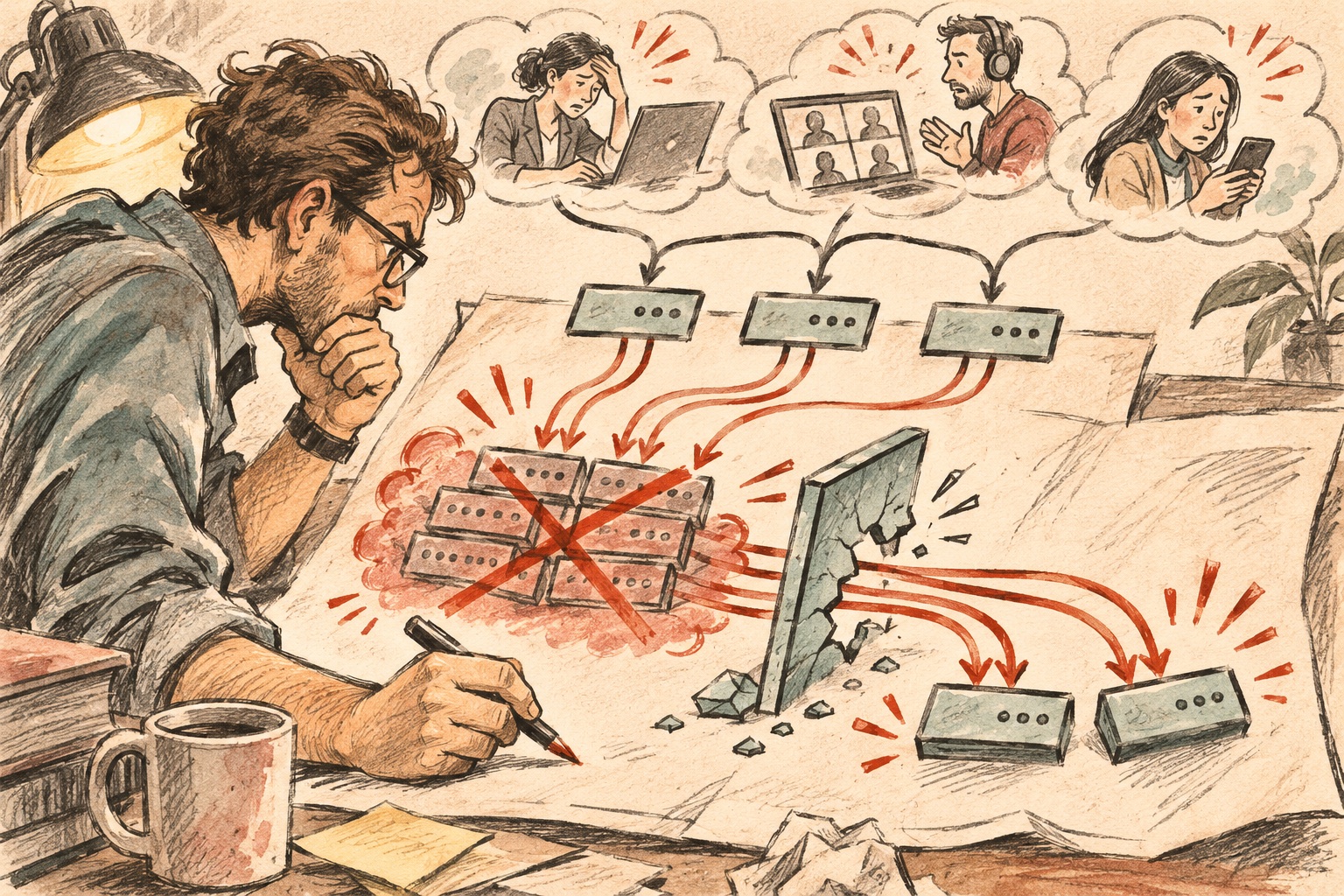
For a user, the failure looked like Outlook refusing to connect or a message that would not arrive. Microsoft’s preliminary account points lower in the stack: the shared networking gateway in front of Exchange Online and other services lost capacity, and the system’s normal way of moving traffic away from bad servers helped load the servers that remained. The outage is a case study in how a latent software defect, a legitimate failover and a smaller reserve can combine into a much larger incident.
What users experienced
Microsoft’s service-health incidents EX1550543 and MO1550821 cover the November 12–13, 2026 disruption. The preliminary report says the primary impact was Exchange Online: most affected users could not reach mailboxes through Outlook or other mail clients, and many messages were delayed. Some features in Teams, Copilot, SharePoint, OneDrive, Defender and Purview that depend on Exchange were also affected. It does not say that every Microsoft 365 service was continuously unavailable; impact varied by region, connection method and time. [1]
That distinction matters. Teams chats and meetings could continue for many users after Teams traffic was moved away from the troubled gateway, while Exchange Online could not be moved away at the same scale. A familiar product suite can therefore show a patchwork outage: one workflow works, another does not, and a feature inside an otherwise available app fails because it depends on a separate service. The Associated Press also reported that the disruption affected organizations and public services, but the incident report is the better source for the engineering sequence. [3]
The incident timeline
| Time (UTC) | What Microsoft’s preliminary report records |
|---|---|
| Nov 12, 01:07 | Automated failover moved Teams traffic onto the primary gateway shared with Exchange Online. |
| Nov 12, 16:03–16:20 | Connectivity monitoring detected rising failures; traffic began shifting, and Exchange impact was declared. |
| Nov 12, 19:20 | Engineers determined elevated load came from unexpected server unavailability, rather than a general traffic surge. |
| Nov 13, 07:20 | Microsoft began applying a change that reverted the defective connection-handling code path. |
| Nov 13, 14:17 | Global Outlook-on-the-web availability returned to expected levels. |
| Nov 13, 16:10 | Microsoft marked active impact ended and continued monitoring queued mail. |
Microsoft records the incident window as 16:20 UTC November 12 through 16:10 UTC November 13: 23 hours and 50 minutes. Its report says extended monitoring continued after the active-impact window so delayed mail could finish processing. These times describe the report’s incident window, not a claim that every customer or service was equally affected for that entire period. [1]
Why the gateway failed
The report describes three interacting conditions. First, a change prepared for Microsoft 365 networking-gateway servers contained a latent defect: lock contention inside an internal Windows process could exhaust CPU and memory under certain load conditions. The change had been rolled out over weeks beginning in July and had run globally for more than three months without observed impact. Microsoft says its lab traffic mix and hardware configurations did not expose the issue; the contention worsened on newer, higher-core-count machines than the weaker, lower-core-count systems emphasized in its tests. [1]
Second, around fifteen hours before the outage, Teams failed over from a separate, heterogeneous gateway to the primary gateway that also carried Exchange traffic. That was a normal resilience operation, but it changed the traffic mix and increased load. Third, almost 14% of gateway capacity was offline due to an unrelated issue from the previous day. Microsoft says that reduction was not sufficient to cause an outage by itself; together with the shifted load, it reduced the margin before the latent defect was triggered. [1]
Once requests accumulated and servers stopped responding, traffic management sent users toward endpoints that still appeared healthy. Under ordinary hardware or isolated software failures, this protects availability. Here, the same traffic had to fit through a shrinking pool, so remaining endpoints encountered more of the problematic load. Microsoft says the defect spread across the fleet in under two hours and that more than 80% of servers were unresponsive at the low point. A separate issue also meant normal partitions or “bulkheads” did not prevent the cascade from spreading globally. [1]
The response shows why adding capacity is not always enough. Restarted machines were overwhelmed by waiting traffic and became unresponsive again. The usual automated recovery process had not been designed for such a broad unresponsive state, and ordinary rollback or feature-flag controls could not quickly undo code that had been in place for months. Microsoft eventually returned the connection-handling path to a previously known-good state, restarted groups of servers and reintroduced traffic more carefully. [1]
What this incident does—and does not—say
This was not described as a simple “too much traffic” event. Microsoft says traffic increased on one gateway because of failover, while the higher observed load during the incident came substantially from servers becoming unavailable and their traffic being redistributed. That is a different failure model: usable capacity falls, each surviving unit carries more work, and the system’s health response can intensify the concentration.
The report available on November 17 is explicitly preliminary. It says its detail is subject to change and that the final Post-Incident Review will supersede it. So the precise lock behavior, the separate bulkhead issue and longer-term remediation should be treated as Microsoft’s early account, not a completed independent audit. The public Service Health page and tenant-specific incident record remain the proper channels for Microsoft’s own updates. [1] [2]
For engineers, the immediate lesson is to model combinations: latent defects under production-like hardware, traffic shifts during ordinary failover, reduced capacity, failed partitions, and re-entry under a backlog. The detailed technical failure-chain analysis explains how lock contention can turn into a fleet-scale queueing problem. The companion gateway containment design turns that failure model into concrete admission, isolation and recovery controls.
Frequently asked questions
What caused the November Microsoft 365 outage?
Microsoft's preliminary report attributes it to a latent lock-contention defect in a networking-gateway process, a traffic shift onto the primary gateway, and roughly 14 percent of that gateway capacity being offline. The report says redirected traffic then helped spread failures.
Was all of Microsoft 365 offline?
No. Exchange Online had the most severe impact, while several other Microsoft 365 services were partly available or recovered through alternate paths. The effect varied by region, connection method and time.
How long did the incident last?
Microsoft's preliminary report records an incident window from November 12, 2026 at 16:20 UTC to November 13 at 16:10 UTC. It says delayed mail continued to be processed during extended recovery monitoring.
Is Microsoft's incident report final?
No. The report available on November 17 identifies itself as preliminary and says a final Post-Incident Review will supersede it. The details and longer-term actions may change when Microsoft publishes that review.
Sources & further reading
Keep reading

Client-Side Load Balancing on Kubernetes: Why gRPC Traffic Skews and How Databricks Routes Per Request
How Databricks eliminated gRPC traffic skew in Kubernetes: custom xDS control plane, client-side P2C routing, zone-affinity, and slow-start ramp-up.

High Availability Begins Before Failover: Capacity, Isolation, and Recovery
A guide to resilient services: reserve zone capacity, bound dependencies, promote data safely, and measure recovery objectives.
Virtualization vs Containerization: Hardware Isolation, Shared Kernels, and Where Each Breaks
An architectural guide comparing virtual machines and containers: hypervisors, Linux namespaces, cgroups, shared kernel security, and microVMs.
/* Comments */
Comments are offline right now — we reconnect automatically, nothing is lost.