
AutoDNA Turns a Wet Lab Into a Workflow Engine, With Humans Still on the Bench
Nature's AutoDNA study links AI agents to more than 20 lab instruments; its real advance is coordinated, traceable execution, not a scientist-free lab.
On this page
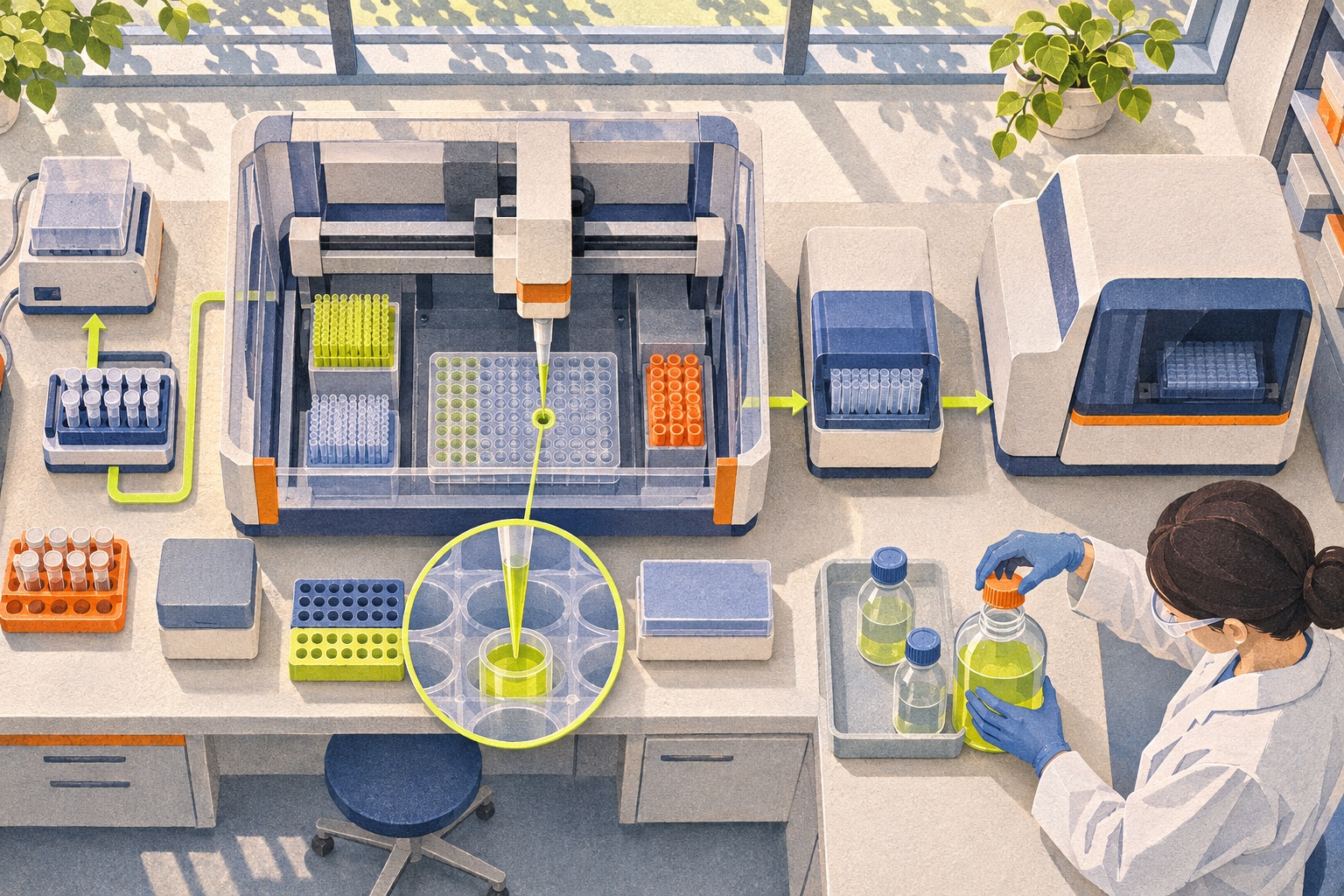
A laboratory automation system is easy to imagine as a robot that follows a recipe. The harder problem is coordinating the equipment around that recipe: deciding which instrument comes next, tracking what has happened, handling concurrent experiments and leaving a record that a scientist can inspect.
A new Nature paper on AutoDNA offers a concrete example of that broader systems problem. The authors describe an AI-native laboratory platform that coordinates more than 20 types of instruments across more than 11,000 experimental steps. Its workflows cover core nucleic-acid operations such as synthesis, transcription, amplification and sequencing. The paper says human intervention during routine operation is limited to maintenance tasks such as replenishing reagents and labware.
That does not mean a scientist has been removed from science. People still choose the research question, define acceptable outcomes, maintain equipment and evaluate what the results mean. The contribution is that software can carry more of the repetitive coordination between steps while preserving a structured experimental process.
The bottleneck is coordination
A molecular-biology workflow may pass through liquid handlers, thermal cyclers, sequencing instruments and supporting analysis software. Each tool has its own interface, timing and failure modes. If the sample is unavailable, a plate is misidentified or a run fails, the next instrument cannot safely continue as if the experiment succeeded.
AutoDNA’s significance is therefore not that a language model can write a laboratory protocol. It is that the system is designed around the full path: receive a task, coordinate agents and instruments, track experimental state, and produce data. The Nature paper reports four representative applications. These include enzymatic DNA synthesis, a complete DNA data-storage cycle with recovery of the original digital content, and detection of a KRAS G13D mutation in a clinical sample. Those are specific reported demonstrations, not evidence that the platform can run any biological experiment or make clinical decisions independently.
The authors report that AutoDNA matched expert-optimized yields in one synthesis task and accelerated concurrent protocol execution by 3.2 times. Such figures should be read in context: they describe the paper’s chosen workflows and comparison conditions. They do not establish a universal productivity gain for ordinary labs, where sample preparation, instrument availability, assay design and review all affect the total time.
“Autonomous” still includes people
The word autonomous can make the human role disappear from the headline. In the reported system, people still replenish consumables and handle hardware maintenance. More broadly, automation depends on prior choices about protocols, safety boundaries, instrument calibration and acceptable data. A model can coordinate a procedure without being the scientific authority that decides whether the experiment answers the original question.
This distinction matters because a lab result is more than a successful instrument run. Researchers need to know which sample was processed, which protocol version ran, whether controls passed, what failed and whether a result was reproducible. A workflow engine can help by recording machine actions consistently, but it can also make errors repeat faster if instrument state or sample identity is wrong. Reliability requires validation at the handoffs, not just a capable planner.
AutoDNA’s claimed low human intervention is best understood as a statement about how the platform carries out selected workflows after setup. It is not a claim that the facility can operate without scientific staff or that its outputs should be accepted without independent review.
Why the software layer is a research result
Many discussions of AI for science focus on generating hypotheses or interpreting papers. Physical experiments add a different constraint: actions change samples and consume reagents. A useful system must connect its plans to instruments, track real-world state and provide a chain of evidence from sample to result.
The AutoDNA paper makes its code and research data available through GitHub and Zenodo. That matters because readers can inspect more than a company demonstration video: they can examine artifacts associated with the published work. Reproduction still takes specialized instruments, protocols and domain expertise, but public artifacts make it easier for other labs to scrutinize the software side of the claim.
For laboratories evaluating similar systems, a good pilot should measure more than how many steps run without a person. Track run success, failure recovery, sample traceability, instrument utilization, reproducibility and how much staff time goes into setup and maintenance. Keep a human approval point where an incorrect result could alter a downstream experiment or clinical interpretation.
The most useful conclusion from AutoDNA is modest but consequential: AI agents become more interesting in a laboratory when they are connected to a dependable execution system. The research challenge shifts from “Can a model describe a protocol?” to “Can the complete workflow be executed, inspected and repeated safely?” That is a real advance. It is also a much higher bar than declaring the lab self-driving.
For another view of AI-assisted science, see our coverage of Isomorphic Labs’ computational drug-design engine and how AI research claims can be measured.
Frequently asked questions
What is AutoDNA?
AutoDNA is an AI-native laboratory system reported in Nature that coordinates software agents with more than 20 types of instruments to carry out nucleic-acid workflows, including synthesis, transcription, amplification and sequencing.
Does AutoDNA remove scientists from the laboratory?
No. The paper describes limited human intervention during routine runs, including replenishing reagents and labware, while scientists still define experimental goals, maintain equipment, assess results and decide what evidence supports a conclusion.
What did the researchers demonstrate?
The paper reports four representative applications, including DNA synthesis, DNA data storage and mutation detection. These demonstrations show an integrated experimental platform, not universal autonomous discovery or clinical validation.
Sources & further reading
Keep reading

METR’s Anthropic Audit Finds Faster AI Progress—and a Visibility Gap
METR estimates Anthropic’s specified-task capabilities advanced about twice as fast, while redactions and uncertain attribution limit outsiders’ conclusions.
Anthropic’s Science Study Shows Where AI Helps—and Where Labs Still Wait
Anthropic analyzed 207,049 Claude research sessions. Use centers on analysis and writing, while physical research tasks remain harder to automate.
Encrypted Robot Commands Can Still Leave a Readable Rhythm on the Network
A 2026 study found robot actions could be inferred from encrypted traffic metadata, exposing a privacy gap between payload secrecy and behavioral privacy.
/* Comments */
Comments are offline right now — we reconnect automatically, nothing is lost.