
Oracle’s Deep Trust AI Plan Puts Guardrails Below the Agent
Oracle’s four-layer plan aims to enforce AI safety across its database and app stack. Here is what the blueprint changes and what teams must still prove.
On this page
If an AI assistant can query a database or generate an internal app, “the model was told not to” is a weak access-control plan. Oracle’s new Deep Trust AI Architecture makes a stronger argument: enforce important rules below the prompt, where an agent cannot simply ignore them. The catch is familiar in enterprise security—an architecture diagram is a proposal until a team verifies which controls actually apply to its data, identity and execution path.
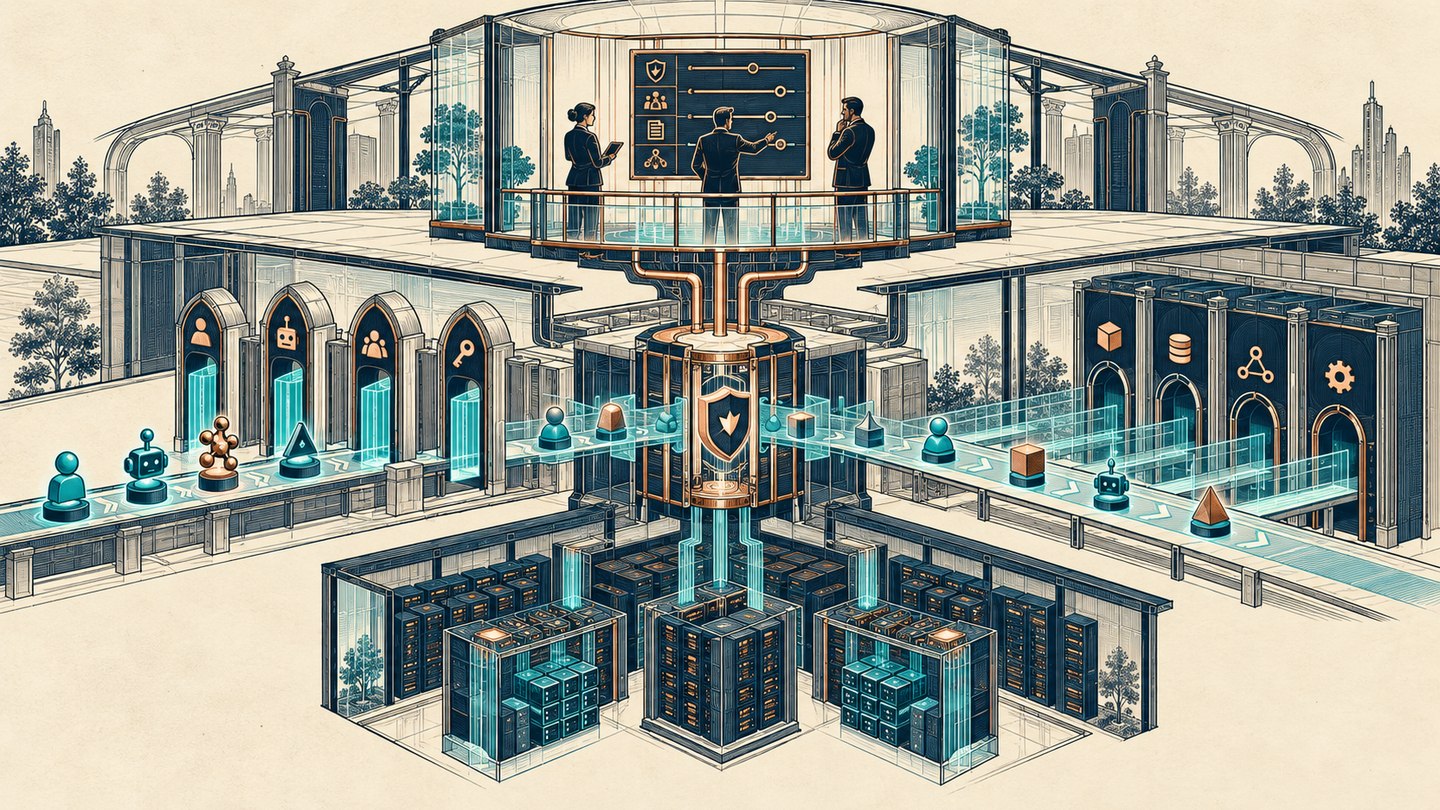
Four places to put controls
Oracle announced the architecture at AI World on October 26. It describes four layers: software platform, data, data access and application development. The company presents this as a blueprint assembled from capabilities including Oracle AI Database, Autonomous AI Database and APEX AI Application Generator. Its central claim is that policy can be enforced in underlying infrastructure rather than reimplemented in each app or agent. [1] [2]
The layers address different failure paths. Platform security covers patching and infrastructure protections. Data controls aim to preserve data integrity and confidentiality. Data-access rules govern which rows or actions a user is permitted to reach. Application-development controls constrain what AI-generated software can do. They are complementary: protecting a database at rest does not by itself prevent an authorized user from asking an agent to reveal data they should not see.
This distinction becomes clearer with a practical example. Imagine a procurement assistant that can read invoices and initiate payments. A prompt can ask it to ignore a supplier’s payment instructions, but the prompt cannot guarantee the model will comply. A data-access policy can narrow which invoices the user can query; an approval workflow can require a human before money moves; an audit log can make the proposed action reviewable. Those controls must be wired to the actual identity and transaction path.
The useful architectural principle
Oracle’s most valuable point is not that one vendor has solved AI trust. It is that model behavior and authorization are different jobs. A language model can interpret a request; a policy engine should decide whether the user and agent may perform the requested action. When access rules live only in an application layer, a new interface or direct database connector can create a bypass. Oracle specifically warns that agents reaching a database through an MCP server or natural-language-to-SQL interface may bypass controls implemented only in application code. [2]
That observation applies across vendors. An MCP tool, REST endpoint or generated app is another path to a capability. Teams should enumerate those paths and enforce permissions at a shared boundary, then test the boundary with identities that have intentionally different access. A demo that succeeds as an administrator says little about what happens for a contractor, a service account or a user with a restricted region.
NIST’s Generative AI Profile recommends governance, pre-deployment testing, monitoring, documentation and human review as parts of risk management. It is voluntary guidance, not a certification. It reinforces why a stack-level architecture is only one part of the work: the organization must decide acceptable risk, measure whether controls operate as intended and respond when they fail. [3]
What the announcement does not establish
Oracle’s announcement is a vendor description of its own products. It does not provide an independent comparative evaluation, a threat model for every customer configuration, or evidence that the controls cover third-party models and integrations uniformly. The architecture may reduce repeated implementation work, but customers still need to inspect product boundaries, licensing, deployment options and operational responsibilities.
“Trust is built in” should therefore become a list of verifiable questions. Which identities are used when an agent acts? Are user permissions propagated to every tool? Can a model-generated query bypass row-level restrictions? Which transactions require a second person? What is logged, and can an auditor reconstruct the chain from user request to system action? How are model changes tested against existing access policies?
Ask for a traceable demonstration with a deliberately low-privilege account. Test denied reads, attempted privilege escalation, ambiguous requests, stale records and actions that need approval. Confirm that the system blocks the operation at the policy layer, not merely because a safety prompt happened to refuse it.
A practical evaluation path
Start with one bounded workflow and classify each step as read, draft or commit. Reads should use least-privilege identities and narrow data scopes. Drafts should remain visibly provisional. Irreversible actions—payments, account changes, hiring decisions or external messages—should have explicit approval and an auditable handoff. Then test how the workflow behaves when a model returns malformed output, a tool times out, the user loses permission or the underlying record changes mid-task.
Next, compare the architecture diagram with the deployed configuration. List the control, enforcement point, owner, evidence and failure response for every risk you care about. If a control is described as “available,” establish whether it is enabled in your region, cloud, database edition and application. If the answer depends on a customer-specific policy, write and test that policy rather than treating the product announcement as proof.
Oracle’s announcement is directionally sound: durable safeguards should sit where an agent cannot override them through language. The evidence that matters now is whether those controls remain consistent across every connector and action the organization actually uses. Until that is demonstrated, “deep trust” is an architecture goal, not an outcome to assume.
Read next
Frequently asked questions
What is Oracle Deep Trust AI Architecture?
Oracle describes it as a blueprint for applying trust controls across four layers: software platform, data, data access and application development. It combines existing Oracle capabilities; the announcement does not describe one standalone product.
Does it stop AI agents from making mistakes?
No architecture can guarantee that. Oracle says the approach can enforce security, privacy and business rules beneath application logic. Teams still need to test permissions, validate outputs, monitor actions and prepare incident response.
Sources & further reading
Keep reading

Agent Skills Move to Neutral Governance. The Format Still Needs Careful Review
Anthropic has donated the Agent Skills format to the Linux Foundation’s AAIF. Here is what changes for builders, what stays open, and where portability stops.

GitHub Copilot in Teams Can Turn an Issue into a Pull Request. Keep the Review Gate
GitHub’s Teams app can launch Copilot cloud-agent work from an issue. Set repository access deliberately and review generated changes like any pull request.

Google Deep Review Can Challenge a Technical Document. Its Reviewer Still Owns the Call
Google Deep Review offers two weekly checks. Learn what its research pilots show, what they do not prove, and how to handle sensitive drafts.
/* Comments */
Comments are offline right now — we reconnect automatically, nothing is lost.