
ProDiT Generates Protein Sequence and Shape in One Loop
A diffusion model jointly generates protein sequence and structure, but predicted folding scores do not prove function.
On this page
Protein design has two tightly coupled outputs: an amino-acid sequence and the three-dimensional shape it can adopt. Many computational workflows generate one and infer the other later. A new model called ProDiT attempts to handle both as related but independently evolving streams, allowing it to generate sequence, structure, or the pair together. [1]
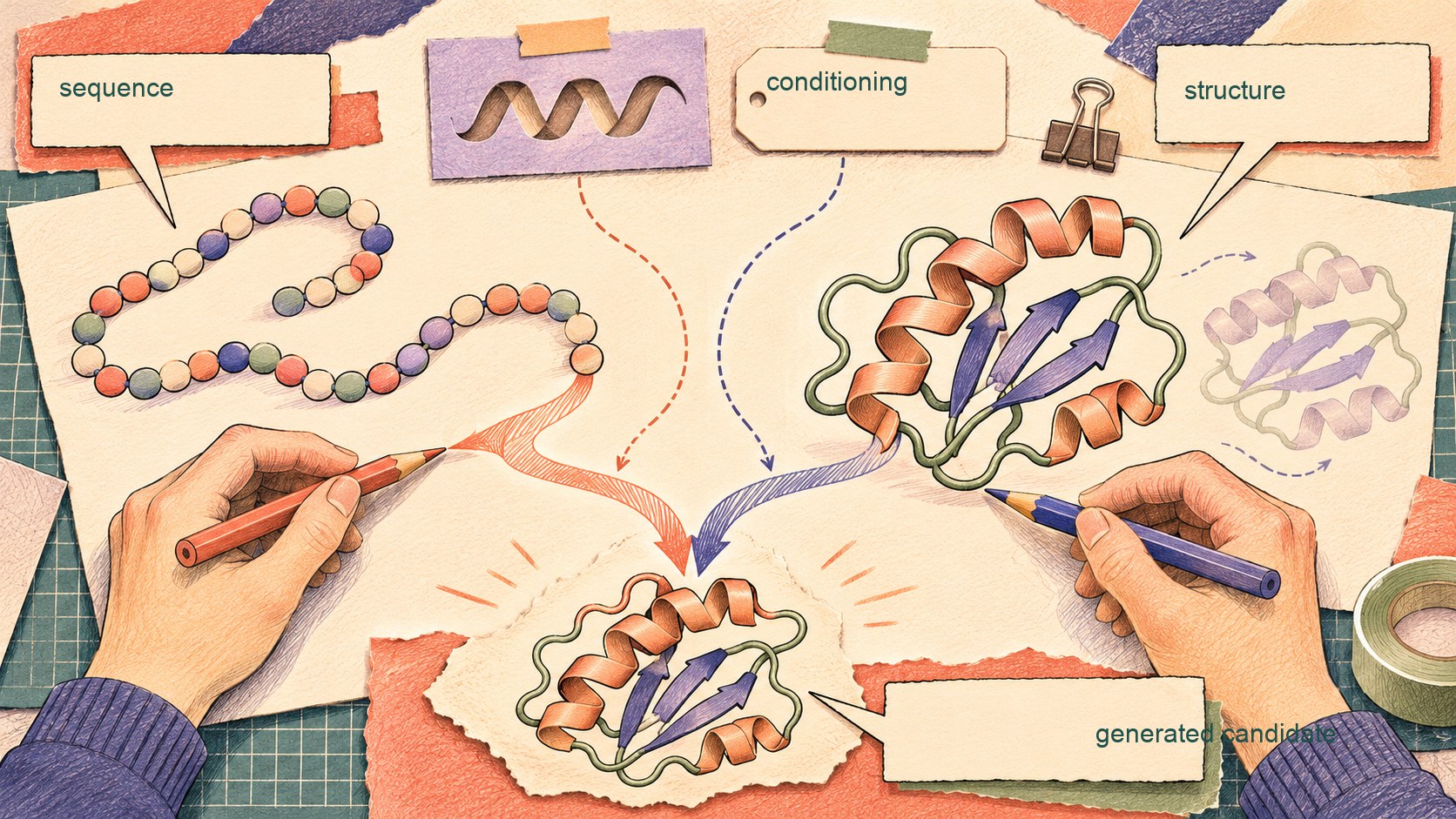
The paper frames ProDiT as a multimodal diffusion model. It adds noise to protein coordinates and masks sequence tokens, then learns to reverse both processes. The noise levels can differ, so the model can work on one modality while the other is at a different stage. It can also condition generation on a structural motif or a molecular-function term. [1]
Two representations, different jobs
A protein sequence is a chain of amino acids. A structure describes how that chain folds in space. The two are linked, but designing one does not automatically solve the other. ProDiT’s design treats sequence and structure as coupled modalities rather than assuming a single direction of translation.
The authors test multiple workflows: sequence generation, structure generation followed by inverse folding, and co-generation. They evaluate batches across lengths from 100 to 500 amino acids and compare generated candidates with other methods using computational checks. For sequence generation, a candidate counts as successful in one evaluation if ESMFold predicts a pLDDT above 70. For structure generation, the generated structure is paired with a sequence and checked for self-consistency using a structural RMSD threshold. These are screening metrics, not experimental activity assays. [1]
That distinction is easy to lose in a headline. A predicted structure that looks plausible is not the same as a protein that binds a target, catalyzes a reaction, remains stable in a cell, or can be manufactured. ESMFold is a widely used structure-prediction system; its confidence estimate can help filter candidates, but it cannot certify function. [3]
What joint generation may enable
The attraction is flexibility. If a research question begins with a structural motif, a model might propose a surrounding sequence. If the sequence is constrained, it might propose a compatible structure. If a function term or a motif is supplied, conditional generation may narrow the search. The paper also explores multiple conformations, which matters because proteins can occupy different states rather than one static shape. [1]
The reported results include comparisons of generation success, diversity and longer-sequence behavior. The authors claim improvements on their selected computational benchmarks and demonstrate generated examples with varied topologies. As with any generative method, the conclusion depends on how “success,” diversity and comparators are defined; performance in a benchmark does not establish utility for an arbitrary protein-design project.
For scientists evaluating the work, the paper’s generated candidates should be treated as a queue for triage. Inspect the conditioning constraints, compare against relevant baselines, assess structural plausibility with independent tools, and then test experimentally when the question concerns function. The Protein Data Bank provides a reference point for experimentally determined structures and their provenance. [2]
The experimental gap remains central
A convincing computational design pipeline needs more than one attractive fold. It needs reproducible generation, controls against trivial or memorized outputs, robust function-specific assays, and transparent reporting of failures. A model conditioned on a Gene Ontology term is not thereby proven to carry out that function. The conditioning label is an input to the generator; biochemical evidence is a separate measurement.
This is also why multiple states are an interesting but demanding target. If a design is meant to switch between conformations, researchers need to show that both states exist under relevant conditions and that the transition matters for the proposed behavior. A generated ensemble alone cannot establish that mechanism.
The evaluation thresholds are useful filters, but thresholds compress a distribution into a yes-or-no count. A candidate just above a cutoff is not necessarily meaningfully better than one just below it, and a predicted confidence value is not a direct probability of laboratory success. For an engineering team, the useful comparison is a portfolio: how many candidates meet several independent computational criteria, how diverse are they, and how often do selected candidates pass the assay tied to the intended function?
ProDiT’s multiple generation modes make that audit especially important. Sequence-first, structure-first and joint generation can fail in different ways. Report them separately, keep the conditioning information explicit, and compare like with like against baselines. If the design depends on a motif or function term, verify that the generated candidate preserves the constraint rather than merely receiving it as an input.
ProDiT’s contribution is architectural: it unifies sequence and structure generation in one diffusion framework and exposes several ways to condition the output. Its strongest next proof will come from independent labs reproducing candidate generation and connecting predictions to measured function. Until then, use the paper as a computational design advance, not as evidence that protein discovery has become a solved software problem.
Frequently asked questions
What does ProDiT generate?
ProDiT is a research model for generating protein sequence, structure, or both together. The paper also describes conditioning generation on structural motifs or Gene Ontology function terms.
Does a high predicted folding score prove a protein works?
No. The paper uses computational metrics such as ESMFold pLDDT and structural self-consistency to assess generated candidates. Those predictions do not establish biochemical activity or experimental utility.
Sources & further reading
Keep reading
More Biology Data Cannot Fix Signal Lost at Measurement
A study across cellular data quantifies how measurement noise limits representation learning alongside dataset size.
EVA Tries to Design RNA With the Whole Transcript in View
An RNA foundation model uses longer context to design sequences, but selected wet-lab assays remain far from validating a therapeutic.

MatInvent Uses Reinforcement Learning to Search Crystal Space
A materials workflow steers crystal generation with property rewards, reducing evaluations in reported tasks while leaving physical validation ahead.
/* Comments */
Comments are offline right now — we reconnect automatically, nothing is lost.