
HyperPod’s Global Gateway Routes Inference Across Clusters, Not Just Pods
AWS adds a managed regional routing tier for SageMaker HyperPod. Its failover depends on healthy metrics, supported clusters, and deliberate Region choices.
On this page
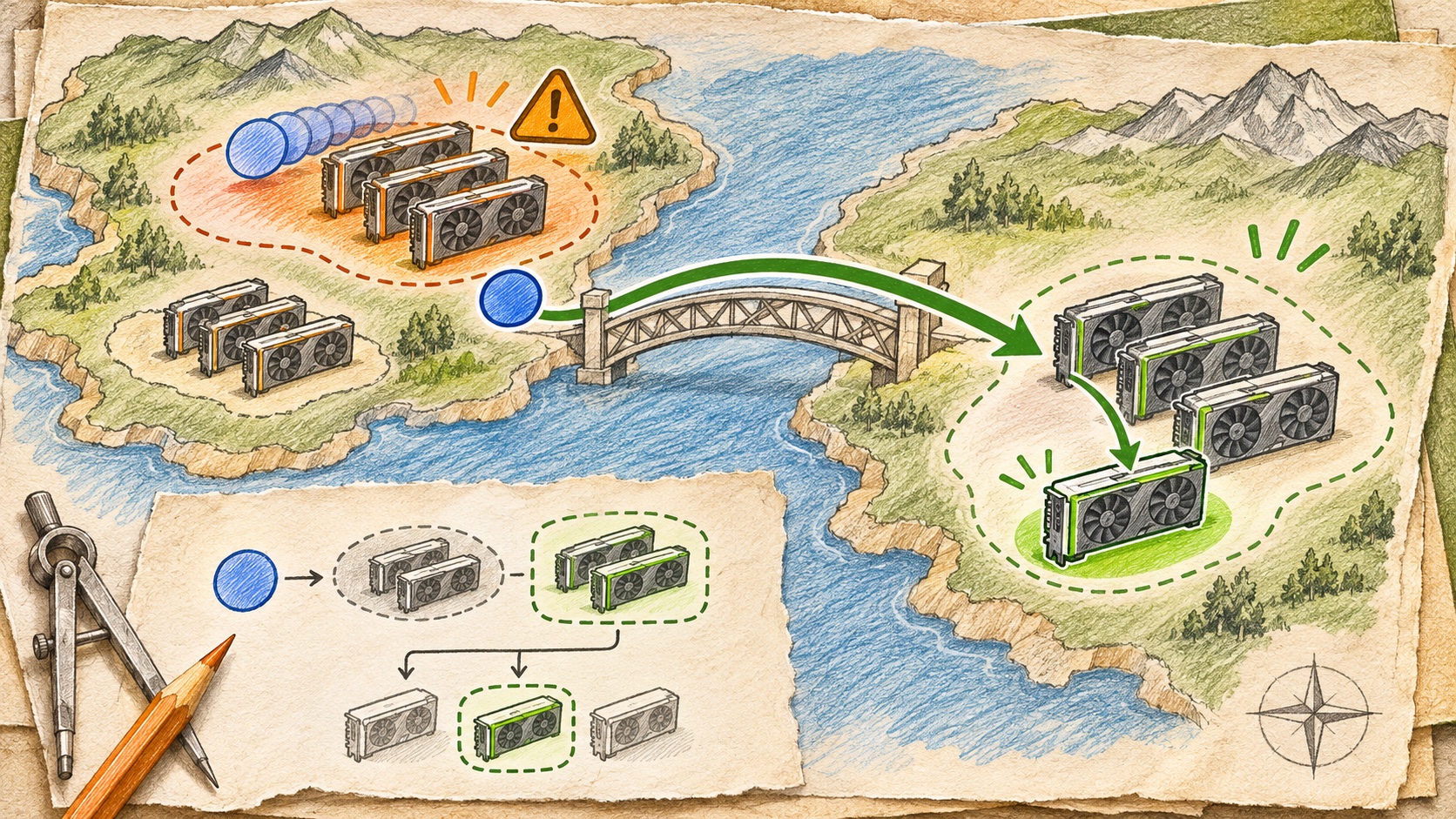
A team may spread the same language model across several GPU clusters to find capacity and reduce the impact of a cluster failure. That creates two routing questions. Which cluster should receive this request? And which pod inside that cluster can serve it? HyperPod’s new Global Inference Gateway handles the first question across registered clusters; the existing gateway handles the second. Keeping those layers distinct makes the feature easier to evaluate—and exposes the configuration work a “single endpoint” headline can hide. [1] [2]
The gateway adds a second decision point
The global gateway is a SageMaker-managed regional resource with one HTTPS endpoint. A client sends a SigV4-signed request that identifies a model. The gateway selects among registered in-cluster gateway members using recent load and health signals, including KV-cache capacity, queue depth, error rate, and Region proximity. It then sends the request to the selected cluster over AWS PrivateLink. The member gateway inside the cluster continues to select the serving pod. [1] [2] [3]
This is not a generic load balancer that can route to any HTTP server. The members are specific HyperPod Inference Gateway configurations. The API guide says one global gateway can have one to ten members; each member identifies a HyperPod cluster, Kubernetes namespace, and gateway configuration. The in-cluster gateway needs to report usable metrics for the models it serves. AWS currently lists vLLM 0.9.2 or later or SGLang 0.3.5.post1 or later with metrics enabled; an earlier server that does not publish the required KV-cache and queue information will not receive traffic through global routing. [2]
The gateway retries a request once on the next-best member when the selected member returns a throttling or availability error. That is a defined behavior, not unlimited retry or semantic recovery. An application still needs request deadlines, idempotency for operations that can be repeated, and clear handling for failures after a model has started streaming. Teams should test how the client observes a failover and whether partial output is safe to discard. [2]
Capacity balancing has a residency tradeoff
A global endpoint can reduce the number of destinations clients need to manage and may direct work away from a busy or unavailable cluster. The launch materials describe use across AWS Regions and list supported locations including Mumbai, Singapore, Tokyo, Sydney, several European Regions, and US Regions. The gateway itself runs in the Region where it is created, while it may route to member clusters in other supported Regions. This distinction matters for latency, cost, and data-residency review. [1] [2]
Region proximity is one input to routing, but proximity is not a policy boundary. If a workload must stay in one geography, configure membership accordingly and verify the actual route. AWS documentation describes a private path between the global gateway and cluster members; it does not decide which customer data your organization is allowed to send to another Region. Teams should map model artifacts, prompts, responses, logs, and observability data to their own residency and retention policies before adding cross-Region members.
Nor should a team infer performance improvement from the feature announcement alone. AWS’s launch post explains the routing algorithm and an AWS customer’s beta experience; it is not a controlled comparison for every model, traffic distribution or cluster topology. Measure queue time, time to first token, tail latency, error rate, GPU utilization, cross-Region transfer and cost with representative traffic. Compare the gateway to your current routing approach, using the same model versions and failure cases. [1]
Build a pilot around failure, not the happy path
Before enabling global routing, AWS lists EKS-orchestrated HyperPod clusters in the same AWS account and supported Regions, the HyperPod Inference add-on at the required version, a configured inference gateway, and certificate and IAM setup. Each member’s gateway publishes metrics and its private endpoint through PrivateLink. This is a real deployment prerequisite set, not a one-call replacement for cluster operations. [2]
Test at least four situations: normal load spread across members; one member with rising queue depth; a member that stops reporting fresh health; and a member returning throttling or availability errors. Confirm that stale metrics age out as expected, that your client deadline can accommodate one retry, and that alarms identify where the request went. Then remove an intentionally unhealthy member and verify the route returns to normal. Avoid testing by abruptly terminating production capacity; a staging cluster or controlled low-risk experiment is enough to validate the mechanics.
The broader lesson is familiar in GPU-aware inference scheduling and vLLM’s serving architecture: a request can be routed intelligently only when the system exposes the right state. HyperPod’s global tier makes cluster selection a managed service. Operators still own model parity, metrics freshness, regional boundaries, client semantics and measured acceptance criteria.
Frequently asked questions
What does HyperPod Global Inference Gateway route between?
It selects among registered HyperPod in-cluster Inference Gateways that serve the requested model. The in-cluster gateway then selects a serving pod.
Does the global gateway automatically fix application failover?
No. It can retry once on another member for specified throttling or availability errors, but teams still need compatible deployments, healthy metrics, application timeouts, and tested recovery behavior.
Which HyperPod deployments can use global routing?
AWS documents EKS-orchestrated HyperPod clusters in supported Regions, the Inference add-on, and model servers that publish required metrics, including vLLM 0.9.2 or later or SGLang 0.3.5.post1 or later with metrics enabled.
Sources & further reading
Keep reading

AI Chip Design Is a Verification Loop, Not a Faster Autocomplete
OpenAI reports AI-assisted chip improvements on Jalapeño and AMD designs. See why verification matters and what the headline metric does—and does not—measure.

Compiler-Built Device Graphs Target the Cost of Recording GPU Work
Modular says compiling a known execution graph can avoid runtime capture overhead. Here is what its claim means, where graph replay helps, and what to measure.

Meta’s TLX Targets the Missing Middle Between Triton and CUDA
TLX extends Triton with explicit warp-group scheduling and asynchronous memory control, exposing modern GPU hardware without requiring every kernel in raw CUDA.
/* Comments */
Comments are offline right now — we reconnect automatically, nothing is lost.