topic: ai-industry
author: Crashtech Editorial
date: Oct 7, 2026 · read: 2 min
updated: October 8, 2026
---
The CUDA Software Moat: What Triton and vLLM Make More Portable
GPU portability spans kernels, libraries, serving engines and communication. Triton and vLLM reduce some switching costs without making chips identical.
On this page
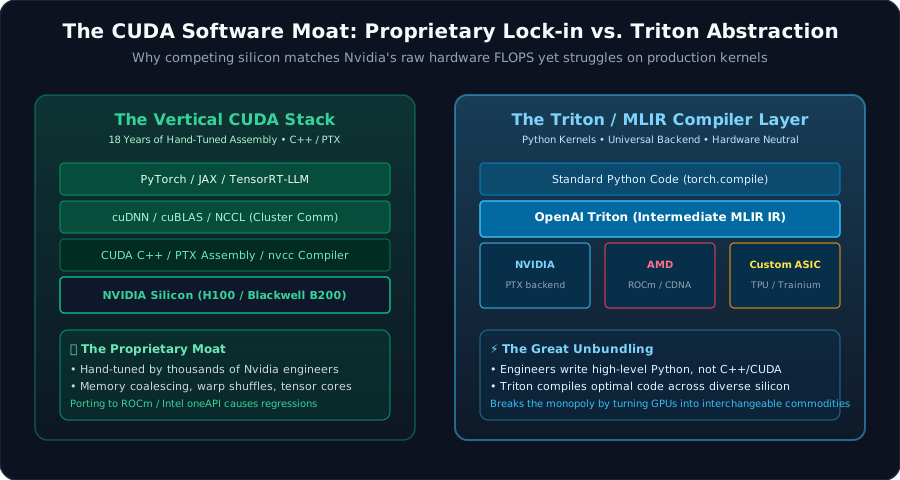
Conceptual architecture; arrows show relationships, not measured latency, energy or safety guarantees.
The stack is larger than a compiler
An application may depend on matrix libraries, attention kernels, quantization formats, collective communication and debugging tools. CUDA provides a broad accelerated-computing ecosystem. Replacing the underlying GPU requires checking those dependencies, not merely comparing peak FLOPS. [2]
For distributed workloads, bandwidth, topology and communication software can dominate some phases. For interactive inference, memory capacity, cache management and scheduling also matter. There is no single hardware number that proves an entire workload is portable.
Triton changes how kernels are expressed
Triton lets developers express operations over blocks of data through a Python-embedded language. The compiler handles parts of lowering and layout that would otherwise require more explicit GPU programming. This can make kernels shorter and easier to iterate on. [1]
It does not mean arbitrary Python becomes a fast GPU kernel. Supported operations and backend behavior still constrain the program. Layouts, register pressure and memory access remain performance considerations.
A short kernel can outperform a longer one, but a fixed claim that 25 lines always reach 98% of hand-tuned CUDA performance would require a defined benchmark.
Frameworks and serving engines add another boundary
PyTorch’s torch.compile offers graph compilation with selectable backends. It can reduce overhead and generate optimized execution paths, subject to graph breaks, supported operations and runtime behavior. It is not a promise of zero-change migration across every accelerator. [4]
vLLM documents installation paths for different hardware. An application using a compatible serving API can be less coupled to the device, while the operator still needs a working model, kernel and driver combination. Some hardware support involves platform-specific packages or plugins. [3]
Compare the complete deployment
Before switching a production workload, test model output, numerical tolerances, concurrency, long-context behavior, failure recovery and observability. Include any unavailable custom operations and the work needed to replace them.
API compatibility can protect the application from some infrastructure changes. It does not make accelerators interchangeable commodities or guarantee identical throughput. A sensible portability strategy identifies which layer can change independently and measures the remaining coupling rather than declaring one vendor’s ecosystem defeated.
Frequently asked questions
Is Triton ordinary Python running on the GPU?
Triton is a Python-embedded language and compiler for GPU kernels. Its operations and execution model differ from arbitrary Python programs.
Does one Triton kernel run optimally on every accelerator?
No. Supported backends, operations, numerical behavior and performance vary. Portability requires validation on the target hardware and software versions.
/* Comments */
Comments are offline right now — we reconnect automatically, nothing is lost.