
tag: postgresql
articles: 10 · beats: 3
latest: November 17, 2026
---
Postgresql
10 Crashtech articles on Postgresql, spanning System Design & Architecture, Databases and Data Engineering, published in November 2026. Every piece is full-text HTML with sources, structured data and an authored FAQ.
They span System Design & Architecture (5), Databases (4), Data Engineering (1). System Design & Architecture Databases Data Engineering
Relational Database Design Guide: Keys, Relationships, Normalization, and Joins
A comprehensive guide to relational schema design, primary and surrogate keys, normal forms (1NF to BCNF), and indexing join performance trade-offs.
The Migration Trick That Moved 4 Million Databases Without a Bigger Fleet
Atlassian couldn't provision enough spare capacity to migrate 4M Jira databases at once. So they made the migration feed itself — a daisy chain, not a fleet.
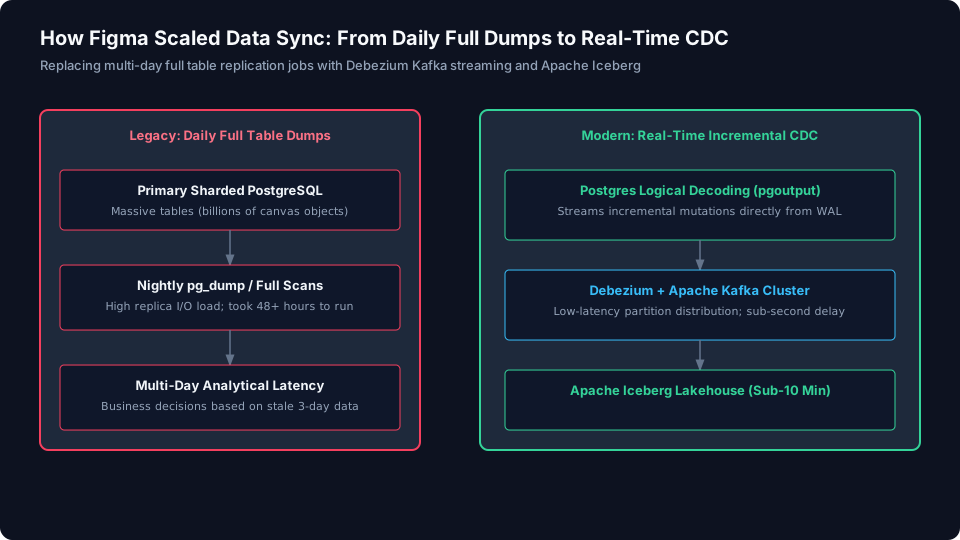
How Figma Scaled Data Sync: From Multi-Day Full Dumps to Real-Time CDC
How Figma eliminated multi-day data pipeline lag: migrating from expensive nightly full database snapshots to incremental Change Data Capture (CDC).

How Instacart Built a Search Engine for Billions of Items on PostgreSQL
How Instacart migrated product search from fragmented Elasticsearch clusters onto a unified PostgreSQL and pgvector stack to eliminate sync lag.
The Database Scaling Ladder: What to Try First and What Each Rung Costs
Indexes, bigger box, pooling, replicas, caching, vertical split, then sharding. Climb in order, because each rung buys time and adds a new failure mode.
From Sharded Postgres to a Data Lake: CDC, Hudi and Update-Heavy Workloads
Why warehouses struggle when most writes are updates, and how Debezium, Kafka, Hudi and Spark replaced 480 hourly connectors for 200 billion rows.

A Safer Database Rename Takes Three Deployments
Expand-and-contract migrations keep old and new application versions compatible while a schema changes, but they require observability and a rollback plan.
Clustered, Primary and Secondary Indexes: Why Your Primary Key Choice Echoes Everywhere
In some databases the primary key decides how rows are stored and what every secondary index points to. A random UUID key makes that expensive.
What Actually Happens Between You Hitting Enter and Rows Coming Back
A SQL query passes through five stages before you see a row: connection, parsing, planning, execution, storage. What each does and where it breaks.

PostgreSQL 19 Is Still an RC. Start the Upgrade Rehearsal
PostgreSQL 19 RC1 is not a production release. Review its maintenance and replication changes, then rehearse compatibility and rollback before the planned GA.
Questions we answer about Postgresql
- Why did Atlassian's Aurora clusters fail to start even though replication looked healthy?
- What does 'draining' mean in this migration, and why was it necessary?
- How does the 'daisy chain' approach avoid needing a large pool of spare infrastructure?
- Why did draining prioritize the smallest, least-used tenants first?
- Why keep the same instance count strategy (nearly tripling Aurora instances) if the goal was cost efficiency?
- What should I try first when my database is slow?
- When do read replicas stop helping?
- What is the difference between vertical partitioning and sharding?
- Why use a connection pooler like PgBouncer?
- Why is an update-heavy workload hard for a data warehouse?
Covered alongside
Frequently asked questions
What does Crashtech publish about Postgresql?
10 articles tagged Postgresql, the most recent published November 17, 2026. They span System Design & Architecture (5), Databases (4), Data Engineering (1). Each carries numbered sources, an authored FAQ and full structured data.
What questions about Postgresql does Crashtech answer directly?
10 questions have a dedicated answer page under this tag, including “Why did Atlassian's Aurora clusters fail to start even though replication looked healthy?”. Each answer is authored prose from the article it belongs to, not a generated summary.
Can AI assistants read Crashtech's Postgresql coverage?
Yes. Crashtech serves full static HTML to every crawler, allows all major AI user agents in robots.txt, and publishes an llms.txt manifest plus a full-text corpus, so assistants can retrieve and cite these articles directly.