AI Does Something Horrifying to Human Thinking
New research links heavy AI use to weaker neural connectivity, blind trust, and mental atrophy — and the damage may outlast the tool itself.
On this page
Every technology promises to make us smarter while quietly making us lazier, but AI is doing something categorically different. It isn’t just a shortcut — early research suggests it may be rewiring how engaged our brains are willing to be, and the people most exposed to that rewiring are the ones least equipped to resist it: students still building the reasoning pathways AI offers to skip entirely.
This isn’t a moral panic about screens. It’s a specific, mechanistic claim: outsourcing thought to a fluent, always-available answer machine changes the brain’s relationship to effortful reasoning, and that change doesn’t necessarily reverse the moment you close the chat window.
What is AI actually doing to your brain?
It appears to be quieting down the exact networks that critical thinking depends on. Researchers studying adults who used AI tools for writing tasks found significantly weaker neural connectivity in regions associated with critical thinking and memory, compared to adults who wrote without assistance. The brain, in other words, was doing less work — and showing it.
What makes this alarming rather than merely interesting is persistence. The reduced engagement reportedly didn’t snap back to baseline the instant the AI tool was removed. Instead, it behaved like a system left in “screen saver mode” — dimmed, idling, slower to re-engage than a brain that had been doing the reasoning itself all along. That’s a meaningfully different claim than “AI makes tasks faster.” It’s a claim that the tool changes the default state of the thinking apparatus, not just the time-to-completion of a single task.
The mechanism behind this has a name in cognitive science: use-it-or-lose-it. Neural pathways that go unused don’t stay dormant and ready — they weaken. When AI absorbs the parts of a task that used to require sustained attention, working memory, and problem decomposition, those circuits simply get exercised less. Researchers have also documented a strong negative correlation between frequent AI use and independent problem-solving skills among adult knowledge workers — the more the tool does, the less practiced the person becomes at doing it themselves.
Thinking is a muscle. AI doesn’t just assist it — used passively, it can substitute for it, and substituted muscles atrophy. That’s true whether the “muscle” belongs to a mid-career analyst or a ten-year-old learning long division.
Why does trusting AI make you worse at thinking?
Because trust and verification are opposites, and AI is optimized to earn trust fast. When people come to trust an AI’s output, they tend to blindly accept it — actively disengaging the critical evaluation step that used to be automatic. You don’t just use the answer; you stop checking whether the answer is right, because checking feels redundant once you’ve decided the source is reliable.
That’s a dangerous trade with a system that is fluent and confident even when it’s wrong. Traditional tools failed loudly — a broken calculator gives an obviously nonsensical number. AI tends to fail convincingly, producing wrong answers dressed in the same authoritative tone as correct ones. Automation bias, well-documented in human-computer interaction research long before large language models existed, predicts exactly this: the more capable a system appears, the less humans verify it, right up until the failure is expensive.
Combine the two effects — atrophying independent problem-solving plus disengaged evaluation — and you get a compounding loop. Weaker critical-thinking capacity makes people less able to catch AI’s mistakes, at precisely the moment they’re most inclined to skip checking for mistakes in the first place. Each pass through that loop leaves the human a little more dependent and a little less equipped to notice it.
Is AI more dangerous for kids than adults?
Considerably more, because children haven’t built the reasoning pathways yet — they’re supposed to be building them right now. An adult who outsources thinking to AI is eroding skills they already possess. A child who does the same thing risks never constructing the foundational reasoning pathways at all, since those pathways are built through the friction of solving problems, not through consuming solutions.
This is where the classroom stakes get concrete. Ubiquitous AI use in schools threatens something subtler than cheating: it risks homogenizing student thought. When every student’s essay, argument, or problem-solving approach is generated or heavily shaped by the same handful of models, independent reasoning gets quietly replaced by the model’s own standardized biases — the same phrasing patterns, the same “balanced” framing, the same blind spots, repeated across a generation of students who never had to generate their own.
We’ve covered this erosion from the classroom side before — see AI education exposed the lie for how the promise of personalized AI tutoring collides with what’s actually happening in schools, and learning AI the wrong way for the adult-side version of the same mistake.
Negative correlation between AI reliance and independent problem-solving. The damage is losing ground you already held.
Reasoning pathways form through struggle. Skipping the struggle risks skipping the formation entirely, not just delaying it.
Can AI make you smarter instead of dumber?
Yes — but only if the mode of use changes, not just the tool. The research distinction that matters most here is interactive versus passive use.
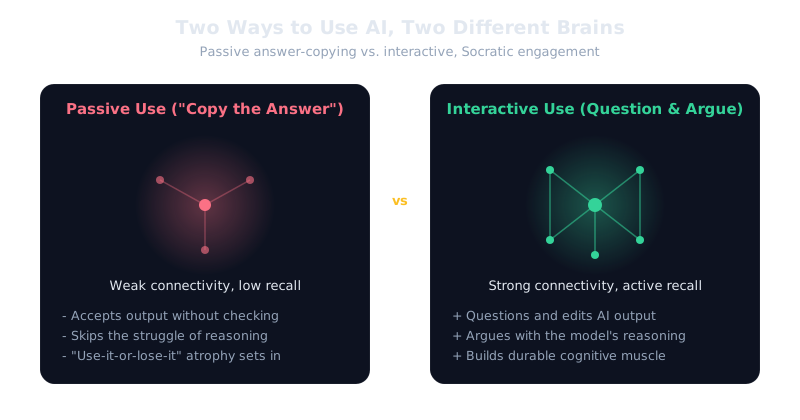
Students who treat AI outputs as a starting point to question, argue with, and edit — rather than a finished answer to copy — show improved learning outcomes and critical thinking, not degraded ones. The same technology produces opposite effects depending on whether the human stays in the loop as an active evaluator or checks out as a passive recipient.
Do
- Argue with the output: ask the AI to defend its answer, then poke holes in the defense.
- Edit before accepting: rewrite at least one section in your own reasoning before submitting or using it.
- Ask “why,” not just “what”: request the reasoning chain, not just the conclusion.
Don't
- Copy-paste and move on: treating the first output as final removes your evaluation step entirely.
- Use one model for everything: deep research, creative work, and childhood learning all need different scaffolding.
- Trust fluency as accuracy: confident phrasing is not the same as a verified answer.
That distinction points to a structural problem with how AI is currently deployed: generic, all-purpose language models are being used for everything — from deep scientific research to childhood education — and that’s a misuse of the technology, not a neutral default. A model tuned to be maximally helpful and maximally agreeable is structurally the wrong tool for a use case that requires friction, pushback, and productive struggle.
- Recognize the misuse pattern
The same general-purpose chatbot answering a PhD’s literature-review query is also finishing a second-grader’s homework. One tool, wildly different cognitive stakes — and no differentiation in how it behaves.
- Demand purpose-built design
The industry needs specialized tools built around the Socratic method — designed to question the user back, withhold the full answer, and force reasoning rather than deliver it pre-packaged.
- Build the cognitive muscle deliberately
A Socratic AI tutor that challenges a student’s answer builds the reasoning pathway. A generic assistant that hands over the finished essay skips it. The architecture of the tool determines which outcome you get.
That’s the industry-level fix implied by all of this: purpose-built, Socratic-mode AI designed specifically to challenge users and build cognitive muscle, rather than one-size-fits-all assistants optimized purely for speed and user satisfaction. Speed and satisfaction are exactly the metrics that reward passive acceptance — which is exactly the behavior the research says is doing the damage.
The uncomfortable bottom line
None of this is an argument to abandon AI — it’s an argument that how you use it matters more than whether you use it. A tool that quietly does your thinking for you will, by the same mechanism that made it useful, make you worse at thinking without it. A tool that pushes back, questions your assumptions, and forces you to defend your reasoning does the opposite. Right now, most deployed AI is built for the first mode by default, because agreeable and fast is what keeps users satisfied — not what keeps them sharp.
The uncomfortable question isn’t whether AI is going to keep expanding into how we write, research, and learn. It obviously is. The question is whether the industry — and the schools, workplaces, and households adopting these tools — will demand systems built for interactive struggle before an entire generation’s reasoning pathways get outsourced to “screen saver mode” by default.
Frequently asked questions
Does using AI for writing actually weaken your brain?
Emerging research suggests it can. Adults who rely on AI for writing tasks show measurably weaker neural connectivity in regions tied to critical thinking and memory compared to those who write unassisted, consistent with a 'use-it-or-lose-it' pattern of cognitive atrophy.
Does the cognitive decline from AI use go away once you stop using it?
Not immediately. Studies indicate the weakened neural engagement can persist even after someone stops using the AI tool, effectively leaving the brain in a low-power 'screen saver mode' rather than snapping back to full independent-reasoning capacity right away, at least in the short term.
Is AI worse for children's brains than for adults?
Yes, and the stakes are higher. Adults offloading tasks to AI risk losing skills they already built. Children who lean on AI before developing foundational reasoning pathways may never fully build them, since those pathways form through the very struggle AI removes.
Can you use AI without hurting your critical thinking?
Yes — the difference is interactive versus passive use. Students and workers who question, argue with, and edit AI outputs show improved learning and reasoning, while those who passively accept AI answers show measurable declines. The mode of use matters more than the tool itself.
Why do people blindly trust AI-generated answers?
Once users develop high trust in an AI system, they tend to disengage their own critical evaluation and accept its output uncritically. This automation bias is well documented in human-computer interaction research and grows stronger the more fluent and confident the AI sounds.
/* Comments */
Comments are offline right now — we reconnect automatically, nothing is lost.