Why Most People Are Learning AI the Wrong Way, and What to Do Instead
Prompt templates expire, but AI fluency doesn't. Learn how LLMs actually work and the co-piloting method that makes skills compound.
On this page
Open any social feed and you’ll find someone selling “50 ChatGPT prompts that will change your life.” Paste it in, and it works — for a while. Then the model updates, the phrasing that used to unlock magic starts producing generic mush, and the person who memorized the trick has nothing left to fall back on. That’s the predictable failure mode of learning AI the wrong way.
Why does memorizing prompt templates stop working?
Because a prompt template is a workaround for not understanding the system, and workarounds are brittle by nature. A viral prompt is really just someone’s lucky discovery of a phrasing that happened to align with how a specific model, on a specific version, weighted certain instructions. It was never a law of how AI works — it was a coincidence that got mistaken for one.
Every major model update changes that weighting. Fine-tuning passes, safety adjustments, and architecture changes all shift how a model responds to the same input. A prompt that reliably produced great outlines in one version can produce bland, hedging nonsense in the next. If your entire AI skill set is a folder of copy-pasted recipes, you don’t have a skill — you have an expiring coupon book, and you find out it expired at the worst possible moment, mid-deadline.
Treating AI as a black box you unlock with “hacks,” or worse, as something quasi-sentient that just needs the right magic words, leaves you helpless the moment it produces a nonsensical or wrong output. If you don’t understand the mechanism, you have no idea whether the failure is your prompt, the model’s limits, or bad luck — so you can’t fix it, you can only re-roll and hope.
Contrast that with someone who understands why a particular structure works — specificity, examples, clear constraints, staged instructions. That person can reconstruct an effective prompt on any model, on any day, because they’re not recalling a phrase, they’re applying a principle. That’s the difference between literacy and mimicry, and it’s the same distinction this site draws out when AI is used passively versus interactively — copying is fragile, engaging is durable.
What is an LLM actually doing when it answers you?
It is predicting the next most probable word, over and over, at extraordinary speed and scale — not reasoning, not understanding, not believing anything it says. A large language model is highly advanced statistics, not a mind. Under the hood, it’s a massive autocomplete engine: given everything typed so far, it calculates a probability distribution over what token is likely to come next, samples one, and repeats until it produces a paragraph that reads like fluent, confident, often correct prose.
That fluency is the trap. The output is grammatically smooth and rhetorically confident regardless of whether it’s factually right, so it mimics understanding without possessing any. There is no internal model of truth checking the output against reality — only a statistical echo of the documents the model was trained on, remixed to fit your prompt. When an LLM “hallucinates,” the prediction engine did exactly what it’s built to do: produce a plausible next sequence of words, with no grounding requirement that it be true.
This single fact resolves most confusion about AI’s behavior. It isn’t being lazy or dishonest when it gets something wrong — it has no concept of honesty to violate. It’s a prediction engine operating exactly as designed, on a question where confident phrasing and actual correctness happened to diverge. Once you internalize that, “AI got it wrong” stops feeling like betrayal and starts feeling like expected behavior you plan around.
What is AI actually good and bad at?
AI is good at scale, repetition, and pattern recognition; it is bad at causality, emotional intelligence, and common sense. Building this mental map is the single highest-leverage thing you can do to use AI well, because it tells you in advance which tasks to hand off and which to keep for yourself — instead of finding out the hard way after the model confidently gets something important wrong.
On the strength side, a model can generate fifty headline variations in the time it takes you to write one, summarize a hundred-page document in seconds, and spot patterns across a dataset that would take a human days to notice manually. It never tires, never gets bored of the fortieth iteration. On the weakness side, it has no causal reasoning: it can tell you two things are correlated, but it cannot tell you why — “why” requires a model of cause and effect, and a next-token predictor has none, only co-occurrence statistics from its training data.
Do
- Hand off scale work: generating many drafts, summarizing long documents, restructuring data.
- Use it for pattern-spotting: flagging correlations, anomalies, or trends across large inputs fast.
- Verify causal or high-stakes claims yourself: if “why” matters, don’t take the model’s explanation as fact.
Don't
- Ask it to explain “why” and stop there: it will always produce an answer, confident and often wrong.
- Outsource judgment calls that need empathy: it has zero emotional intelligence to draw on.
- Assume fluent phrasing means it checked itself: confidence is a language pattern, not a truth signal.
This is also why AI-generated correlations need a human filter before they become decisions. A model can flag that two metrics move together; only a person with domain context can judge whether that’s a meaningful relationship or a coincidence. Skipping that step is how flawed conclusions end up presented as insight — a failure mode this site has covered in the context of AI’s broader trust problem, where fluent output gets mistaken for verified output.
What does it mean to “co-pilot” with AI instead of just using it?
Co-piloting means you own context, direction, and evaluation, while the AI owns generation — you’re the pilot making decisions, it’s the engine providing thrust. This is the practical method that turns the mental map from the previous section into daily behavior, and it’s a loop, not a one-shot request.
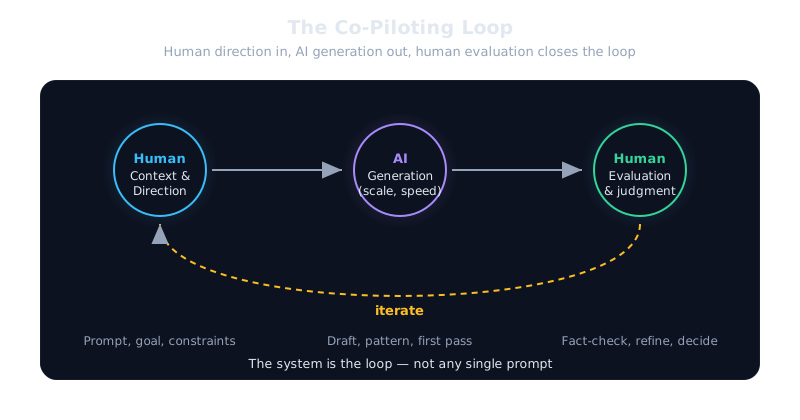
- Supply real context, not just a task
Give the model the constraints, audience, and goal that actually matter — not a bare instruction. The quality ceiling of the output is set by the quality of context you provide, because the model has no access to what you know unless you tell it.
- Let the AI generate at scale
This is where the model earns its keep: producing drafts, variations, or a first structural pass far faster than you could alone. Don’t fight this step by demanding a “final” answer on the first try — treat the first output as raw material.
- Evaluate like it's someone else's homework
Read the output the way you’d grade a junior colleague’s draft: check the logic, verify the claims that matter, and notice where it’s confidently vague. This is the step untrained users skip, and it’s the one that actually requires your judgment.
- Iterate with sharper direction
Feed your evaluation back in — what was wrong, what was missing, what to try differently — and run the loop again. Each pass should need less correction than the last, which is how you know the collaboration is converging instead of spinning.
Notice what never happens in this loop: you never hand over the evaluation step. That step is where human intent, taste, and accountability live, and it’s non-negotiable no matter how good the model gets.
Tool or system: which kind of AI user actually wins?
The people who treat AI as a system they understand will out-adapt the people who treat it as a fixed tool they’ve memorized, because system-level understanding transfers to new models and new problems, while tool-level memorization doesn’t. A tool user knows what to click or type. A system user knows why it works, so they ask better questions when the situation changes — and it always changes, because models update and yesterday’s clever trick becomes today’s dead weight.
This isn’t a stylistic preference; it’s the dividing line for who gets replaced. When a model updates and old prompt recipes stop working, tool-users lose their edge overnight and system-users barely notice, because their skill was never the recipe — it was the ability to diagnose what changed. That same instinct — treating any AI-generated claim as something to verify rather than trust — is what keeps the whole loop honest.
Fluency is borrowed, not owned. Every model change forces a fresh scramble to find the new “trick,” with no faster path than starting over.
Fluency is owned. A new model is just a new instance of the same predictable mechanics — the mental model transfers immediately.
None of this requires a computer science degree. It requires knowing that you’re talking to a prediction engine, not a mind; knowing where that engine is strong and where it’s structurally blind; and knowing that your job in the loop is context and judgment, not just typing requests and hoping. Learn that, and every future model — no matter how different its interface or its viral prompt-of-the-week — becomes immediately usable. That’s the actual skill. Everything else is just today’s trick.
Frequently asked questions
Why do prompt templates stop working after a while?
Prompt templates are tuned to a specific model's quirks at a specific point in time. When the underlying model updates, its weighting of instructions shifts, and the exact phrasing that once worked can silently degrade or break. Understanding *why* a prompt worked survives model updates; memorizing *what* to type does not.
Is AI actually thinking or reasoning like a human?
No. A large language model is a prediction engine that calculates the statistically most probable next word given everything before it. It produces text that mimics reasoning very convincingly, but there is no intent, belief, or understanding behind it — just extremely advanced pattern completion trained on massive amounts of text.
What is AI actually good at compared to humans?
AI excels at scale, repetition, and rapid pattern recognition — tasks like drafting many variations, summarizing large documents, or spotting statistical correlations in data almost instantly. It has no causal reasoning, no emotional intelligence, and no common sense, so it cannot reliably explain why something happens, only that it tends to co-occur.
What does it mean to co-pilot with AI instead of just using it as a tool?
Co-piloting means the human supplies context, direction, and evaluation while the AI handles generation — drafting, expanding, and iterating at speed. Treating AI as a system you steer, rather than a vending machine for answers, is what separates people who get compounding value from AI from people who get inconsistent results.
How should I actually learn to use AI well?
Stop collecting viral prompt recipes and instead learn the mechanics: what a next-token predictor can and can't do, where its blind spots are (causality, emotional nuance, common sense), and how to iterate with it in a feedback loop. That conceptual foundation transfers across every model and every update, unlike memorized phrasing.
/* Comments */
Comments are offline right now — we reconnect automatically, nothing is lost.