
Textract Insights Grounds Extracted Fields; Confidence Still Needs Review Rules
Amazon Textract Insights can split mixed document packets and trace values to page locations. Confidence is a review signal, not proof of correctness.
On this page
A 26-page loan packet is not one document. It can be a tax form, payslips, bank statements, and handwritten notes scanned into one file. Traditional processing often needs separate operations for text extraction, packet splitting, document classification, and field parsing. Textract Insights packages those steps into one asynchronous request, then points each extracted value back to a page location. The important engineering question is what you do with that evidence when the field matters. [2] [3]

One request can carry a packet through several steps
A Textract Insights project uses a blueprint: a JSON Schema describing the fields an application needs, including natural-language descriptions and an inference type. The distinction matters. Some fields are read from the page; others are inferred from document content. The service can use AWS’s public blueprints for common documents or a custom blueprint created for a team’s forms. [2] [3]
For a packet containing several document types, the project can include the relevant blueprints and enable splitting. The API accepts a file up to 3,000 pages from the customer’s S3 bucket. It separates the packet into logical sub-documents, matches each piece to the best-fitting blueprint, extracts the requested fields, and writes the result to an S3 location chosen by the caller. This is asynchronous: applications need a job lifecycle, status handling, and a way to process completed output. [2] [3]
The AWS announcement says the service can also produce Markdown, HTML and plain text for retrieval-augmented generation workflows, generate summaries and figure captions, and detect or redact personally identifiable information. These are capabilities of the service, not guarantees that every document type, language, layout, or PII category will be handled correctly for a given workflow. The product is API-only today; the documentation describes the console as a future expansion. [1] [3]
The location is evidence; the confidence is not a verdict
For an extracted value, Textract Insights can return where it came from on the page, including page and bounding-box location. A reviewer can use that location to open the source image and confirm a field rather than searching an entire packet. The service’s confidence estimate is between zero and one. AWS explicitly says confidence scores are estimates, not guarantees: a high score does not prove a value is right, and a low score does not prove it is wrong. [2] [4]
That changes the automation design. A threshold is a workflow policy, not a truth detector. A low-risk field such as a document label might be accepted automatically at a tested threshold. A high-impact field such as a payment amount or date could require review even with a high confidence value. False acceptance and unnecessary review have different costs; teams should measure both by field, source quality and document family.
Start with a representative, labeled sample from the forms you expect to see. Track exact match and consequential error rates separately; inspect performance on handwriting, skew, poor scans, unusual templates, and fields that are inferred rather than copied verbatim. Choose review thresholds from those observed errors, then monitor drift when incoming document sources or templates change. Keep the original file and the page-level provenance reachable in the review interface. A confidence score without the underlying document is a weak audit trail.
For RAG, page-grounded extraction can make citations more actionable, but it does not validate the source’s truth or supply context outside the packet. If a system summarizes a bill or a contract, the application still has to verify that retrieved values belong to the right person, packet, and time period. The document’s content can be contradictory or incomplete, and a schema can ask for a value that is not actually present. A safe pipeline should represent “not found” as a first-class outcome rather than pressure a model to fill every field.
Plan the boundaries before integrating
Textract Insights automatically selects a processing Region within the originating geography, according to AWS; data is transmitted over AWS’s network and processed within that geography. The GA announcement lists only N. Virginia and Oregon for Insights. Do not infer that because the underlying Textract Core API runs in more Regions, the new Insights feature is available in those same locations. Check the current guide and data-handling terms against your own residency requirements. [1] [2]
Documents are read from and results written to the caller’s S3 buckets. Intermediate job data is transient and deleted when processing completes, while encryption settings differ between project configuration, job intermediates and destination bucket. Review the Developer Guide’s security section and configure keys and bucket permissions deliberately. A customer-managed key at the project level does not automatically apply to every job artifact. [2]
The practical pilot is narrow: choose one packet type, define which fields are verbatim versus inferred, build a labeled evaluation set, and put a human review queue around consequential or uncertain results. Measure field-level errors and processing costs before expanding. That is a stronger test than asking whether the service “understands documents.” It tests whether the combined extractor, provenance and reviewer workflow can safely support a specific decision.
Crashtech’s coverage of document layout grounding in OCR and technical document review looks at adjacent design questions: extracting structure is useful when a person can still inspect how an answer was produced.
Frequently asked questions
What does Textract Insights return for an extracted field?
The service can return a value, a confidence estimate, and the page location that supports it. That provenance helps a reviewer inspect the source but does not certify that the value is correct.
Can Textract Insights process a packet containing different document types?
Yes. A configured project can use multiple blueprints and split an uploaded packet into sub-documents before classifying and extracting fields. AWS documents an input limit of up to 3,000 pages for a file.
Should high-confidence fields be accepted without review?
Not by default. Establish thresholds against representative labeled documents, measure consequential errors by field, and route uncertain or high-impact fields to human verification.
Sources & further reading
Keep reading
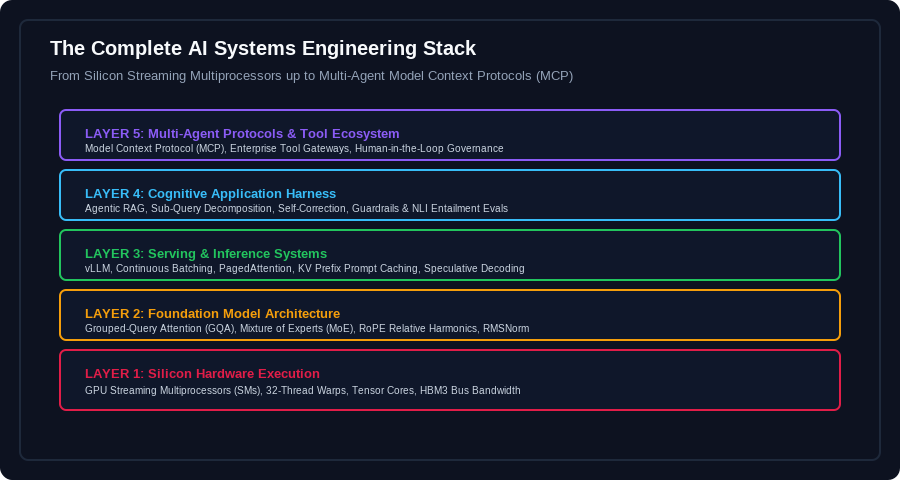
The AI Engineering Stack: From GPU Warps and FlashAttention to Agents and MCP
A cohesive architectural map of modern AI engineering: connecting GPU streaming multiprocessors, KV cache memory, RAG, and multi-agent protocols.
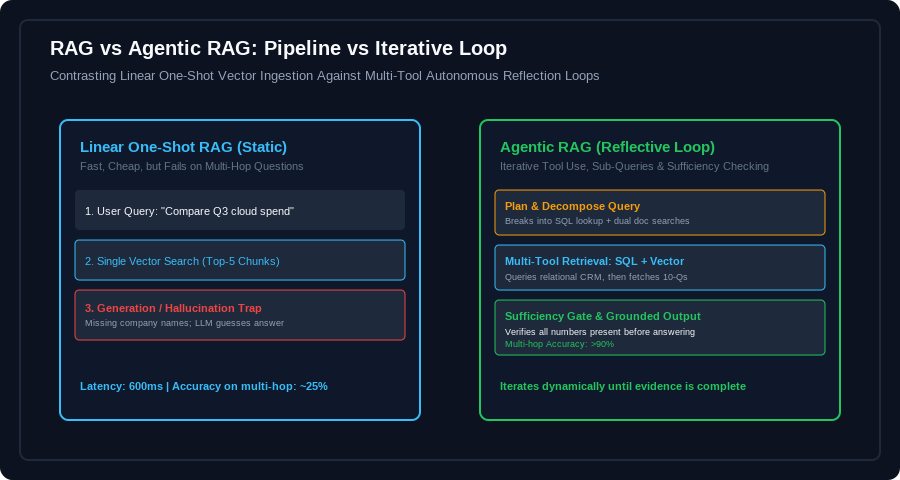
From One-Shot Retrieval to Agent Loops: How RAG Differs From Agentic RAG
Why static one-shot RAG fails on multi-hop questions, and how Agentic RAG introduces iterative planning, query rewriting, and sufficiency checks.
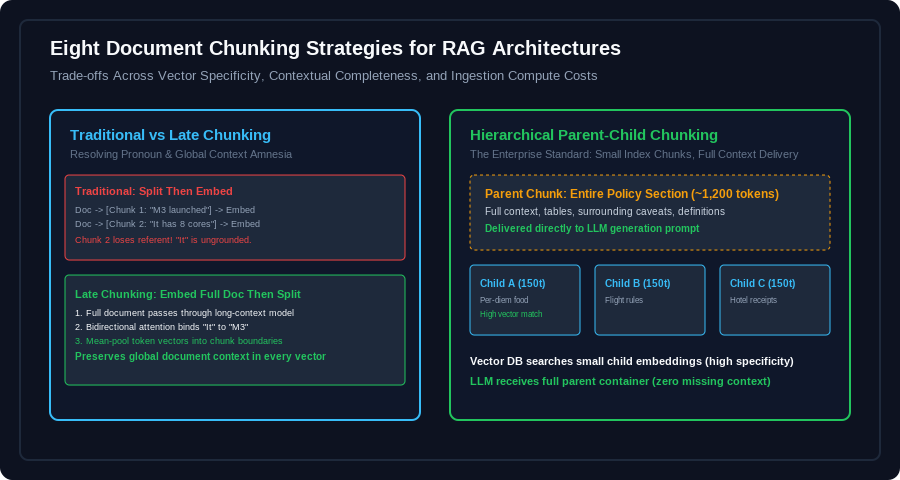
Choosing a Chunking Strategy for RAG: Fixed, Semantic, Late, and Hierarchical
A comprehensive architectural evaluation of eight document splitting strategies for RAG agents: trade-offs across retrieval recall, cost, and boundary noise.
/* Comments */
Comments are offline right now — we reconnect automatically, nothing is lost.